

Guessing is not a strategy; it's a liability. You've likely stared at a sequence of rotating shapes and felt the clock ticking down while your mind went blank. It's frustrating to see your practice scores fluctuate when you're aiming for a high-stakes role in an EPSO competition or a major corporate firm. You aren't alone in feeling like these exams are designed to confuse you, but relying on intuition will eventually lead to a bottleneck in your performance.
This guide will replace that uncertainty with a systematic framework for pattern recognition. You'll learn how to master Abstract Reasoning Tests by decomposing complex visual data into logical components. We'll show you how to identify the underlying rules in seconds, moving you from frantic guessing to calculated accuracy. This is about mental training, not luck.
We're breaking down the core methodologies used in 2026 exams, from matrix completion to sequence logic. We will examine the specific tactics needed to improve your speed and build the mental muscle memory required to pass under pressure. By the end of this guide, you'll have a repeatable system to navigate even the most complex psychometric patterns with total confidence.
Key Takeaways
- Understand how to identify the underlying logic of non-verbal data by treating fluid intelligence as a trainable skill rather than an innate talent.
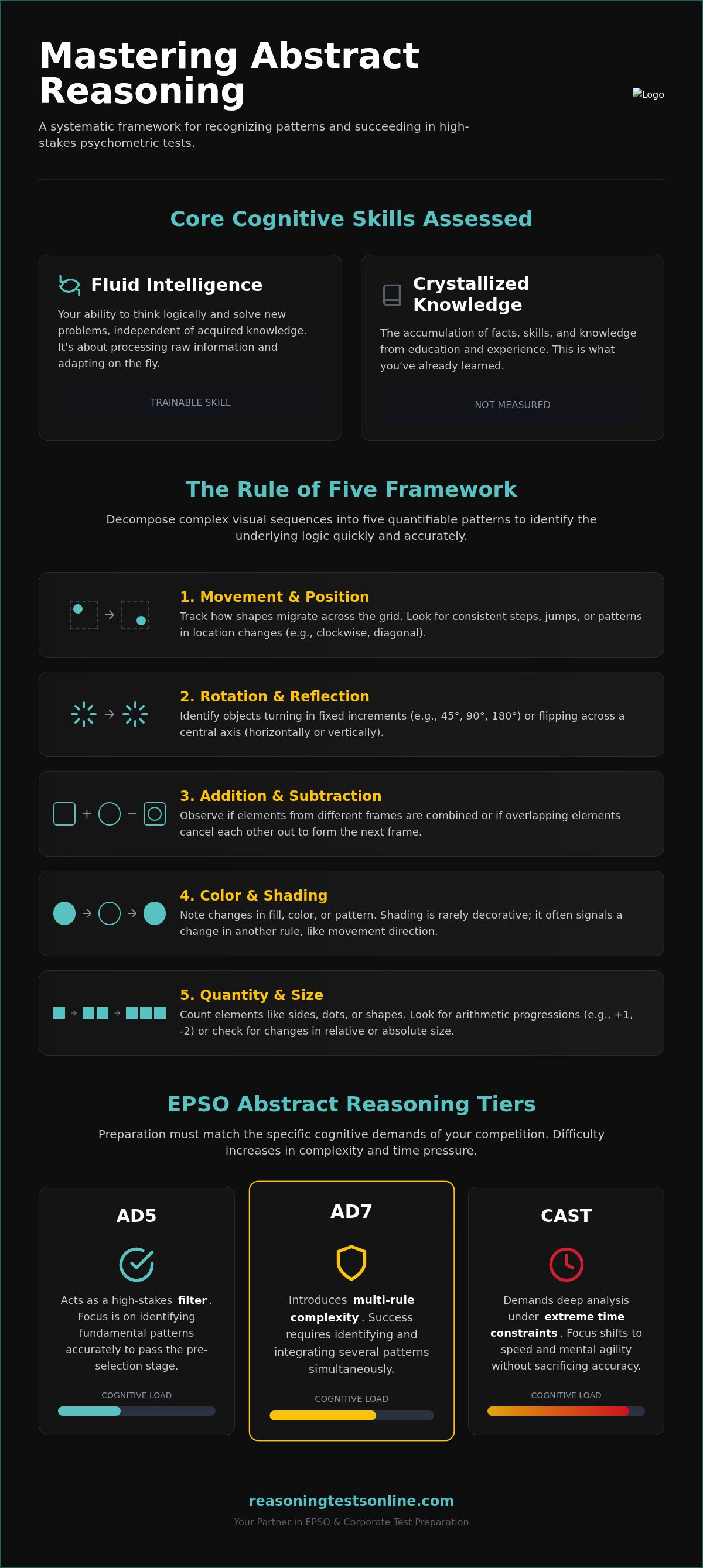
- Apply a systematic "Rule of Five" framework to decompose complex visual sequences into quantifiable patterns like movement, position, and rotation.
- Master the "scan and isolate" method to solve Abstract Reasoning Tests in under 10 seconds, neutralizing the pressure of strict exam timers.
- Differentiate between AD5, AD7, and CAST difficulty levels to ensure your preparation matches the specific cognitive demands of your competition tier.
- Build mental muscle memory by prioritizing detailed logic explanations over high-volume practice to ensure consistent accuracy during live simulations.
What is an Abstract Reasoning Test? Logic Beyond Words
Abstract Reasoning Tests measure your ability to identify rules and patterns within non-verbal data. Unlike verbal tests that rely on language or numerical tests that require arithmetic, these assessments use shapes, lines, and symbols. You aren't reading text; you're analyzing a visual language. This format strips away cultural and linguistic barriers, allowing recruiters to see how your brain processes raw information. It's a pure test of your mental hardware.
Employers and EU institutions use these tests to gauge fluid intelligence. This is the capacity to think logically and solve problems in novel situations, independent of acquired knowledge. While crystalized knowledge covers what you've learned through education and experience, fluid intelligence is about how you handle the unfamiliar. This is why many assessments utilize formats like Raven's Progressive Matrices. These focus on pattern completion to predict how well a candidate will adapt to complex, fast-changing professional environments.
Numerical reasoning checks your ability to interpret data and perform calculations. Verbal reasoning evaluates your comprehension of written arguments. Abstract Reasoning Tests, however, isolate your cognitive processing speed and logical agility. They reveal how quickly you can synthesize rules from chaos. Most of these tests use logical matrices, which are grids or horizontal sequences where elements change from one frame to the next. You'll look for shifts in color, size, orientation, or quantity to find the missing piece.
Fluid Intelligence vs. Crystalized Knowledge
These tests don't care about your degree or your vocabulary. They remove the noise of prior experience to see how you perform in a vacuum. This makes them highly predictive of job performance in high-stakes roles. If you can decode a matrix under pressure, you can likely synthesize information in a complex professional setting. Don't mistake fluid intelligence for a fixed trait. While the intelligence is fluid, the technique for the test is a learned skill. You can train your brain to recognize these patterns through systematic exposure.
The Role of Abstract Reasoning in EPSO Exams
For EPSO candidates, this isn't just an IQ test; it's a gatekeeper. In the pre-selection phase for AD5 and AD7 competitions, your score often determines if you even reach the next stage. It's a high-stakes filter designed to identify the most agile minds. For the CAST exam, the focus shifts from simply seeing shapes to a deep analysis of logic under extreme time constraints. You aren't just identifying a pattern; you're doing it against a clock that doesn't forgive hesitation. Mastery means moving past intuition and adopting a structured approach to every shape you see.
Common Patterns in Abstract Reasoning: The Rule of Five
Success in Abstract Reasoning Tests requires a transition from passive observation to active decomposition. You aren't just looking at shapes; you're auditing a system. We use the "Rule of Five" to categorize every change you see. This methodology ensures you don't miss subtle shifts that lead to incorrect answers. By breaking down a complex image into these five categories, you strip away the confusion and reveal the underlying logic.
- Movement and Position: Shapes often migrate across a grid. They might move one spot clockwise or jump across a diagonal. If you track the center of gravity for each shape, the logic becomes clear.
- Rotation and Reflection: Shapes rotate in fixed increments. Look for 45, 90, or 180 degree turns. Reflection involves flipping a shape over a horizontal or vertical axis.
- Addition and Subtraction: Logic often dictates that frame A plus frame B equals frame C. Sometimes, overlapping elements cancel each other out entirely.
- Color and Shading: Shading isn't decorative. It often signals a change in another rule, such as a reversal in rotation direction or a shift in movement speed.
- Quantity and Size: The number of sides on a polygon or the total count of dots often follows an arithmetic progression.
Scientific research often uses a test of abstract reasoning to quantify cognitive load and fluid intelligence. This academic rigor is exactly what you need to apply to your own preparation. You aren't just practicing; you're refining your mental hardware to handle high-density information without crashing.
Sequential Progression and Series
EPSO tests frequently use the "next in series" format. You'll see five frames and must choose the sixth. The trap here is the "distractor." This is a shape that changes randomly or follows a separate, irrelevant rule. If you can't find a pattern for one element after two frames, ignore it. Focus on the variables that actually evolve. Tracking multiple variables simultaneously is the hardest part of this format. Use a scratchpad to note down the rule for each element individually before looking at the options.
Logical Matrices and Analogies
Grids demand a different approach. A matrix rule is a multi-directional logical constraint that applies across rows and columns simultaneously. If a rule works horizontally but fails vertically, it's not the complete logic. You must verify your hypothesis in both directions before selecting an answer. Analogies work similarly. If shape A transforms into shape B through a specific rotation and color swap, shape C must undergo the exact same transformation to become shape D. To master these patterns, you need to see them in action. Using realistic abstract reasoning simulations helps you build the muscle memory required for the real exam.
The 60-Second Rule: Strategic Speed and Accuracy
Speed is the primary reason candidates fail EPSO competitions. It isn't usually the complexity of the logic that defeats you; it's the pressure of the clock. When you have less than a minute per question, you don't have time to contemplate the aesthetics of a matrix. You need a mechanical approach. Abstract Reasoning Tests are designed to exploit hesitation. If you stare at a sequence for more than 15 seconds without identifying a single rule, your strategy has failed. You must switch from observation to isolation immediately.
The "scan and isolate" method is your best defense against time loss. Instead of trying to grasp the entire logic at once, focus on one specific attribute. Isolate a single dot, a line thickness, or a rotation angle. Once you find the rule for that one element, you can reverse-engineer the rest of the problem using the multiple-choice options. Elimination isn't just a backup; it's a primary tool for speed. If three choices violate your first identified rule, they're gone. You've already improved your odds significantly without even looking at the second variable.
Stalling is a score-killer. If you're "stuck," you're losing points on future questions you haven't even reached yet. The psychology of the stuck candidate is one of sunk-cost fallacy. You feel that since you've spent 40 seconds on a question, you must finish it. This is a mistake. Mark your best guess, move on, and protect your remaining time. Speed requires the discipline to walk away from a losing battle to win the overall war.
The Systematic Decomposition Method
This four-step process turns chaos into a checklist. It's the most efficient way to navigate complex Abstract Reasoning Tests under pressure:
- Step 1: Isolate a single element, such as a black triangle, and ignore all other shapes in the frame.
- Step 2: Determine its movement or transformation rule across the sequence. Does it move one step clockwise? Does it flip every two frames?
- Step 3: Immediately check the answer choices. Eliminate any that violate this first rule.
- Step 4: Pick the next most obvious element and repeat the process until only one answer remains.
Mental Training and Muscle Memory
Mastery isn't about being "smart" on the day of the test. It's about mental training. Repeated exposure to realistic simulations reduces your cognitive load, allowing your brain to recognize patterns subconsciously. When you practice under timed conditions that mimic the actual EPSO interface, you build the muscle memory needed to stay calm. High-volume practice develops an intuition for common patterns, turning a 60-second struggle into a 10-second scan. Your goal is to reach a level where you don't think about the rules; you simply see them.
EPSO Abstract Reasoning: AD5, AD7, and CAST Differences
You cannot prepare for every EU competition using the same blueprint. While the core principles of Abstract Reasoning Tests remain constant, the difficulty ceiling shifts based on the tier of the competition. Recruiting for a graduate position requires a different cognitive profile than hiring a senior administrator. If you're applying for an AD5 role, your primary challenge is the clock. These tests focus on foundational logic and high-speed processing. You must identify single or dual-rule transformations instantly to stay ahead of the timer.
AD7 senior competitions raise the bar by adding layers of complexity. You'll encounter multi-layered rules where three or four variables change simultaneously. A shape might rotate, change color, and move across a grid according to three independent logical sequences. This requires deeper analysis and a more disciplined approach to isolation. CAST exams for contract agents often feature variations in pattern density. Some questions might feel straightforward, while others use high-density visual data to test your focus under fatigue.
Understanding these distinctions prevents you from under-preparing. If you're targeting a senior role, practicing with entry-level materials will give you a false sense of security. You need to train at or above the difficulty level of your specific competition to ensure your accuracy doesn't crater when the logic becomes more abstract.
Navigating the EPSO Testing Interface
The digital environment is a significant factor in your performance. You don't have paper; you have a screen and a limited scratchpad. This physical constraint changes how you process information. You can't draw on the shapes or physically mark the screen. Technical pitfalls, such as lag during the computer-based testing (CBT) phase, can also derail your rhythm. Using realistic simulations is the only way to build the interface familiarity required to handle these hurdles without losing focus. You need to know exactly how the "flag" and "next" buttons work before the real exam begins.
Why EPSO Tests Are Different from Standard IQ Tests
EPSO logic has a specific flavor that general IQ tests often lack. It is predictable but highly pressurized. Standard practice might help your general fluid intelligence, but it won't prepare you for the specific pattern bank EPSO uses. Success requires more than just being "smart." You need to understand the nuances of how EU examiners structure their matrices and sequences. For a deep dive into these specific logic traps, consult Mastering Abstract Reasoning: The EPSO Candidate’s Guide. General practice is a start, but specialized training is what secures the spot. To ensure you're ready for the 2026 requirements, start your EPSO simulation today and build the muscle memory needed to win.
Mastery Through Simulation: How to Prepare for 2026
Understanding the logic of Abstract Reasoning Tests is only half the battle. The true test is execution under pressure. You might recognize a rotation rule in a relaxed environment, but identifying it while a countdown timer is visible requires a different level of mental conditioning. Mastery in 2026 isn't about knowing the theory; it's about making that theory second nature. You must move past the "learning" phase and into the "simulation" phase to ensure your performance remains consistent on exam day.
Detailed answer explanations are your most valuable asset during this transition. If you simply move to the next question after a mistake, you've wasted the opportunity to refine your system. Every wrong answer is a blueprint for improvement. Analyzing the logic behind a failed question helps you internalize the patterns you missed, turning a blind spot into a strength. Quality of practice always beats quantity. Solving ten questions and fully deconstructing their logic is more effective than rushing through fifty without a review.
Consistency is the key to building muscle memory. Avoid the weekend marathon. Cognitive fatigue sets in quickly during abstract analysis, which leads to diminishing returns and frustration. A 20-minute daily drill is far more effective for long-term retention. This approach keeps your pattern recognition sharp and prevents burnout. Reasoning Tests Online provides the specialized environment needed to bridge the gap between theory and success. By using realistic simulations for AD5, AD7, and CAST, you ensure your preparation matches the actual exam conditions you'll face.
Analyzing Your Mistakes
Getting a question wrong is the most important part of your preparation. It provides data that a correct answer cannot. When you fail a question, categorize the error immediately. Was it a rule failure where you didn't recognize the "Rule of Five" logic? Was it a time failure where you spent too long on a single element? Or was it a distractor trap? Use the platform's analytics to identify your "blind spots." If you consistently miss rotation-based patterns, you know exactly where to focus your next training session.
Final Preparation Checklist
Before you sit for the actual exam, you must ensure your preparation is complete. Use this checklist to verify your readiness:
- Ensure 100% familiarity with the "Rule of Five" patterns discussed in section two.
- Complete at least 5 full-length timed simulations to build stamina.
- Review your "mental training" drills to sharpen pattern recognition speed.
- Verify your ability to use the "scan and isolate" method in under 10 seconds.
Start your EPSO Abstract Reasoning practice today with our realistic simulations. Transition from guessing to mastery by training with the same logic and interface you'll encounter in the 2026 competitions. Success is the result of systematic preparation, not luck.
Secure Your Success in the 2026 EU Competitions
You've moved from seeing shapes to analyzing logic. You now have the Rule of Five to decompose patterns and the 60-second rule to manage the clock. These tools are the difference between a candidate who guesses and a professional who executes. Success in 2026 requires more than just understanding these concepts; it requires the muscle memory to apply them under the pressure of a real testing environment. Abstract Reasoning Tests are a hurdle, but they're also a chance to prove your cognitive agility.
The path to a career in EU institutions or top-tier corporate firms is paved with these assessments. You don't have to face them unprepared. By using specialized AD5, AD7, and CAST practice packages, you can transform your anxiety into a strategic advantage. Detailed logic explanations for every question ensure you never make the same mistake twice. Our timed exam simulations replicate the exact environment you'll face, ensuring there are no surprises on the day.
Master EPSO Abstract Reasoning with Realistic Simulations and start your training today. It's time to replace uncertainty with mastery. You've done the reading; now it's time to do the work. We're ready to help you succeed.
Frequently Asked Questions
How can I improve my abstract reasoning score quickly?
You can improve your score by shifting from intuition to a systematic decomposition method. Instead of looking at the whole image, isolate a single element and track its movement across the sequence. Use the multiple-choice options to eliminate incorrect answers as soon as you identify the first rule. Practicing under timed conditions builds the mental muscle memory required to process these patterns without hesitation.
Are abstract reasoning tests the same as IQ tests?
No, they serve a different purpose. While both measure fluid intelligence, Abstract Reasoning Tests are standardized tools used by employers to predict job performance in complex environments. An IQ test is a broad measure of cognitive potential, whereas these assessments focus specifically on your ability to synthesize logical rules from non-verbal data under extreme time pressure.
What is the average time allowed per question in an EPSO abstract reasoning test?
You typically have exactly 60 seconds per question. Most EPSO competitions require you to solve 10 questions within a 10-minute window. This strict limit means that speed is often the primary reason candidates fail. You must develop the discipline to mark a guess and move on if you haven't identified a pattern within the first 40 seconds of a question.
Do I need to be good at math to pass an abstract reasoning test?
Mathematical proficiency is not required for these assessments. These tests evaluate your spatial and logical reasoning, not your arithmetic skills. While some patterns might involve counting the number of sides on a polygon or the total dots in a frame, you won't need to perform complex calculations or use prior mathematical knowledge to find the correct answer.
Can abstract reasoning be learned or is it an innate ability?
It is a highly trainable skill. While fluid intelligence has a baseline innate component, your ability to recognize specific logical transformations improves with systematic exposure. By training with realistic simulations, you teach your brain to categorize visual shifts into recognizable rules. This reduces the cognitive load during the actual exam and turns what feels like guessing into a calculated process.
What are the most common patterns in EPSO abstract tests?
The most frequent patterns follow the "Rule of Five" methodology. You'll encounter shapes that move across a grid, rotate in fixed increments, or change color and shading. Other common rules involve the addition and subtraction of overlapping elements or changes in the quantity of specific features. Mastery comes from learning to check for these five categories in every question you encounter.
How do I handle "distractors" in complex non-verbal questions?
You handle distractors by ignoring any element that doesn't follow a consistent progression. If a shape moves randomly or changes without a clear rule across three frames, it is likely a distractor designed to waste your time. Focus your energy only on the variables that evolve logically. Once you find the rule for one consistent element, the distractors become irrelevant noise.
Is there a penalty for wrong answers in the EPSO abstract reasoning section?
There is no negative marking in the EPSO pre-selection phase. Since you aren't penalized for incorrect choices, you should never leave a question blank. If you're stuck on a complex pattern, use the elimination strategy to remove the most obvious wrong choices and then make an educated guess. Every marked answer gives you a statistical chance of gaining a point.


