

The EPSO abstract reasoning test is not an appraisal of raw visual genius; it is an assessment of mental discipline under an unforgiving clock. If you have ever stared at a multi-element matrix while watching the on-screen countdown slip past the 60-second mark, you know how quickly panic sets in. Falling for subtle visual distractors and guessing under pressure drains your time bank and costs vital points. Mastering proven EPSO abstract reasoning strategies is the only reliable way to eliminate guesswork and take command of the exam.
Cognitive speed isn't luck; it's trained muscle memory. In this guide, you'll master actionable techniques to decode complex visual grids rapidly and protect your test score under real EPSO exam pressure. We will break down the fundamental logical transformations, expose the AD5 vs AD7 complexity gap, and outline a step-by-step scanning routine to ensure you finish all ten questions before time runs out.
Key Takeaways
- Implement structured EPSO abstract reasoning strategies to replace intuitive guessing with predictable, repeatable pattern recognition.
- Categorize every visual transformation using the rule of five to isolate positions, rotations, and counts without cognitive overload.
- Apply the 10-second scanning protocol alongside systematic elimination to strike out deliberate distractors in seconds.
- Protect your overall time bank by establishing a strict 60-second hard limit on every grid question.
- Navigate the AD5 vs AD7 complexity gap by training on timed simulations that mirror the official digital exam interface.
Understanding the EPSO Abstract Reasoning Challenge
The EPSO abstract reasoning test evaluates non-verbal inductive logic under extreme time compression. Unlike verbal assessments that test language comprehension, this module asks you to identify underlying patterns across a sequence of dynamic diagrams. Staring passively at a full grid accomplishes nothing. You need structured EPSO abstract reasoning strategies that dissect visual transformations methodically. Without a disciplined approach, mental stamina degrades rapidly as the timer ticks down.
Exam Structure and Time Constraints
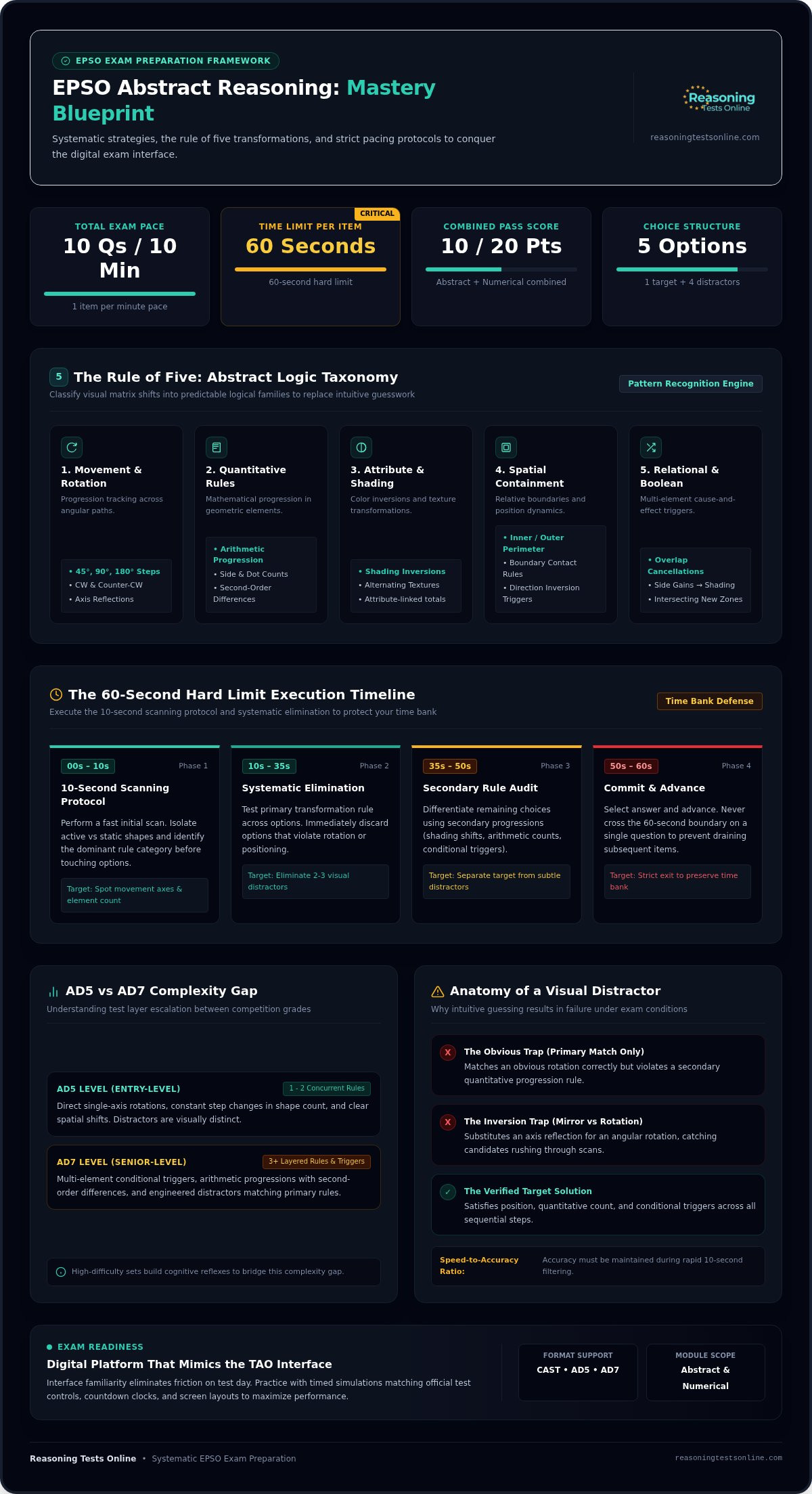
In standard competitions, you face 10 questions in exactly 10 minutes. That creates an unforgiving 60-second limit per item. Each problem displays a series of visual frames followed by five distinct multiple-choice options. Tracking overlapping shapes, spatial shifts, and color inversions across ten consecutive problems causes acute visual fatigue. Candidates who rely on spontaneous inspiration run out of runway. You must build conditioned cognitive reflexes through realistic epso tests practice before confronting the live digital exam interface.
Success requires maintaining your Speed-to-Accuracy ratio under continuous cognitive strain:
- Strict pacing: Spending more than a minute on a single matrix damages your overall time bank.
- Combined pass requirements: You must secure a combined minimum score of 10 out of 20 points across abstract and numerical sections to stay in the selection pool.
- Interface friction: Managing screen tools while parsing complex shapes quickly drains executive focus.
Why Guesswork Guarantees Failure
Intuitive guessing is the fastest route to disqualification. Test designers deliberately engineer visually seductive options, known as distractors, to trap candidates who rely on first impressions. An option might match an obvious rotational rule while completely violating a secondary progression. When you guess, you rarely save time; you simply spend 40 seconds validating an incorrect assumption. Mastering dedicated EPSO abstract reasoning strategies shifts you from erratic guesswork to cold deduction, protecting every single point on your score sheet.
The Rule of Five: Classifying Abstract Logic Transformations
Most candidates fail abstract matrices because they view each diagram as an unpredictable puzzle. Successful applicants do the exact opposite. They apply a systematic taxonomy known as the rule of five to classify every visual shift into distinct, predictable mechanisms. Applying core EPSO abstract reasoning strategies means you stop guessing what might change; you audit what can change. Grouping visual data into five logical families cuts mental processing time in half and keeps you moving forward.
Movement and Rotational Sequences
Spatial shifts follow geometric rules. Track angular progressions across 45, 90, or 180-degree increments in both clockwise and counterclockwise paths. Watch for reflections across horizontal, vertical, or diagonal axes that mirror an element instead of rotating it. For advanced tracking drills across nested grids, review this abstract reasoning pattern recognition guide to sharpen your eye before tackling full tests.
Quantitative and Proportional Rules
Numbers govern visual logic. Track side counts, line intersections, interior angles, and isolated dots across consecutive frames. Pay attention to how quantities evolve:
- Constant step changes: Adding or subtracting a fixed value at every interval.
- Arithmetic progression: Sequences where values grow predictably, such as +1, +2, +3, or rely on second-order differences.
- Attribute-linked quantities: Total dots dictating the number of shaded petals or external spokes.
Relational and Conditional Triggers
Higher-tier questions combine multiple rules into cause-and-effect relationships. If a central polygon gains a side, an external marker may shift its shading from black to white. Spatial containment rules also dictate behavior, where an inner element inverts direction only when touching an outer perimeter. Overlapping figures introduce Boolean transformations, where intersecting line segments cancel out or produce new shaded zones.
Understanding these five transformations transforms chaotic grids into clean, solvable equations. Developing this diagnostic instinct requires deliberate practice against timed items that mimic test conditions. If you want to benchmark your Speed-to-Accuracy ratio against official standards, explore targeted epso tests simulations built to train pattern recognition under pressure.
Executing the 10-Second Scanning Protocol and Systematic Elimination
Trying to absorb an entire visual matrix in one glance creates immediate cognitive paralysis. You freeze, waste valuable seconds, and lose control of the timer. Instead, high-scoring candidates rely on disciplined EPSO abstract reasoning strategies built around the 10-second scanning protocol. This structured intake routine separates dynamic elements from static visual clutter. Combined with systematic elimination, it reduces mental strain and turns abstract puzzles into fast binary choices. Striking out two impossible options instantly increases your mathematical odds of picking the correct answer from 20% to 33%.
Step 1: Isolate a Single Anchor Element
Pick the simplest, most obvious element in the first frame. Ignore surrounding shapes, complex geometries, and secondary lines. Focus entirely on tracking that single marker, whether it is a small black dot, an outer border, or a corner vertex. Follow its progression across the sequence from left to right. Identify its specific transformation rule: is it rotating by 90 degrees, moving one position clockwise, or increasing in count? Lock that rule down before looking at anything else.
Step 2: Apply Systematic Elimination to Answer Choices
Once you solve the anchor element, check the five multiple-choice options immediately. Discard every option that violates your confirmed anchor rule. Strike them out without analyzing their remaining internal components. An option that fails the first test is disqualified, regardless of how neatly its other shapes align. This step neutralizes deliberate distractor elements and usually narrows the field to just two plausible options in under 20 seconds.
Step 3: Resolve the Deciding Feature
Compare the two surviving options side by side. Don't look back at the main sequence yet; find the single detail where the two choices disagree. One might display a shaded circle while the other displays an open circle. Now check the original sequence solely for that specific feature. Once you identify the rule governing the shape or shading, confirm your choice and advance to the next question. Executing these EPSO abstract reasoning strategies ensures you finish each question within the time limit while protecting accuracy.
Managing Time and the AD5 vs AD7 Complexity Gap
Time management on the EPSO exam is an act of active risk mitigation. Candidates often fail not from lack of analytical power, but from stubbornness on a single item. Spending 90 seconds on one matrix steals precious resources from the remaining grid. Protecting your overall time bank requires rigorous operational discipline. Sound EPSO abstract reasoning strategies balance deep visual analysis with a relentless forward pace, preventing one complex problem from ruining your entire test run.
Enforcing the 60-Second Hard Limit
You must treat the 60-second hard limit as an absolute cutoff. When your mental clock reaches 50 seconds and you haven't cracked the full rule, eliminate whatever choices you can. Make an educated guess between the remaining options, flag the question, and move on immediately. Preserving your time bank ensures you reach every accessible question rather than leaving points on the table at the end of the test.
Neutralizing Distractors and Visual Noise
EPSO test designers deliberately insert decorative elements to trap candidates. A distractor might bounce erratically across corners or change shading without following any logical progression. These elements exist solely to burn your seconds and trigger visual fatigue. Focus on coherent geometric evolution, and review this advanced abstract reasoning tests reference to learn how high-tier distractors are structured.
Navigating the AD5 vs AD7 Complexity Gap
The AD5 vs AD7 complexity gap represents a sharp spike in cognitive load. While entry-level AD5 questions typically layer two simultaneous rules, senior AD7 competitions require processing three or four interdependent transformations at once:
- AD5 items: Standard linear shifts paired with basic alternating shading cycles.
- AD7 items: Compound rotations, arithmetic progressions based on second-order differences, and conditional inversions occurring concurrently.
- Distractor density: Senior tests feature answer choices that satisfy two out of three rules, punishing incomplete verification.
Bridging this gap demands structured exposure to realistic questions designed for your target competition level. To build the required diagnostic speed, start preparing today with specialized epso tests simulations tailored to AD5, AD7, and CAST benchmarks.
Building Exam-Ready Reflexes with Timed Digital Simulations
Reading theory guides or static textbooks builds passive familiarity, not operational speed. On test day, you face an unfamiliar screen, a relentless countdown timer, and strict remote proctoring conditions. Real cognitive reflexes require practicing on a digital platform that mimics the TAO interface. Developing automatic visual search paths and keyboard coordination under realistic test conditions is what separates successful candidates from those who freeze. Integrating active simulation into your EPSO abstract reasoning strategies bridges the gap between knowing the rules and executing them under pressure.
Simulating the Digital Exam Interface
Paper practice cannot replicate the ergonomics of the digital exam interface. Tracking geometric movements across an on-screen grid while a software timer ticks down creates a specific type of visual strain. You must become comfortable flagging items, deselecting eliminated choices, and navigating without physical scratch paper. Training in an authentic browser environment removes technical friction so you can focus entirely on matrix analysis. Use dedicated professional non-verbal reasoning online practice tools to adapt your workflow to the official testing setup.
Balancing Your Speed-to-Accuracy Ratio
Rapid choices mean nothing if they miss the mark, while flawless accuracy is useless if you leave the final four items blank. You must systematically track and optimize your Speed-to-Accuracy ratio. If your accuracy falls below 80%, slow down slightly to verify secondary element rules. If you consistently hit time walls, shorten your initial visual scan. Working through high-difficulty sets expands your mental bandwidth, making standard competition items feel manageable. Review every error immediately using structured answer breakdowns to resolve specific logic blind spots.
Establishing a Structured Preparation Schedule
Consistent, targeted drills beat exhausting weekend study sessions. Dedicate 20 to 30 minutes each day to timed test runs to build genuine visual muscle memory. Pair daily matrix sets with the ultimate guide to abstract reasoning tests for thorough preparation and faster rule diagnosis. Practicing with specialized EPSO test practice packages ensures your EPSO abstract reasoning strategies become automatic reflexes long before exam day arrives.
Take Command of Your EPSO Exam Performance
Passing the abstract reasoning test does not require innate visual genius. It demands methodical discipline. By classifying complex matrices with the rule of five, isolating anchor elements during your initial scan, and strictly enforcing the 60-second hard limit, you convert chaotic grids into predictable, solvable steps. Consistent application of these EPSO abstract reasoning strategies gives you the structural framework needed to eliminate distractors and protect your time bank under genuine test pressure.
Theoretical knowledge alone won't build the reflexes you need on exam day. Real progress requires active practice in the exact digital environment you will encounter during testing. Train with platform simulations that mirror the 2026 EPSO digital testing environment, complete with authentic interface navigation and countdown timers. With specialized difficulty levels for CAST, AD5, and AD7 competitions alongside detailed explanations to decode every pattern transformation, you can systematically eliminate reasoning errors. Master EPSO Abstract Reasoning with Realistic Timed Simulations today and walk into your competition ready to succeed.
Frequently Asked Questions
Can abstract reasoning skills be improved with practice, or is performance purely innate?
Abstract reasoning performance is a trainable skill based on pattern recognition rather than fixed intelligence. While initial intuitive grasp varies, consistent practice builds visual muscle memory for recurring geometric transformations. Candidates who train systematically learn to dissect multi-element matrices in seconds. Adopting structured EPSO abstract reasoning strategies replaces guesswork with reliable deductive habits, substantially improving both diagnostic speed and overall test scores under timed conditions.
What is the rule of five in EPSO abstract reasoning tests?
The rule of five is a classification framework that groups all matrix transformations into five core mechanisms. These categories include positional movement, rotational changes, quantitative shifts such as arithmetic progressions, shape attribute alterations like shading or line style, and relational dependencies between different figures. Categorizing visual items into these five groups prevents cognitive overload and helps candidates systematically identify rules instead of staring aimlessly at complex shapes.
How much time should I spend on each abstract reasoning question during the exam?
You should spend an average of 60 seconds per question. Active EPSO competitions typically allocate 10 minutes to solve 10 abstract reasoning questions. Maintaining this pace requires spending roughly 10 to 12 seconds on the initial visual intake and rule diagnosis, leaving the remaining 40 to 45 seconds for systematic elimination. You must enforce a strict 60-second cutoff to protect your overall time bank.
What is the main difference between AD5 and AD7 abstract reasoning questions?
The primary distinction lies in rule layering and distractor density across the AD5 vs AD7 complexity gap. Entry-level AD5 items generally involve two simple, independent rules, such as a basic rotation combined with an alternating color cycle. Senior-level AD7 questions layer three or four interdependent transformations simultaneously, incorporating features like second-order differences in element counts, accelerated angular shifts, and decoy answer choices that satisfy only part of the pattern.
Why is practicing on a computer screen better than using printed practice books?
Practicing on a screen conditions your eyes to the authentic digital exam interface used during remote testing. Static paper workbooks cannot simulate on-screen countdown clocks, browser navigation controls, or the visual fatigue caused by tracking moving shapes on a monitor. Training on a digital platform that mimics the TAO interface builds technical familiarity, reduces interface anxiety, and optimizes your operational Speed-to-Accuracy ratio before test day.
How does systematic elimination help in solving complex pattern matrices?
Systematic elimination converts complex visual analysis into rapid binary choices. By tracking a single anchor element across frames and immediately striking out answer choices that violate its rule, you eliminate incorrect options without needing to solve secondary patterns. Discarding just two incorrect options improves your mathematical odds from 20% to 33%, allowing you to resolve the question by comparing only the surviving options.
What should I do when I cannot find any pattern within the first 30 seconds?
Switch immediately to your backup plan rather than burning through your remaining time bank. Stop trying to decode the entire grid and check the multiple-choice options to identify obvious visual outliers. Eliminate any choices that look mathematically or structurally inconsistent, make a disciplined selection between the remaining options, flag the question, and move forward. Never spend more than 60 seconds on a stubborn item.


