

EPSO AD5 practice tests reward disciplined work under the clock, not raw intelligence alone. When you train on realistic sample questions (high‑difficulty sets) that mirror the exam screen (digital exam interface), you build speed and a clear elimination method instead of hoping Talent will carry you. Your result hinges on prioritizing easy points and using the digital tools without hesitation.
Fit EPSO AD5 practice tests to the hours you actually have
Your study plan must match your daily availability if you want to master the computer-based competition tests. Three common situations show how to choose the right block:
- Full-time role with little spare capacity: run 30-minute micro-drills that focus on interface familiarity and one reasoning type per day.
- Mixed week with roughly an hour free: protect a steady speed-to-accuracy review rather than adding new question banks.
- Open schedule before a competition window: alternate full timed simulations with short target review so fatigue does not erase gains.
With clients we see that brief, structured sessions protect against fatigue while building steady speed. Consistent exposure to timed sample questions sharpens focus far better than weekend cramming.
Staff selection for permanent administrative posts across EU institutions rests on competitive assessments, so the way you manage preparation time directly shapes your outcome.
| Schedule Type | Daily Commitment | Primary Focus Area |
|---|---|---|
| Intensive Sprint | 2–3 Hours | Timed simulations and systematic elimination |
| Balanced Routine | 1 Hour | Speed‑to‑accuracy ratio and review |
| Steady Pace | 30 Minutes | Micro-drills and interface familiarity |
Short daily blocks build skill without burnout. Practicing on a digital platform that mimics the TAO interface prepares you for real test conditions. To raise spatial accuracy under tight constraints, open this non-verbal practice tool in every study window.
Treat your calendar like a budget and allocate time to your target profile. Full-time professionals gain most from short, intense micro-drills. Candidates with open schedules should alternate full practice-test runs and focused review. Matching preparation to the exact exam screen keeps progress steady at any pace.
Four timed steps that turn practice into exam-day control
You can handle the EPSO selection process with a structured, timed practice routine. Time pressure on the exam screen stays hard even when a calculator is allowed for numerical reasoning. You need speed, accuracy, and full familiarity with a digital platform that mimics the TAO interface.
- Analyze sample questions: Spot logical distractors and apply the rule of five in visual matrices so weak options fall away quickly.
- Master speed strategies: Use the 10‑second scanning protocol for abstract items and the keywords-first method for verbal texts.
- Train with time limits: Solve numerical sets under a 60‑second hard limit per item to keep your speed-to-accuracy ratio stable under real conditions.
- Simulate the testing interface: Run complete packages on a realistic online platform so the layout stops surprising you.
Prioritize easy points first. Timed simulations build muscle memory so strict limits do not break your concentration on test day.
One candidate path shows the arc clearly. A user on the preplounge.com forum topic "Best way to prepare for Oliver Wyman Numerical ..." faced the same bind many AD5 applicants meet: a calculator sits available, yet the clock still dominates the room. The action that followed was simple and repeated: practice under the same tight limit until the stress no longer froze the first scan. The outcome they described matches what we see in training:
"having a calculator available helps, yet the tight time limit still creates difficulties, much like similar digital assessments. so practice practice practice ;)" (source)
Candidates often report that a calculator does not remove the stress of running clocks on numerical sets. Dedicated work on realistic platforms is what builds the required speed and accuracy. Request a quote when you want a package matched to your schedule.
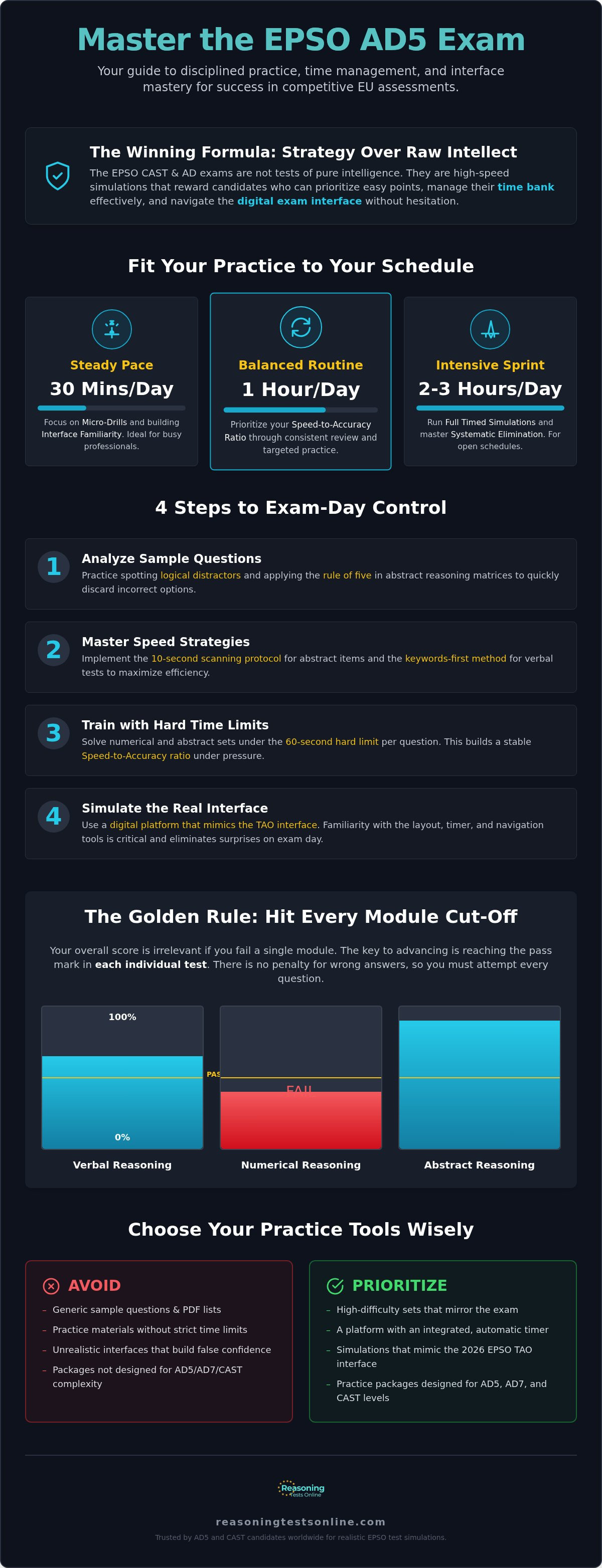
Hit every AD5 module cut-off before the overall score matters
You clear the AD5 cognitive reasoning stage only when you reach the pass mark in each module. Incorrect choices do not cost extra points, so an unanswered guess is not punished.
As a test practitioner, I see many candidates chase an overall total and ignore module cut-offs. That approach fails: falling short in a single reasoning area ends the attempt at once. Each correct answer awards one point, which means you can attempt every item without fear of a penalty.
Spatial overload, not lower ability, often pulls abstract scores down relative to verbal or numerical work. You can train yourself to spot geometric patterns inside strict time limits. Using EPSO Tests with realistic sample questions builds the cognitive stamina those modules demand.
Balance speed and accuracy across all modules if you want a place on the reserve list. High accuracy alone will not save you when the countdown starts; only timed simulations expose that gap before exam day.
Skip paid AD5 packages that lack real timing and interface tools
Generic sample questions waste money when they omit time limits or proper interface tools.
Candidates in training who rely on unaligned sets often leave with false confidence and no real exam speed. Off-target materials never recreate the pressure of the live exam screen.
Advanced abstract items are built for adult competition candidates. Buying heavy packages for learners who are not yet ready for complex spatial reasoning simply drains the budget without raising AD5 performance.
Paid options fail when they skip realistic timed conditions. Premium tools need a digital platform that mimics the TAO interface so you meet strict constraints before the official sitting. Compare plans and feature lists against the demands of the real test.
Check for an active time bank before you pay. Static PDF files cannot teach elimination under live stress. Static files suit early theory; full simulations suit timed preparation. Choose the format that matches the stage you are in, then move to dynamic tests when the clock becomes the main obstacle.
Lock down your setup before a timed simulation starts
Meeting system specifications prevents critical failures on exam day. In practice sessions, candidates often lose focus when a technical glitch breaks momentum mid-simulation. Checking hardware early protects performance under pressure.
Verify browser setup and internet stability before you launch any run. Practice platforms work best on updated browsers. Set screen resolution so the exam screen appears in full without awkward scrolling.
ReasoningTestsOnline uses secure payment processing and encrypted connections to protect payment information. An external service handles payment safety, so no credit card details remain saved on the system.
Plan your testing environment like the real sitting. An early system check keeps attention on sample questions instead of on error messages. Clear screens and a fast interface are part of learning to manage your time bank. Practice with tools that mirror the official platform.
Tip: Always complete a system check prior to exam day to ensure your browser setup accurately matches the digital exam interface.
Feedback from candidates who moved from rushed drills to calmer pattern work points the same way. One participant described the shift after finding a format that left room to think:
"This exercise works wonderfully for honing pattern recognition skills. Other practices tests I have taken were more intimidating, but this one is a good place to start. I felt like I actually had enough time to think and find the pattern, as opposed to being rushed and having questions disappear." (source)
A clear, responsive platform lowers anxiety and lets you focus on complex abstract patterns instead of on the interface itself.
Frequently asked questions
What is the AD5 competition?
The AD5 competition is the administrator-level selection process organized by EPSO for entry-level civil service careers within European Union institutions.
How to prepare for the EPSO test?
Practice with realistic EPSO test simulations that mirror the format of the official exam screen. Discard incorrect choices quickly, apply the 60‑second hard limit on abstract questions, and use the keywords-first method so your speed-to-accuracy ratio holds under pressure.
Where can I find sample questions for AD5?
Dedicated sample questions sit inside specialized EPSO practice packages online. Targeted platforms built to simulate real test conditions, paired with a digital platform that mimics the TAO interface, help you build speed and cut hesitation on exam day.
Which competencies are assessed by EPSO?
EPSO assesses abstract reasoning, verbal reasoning, and numerical reasoning. Numerical tasks check how fast you read complex data tables, ratios, and percentages. Spotting hidden sequences such as an arithmetic progression or second-order differences lets you finish tricky numerical patterns sooner.
What technical requirements must be met before the test?
You need a stable internet connection, a compatible web browser, and a compliant computer setup before any online session. When you purchase practice tools, transactions use encrypted connections; an outside vendor processes payments so the system never retains card details.
Turn reserve-list pressure into a repeatable practice habit
A place on the 2026 reserve list depends on efficient use of the time bank, rapid scanning on numerical tasks, and total familiarity with the digital exam interface (exam screen).
Software that mirrors the real testing environment lets you rehearse elimination under a live countdown. Secure payment processing and payment data security protect each purchase.
Ready to measure your current speed? Start with realistic EPSO AD5 practice tests from the contact page.


