

With over 174,000 applicants competing for just 1,490 spots in the 2026 EPSO AD5 competition, the acceptance rate is now less than 1%. These numerical reasoning questions aren't just testing your math skills. They're a high-stakes simulation of your ability to perform under extreme pressure. You've likely experienced the frustration of freezing when a complex data table appears, only to watch your digital exam interface timer drain away. It's a common trap where careless errors replace logic as stress levels rise.
We understand that passing isn't about raw intelligence. It's about tactical execution. This guide provides the systematic strategies you need to protect your personal time bank and recognize data patterns instantly. You'll learn the shortcuts that professional candidates use to maintain a high Speed-to-Accuracy ratio. We'll show you how to navigate the specific logic of the 2026 tests. This approach moves you away from guesswork and toward a disciplined, results-oriented methodology that secures your place on the reserve list.
Key Takeaways
- Shift your perspective from academic math to operational logic to significantly increase your data interpretation speed.
- Master the four core mathematical frameworks to identify recurring patterns within seconds of seeing a new problem.
- Apply the keywords first method to filter out distractors and isolate the specific variables required by complex numerical reasoning questions.
- Protect your time bank by using systematic elimination to maintain a passing Speed-to-Accuracy ratio under extreme pressure.
- Build essential muscle memory by practicing with high-difficulty sets on a digital platform that mimics the TAO interface exactly.
What Are Numerical Reasoning Questions in Modern Selection Tests?
Numerical reasoning questions assess your ability to extract meaning from complex data sets while a clock counts down. Unlike academic mathematics, these exams don't care if you can solve a high-level equation from memory. They measure operational logic. Can you interpret ratios, calculate percentages, and spot trends under stress? Modern Aptitude tests are designed as high-speed filters for selection processes. For the 2026 EPSO AD5 competition, you have exactly 20 minutes to solve 10 questions. If you treat this like a standard classroom quiz, you'll run out of time before reaching the final set.
Core Components of Psychometric Numerical Tests
You'll face multi-layered tables and bar charts packed with noise. These elements are intentional distractors designed to slow you down. A typical question stem presents a conditional business scenario, such as shifting policy budgets or demographic trends, buried within a sea of extraneous numbers. The multiple-choice options aren't random. They are engineered with plausible trap values. These values represent the results of common calculation errors, like forgetting to convert units or misapplying a percentage increase. You can experience these exact patterns on a digital platform that mimics the TAO interface at epso tests.
The Reality of Timed Cognitive Testing
Time is your primary opponent in the 2026 testing environment. While 120 seconds per question seems sufficient, the multi-step nature of psychometric problems quickly drains your resources. Your working memory is heavily taxed as you filter data, perform arithmetic, and navigate the digital exam interface simultaneously. This is why raw math knowledge often fails. Without structured exam pacing and a focus on your Speed-to-Accuracy ratio, you'll likely freeze when faced with a complex chart. You must treat this as a cognitive simulation where efficiency is as valuable as accuracy.
Guessing without a systematic approach is a guaranteed way to destroy your score. Competitive exams like CAST and AD5 require a combined pass mark of 10 out of 20 across numerical and abstract reasoning. If you guess, you lose the opportunity to compensate for a difficult abstract section. Systematic elimination and the 10-second scanning protocol are essential tools to protect your time bank. These methods allow you to discard impossible choices immediately, ensuring that every second spent on a calculation contributes to a passing result. Don't rely on luck; rely on a repeatable system.
The 4 Core Question Types You Must Master
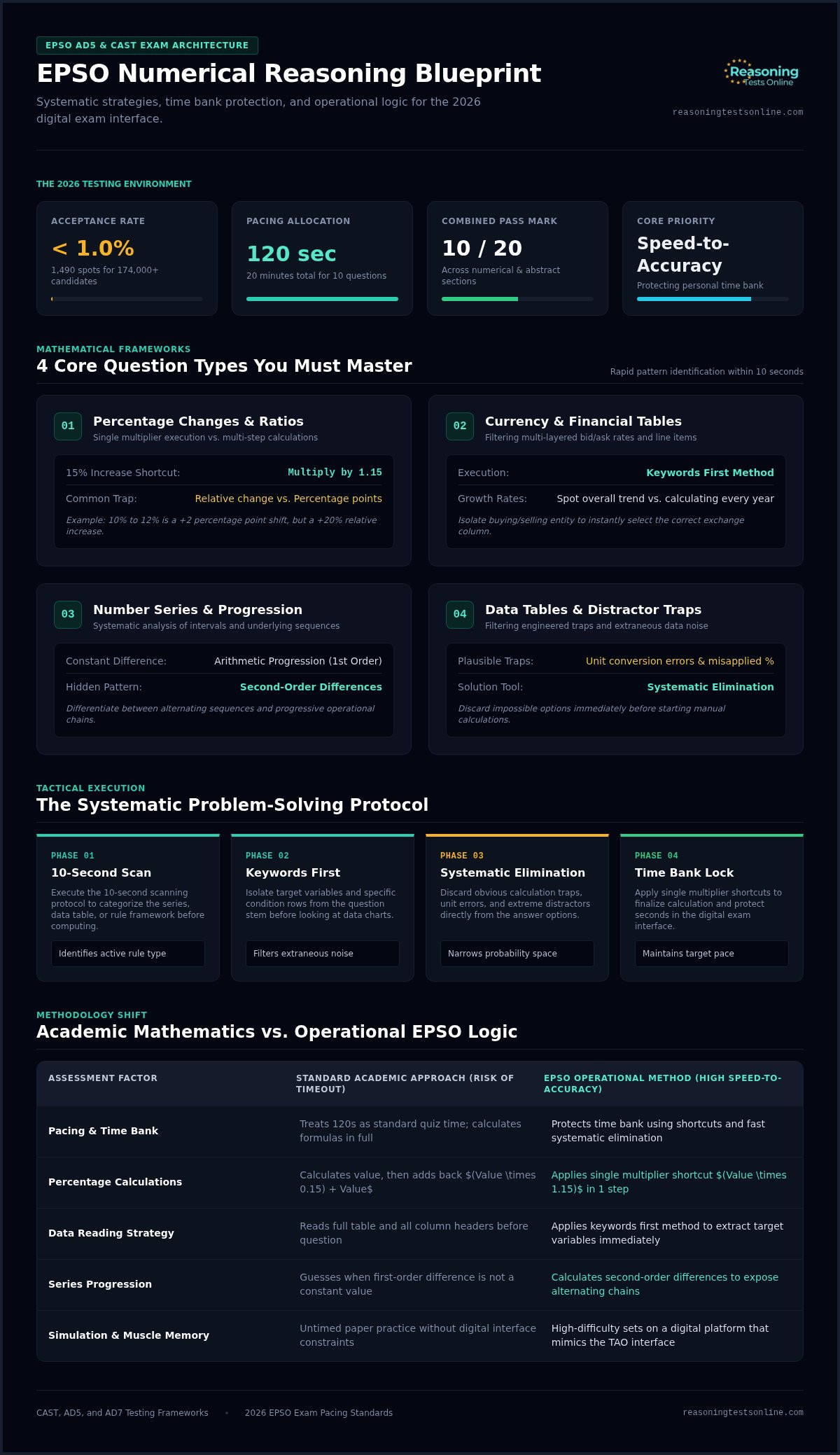
You don't have time to reinvent the wheel on test day. High-stakes psychometric tests rely on four recurring mathematical frameworks to filter candidates. If you can identify the required operation within ten seconds, you protect your time bank and maintain a high Speed-to-Accuracy ratio. Test makers use these archetypes because they allow for deliberate calculation traps in the options. Understanding these patterns is the first step toward beating numerical reasoning questions under pressure.
Percentage Changes, Ratios, and Proportions
Percentage problems are the backbone of most assessments. You must calculate increases and decreases using single multiplier shortcuts. For a 15% increase, multiply by 1.15 instead of calculating the 15% and adding it back. This saves valuable seconds. Watch for the distractor trap involving percentage points. If a market share grows from 10% to 12%, that's a 2 percentage point increase, but a 20% relative change. Test options will always include both. Use systematic elimination to discard the wrong logic immediately.
Currency Conversions and Financial Tables
Financial tables often present multi-layered data like bid and ask rates. You must identify which rate applies based on whether the entity is buying or selling. The digital exam interface often hides relevant line items among irrelevant budget rows. Don't read every row. Use the keywords first method to isolate the correct data point. If a question asks for a compound annual growth rate, look for the overall trend rather than repeating manual calculations for every single year. This keeps your momentum steady and prevents mental fatigue.
Number Series and Arithmetic Progression
Number series require you to spot an arithmetic progression by testing initial value intervals quickly. If the first-order differences don't reveal a constant value, look for second-order differences. This involves finding the pattern between the differences themselves. Distinguish between alternating sequences, where two patterns overlap, and progressive operational chains. Use a 10-second scanning protocol to categorize the series before you start calculating. If you can't see the rule in ten seconds, skip it to save your time bank for easier points later in the test.
Mastering these types requires high-repetition training. You can refine your technique by practicing with EPSO-style simulations that replicate these exact frameworks. Success comes from replacing guesswork with these specific, repeatable systems.
Data Interpretation Tactics: Filtering Distractors and Noise
A distractor is any piece of data in a table or chart that exists solely to drain your time. In high-stakes numerical reasoning questions, these are often irrelevant columns, rows, or baseline years planted to confuse your logic. You don't have the luxury of reading every cell in a matrix. Success requires a disciplined approach to filtering noise. If you waste seconds analyzing data that isn't required for the specific prompt, you'll fail to complete the test session. You must learn to see through the clutter and isolate the variables that actually drive the calculation.
The Keywords First Method for Fast Reading
You shouldn't start by looking at the chart. Read the question stem and the units first. This scanning technique allows you to identify anchor words before you even touch the data. Once you know what's being asked, scan the legend, axis units, and scale multipliers. If the question asks for a percentage in millions, discard any columns that provide raw thousands. This is a critical skill for many professional assessments, including the Skills for Tertiary Admissions Test (STAT), where data interpretation is a core metric. By eliminating non-essential data early, you protect your time bank for the actual arithmetic.
Managing the AD5 vs AD7 Complexity Gap
You must recognize the AD5 vs AD7 complexity gap when preparing for different career levels. Entry-level AD5 tests usually focus on direct data extraction and single-step logic. In contrast, senior-level AD7 exams increase the number of logical distractors. You'll encounter problem statements that exceed three condition rules, requiring you to maintain focus across multi-layered data. Test makers often plant irrelevant baseline years to trigger calculation errors in these advanced sets. If you spot a prompt demanding chained sub-calculations, map out every step before you start typing into the digital exam interface. You can find high-difficulty sets to practice these senior-level hurdles at epso tests.
Systematic Elimination of Plausible Traps
Don't just calculate; eliminate. Systematic elimination is a problem-solving method where you discard impossible answer choices before selecting the correct one. Use estimation ranges to dump extreme outliers. If a ratio is clearly increasing, discard any options that show a decrease. Watch for options that represent incomplete intermediate calculation steps. These are "halfway" numbers designed to catch candidates who stop too early. Identifying these plausible traps protects your Speed-to-Accuracy ratio. If you see an answer choice that results from an inverted ratio operation, dump it immediately. This level of observation ensures that your final choice is based on logic rather than a rushed guess.
Time Bank Strategy: Managing Pacing in the Digital Exam Interface
Success in numerical reasoning questions depends on managing the clock as much as the math. In the 2026 EPSO competition, you have exactly 120 seconds per question. If you spend three minutes on a single item, you've effectively stolen time from two others. You must treat your time as a finite resource. Pacing isn't just about working faster. It's about strategic allocation. Candidates who pass don't just solve problems; they manage their digital exam interface with disciplined efficiency.
Building an Exam Time Bank
You need to bank seconds on straightforward, single-step ratio and table questions. These are your "easy points." If you can finish a basic percentage increase in 45 seconds, you add 75 seconds to your time bank. This reserve is critical for heavy multi-table data comparison items that naturally take longer. Audit your personal pace every five questions to correct drift. If you're behind your target Speed-to-Accuracy ratio at the halfway mark, you must accelerate your filtering process. Don't let a single difficult chart derail your entire session.
Navigating the Digital Exam Interface Under Pressure
The 2026 TAO interface requires specific navigation habits. You should practice on a digital platform that mimics the TAO interface to build muscle memory. Relying on an on-screen calculator is different from using a handheld device. Practice your inputs to avoid costly transcription errors that force you to restart a calculation. Use physical scratchpad shorthand to track intermediate values. Writing down a sub-total allows your working memory to focus on the next logical step without losing your place when the proctoring software or timer creates a distraction.
The 90-Second Decision Rule
Commit to an answer within ninety seconds of reading the prompt. This is your hard abandonment rule. If the final calculation stalls or the data remains unclear after a minute and a half, you must pivot. Eliminate obvious distractors immediately using the systematic elimination methods discussed earlier. Flag the item, make a strategic guess, and advance. Lingering on a "stuck" question destroys your momentum and creates panic. By moving on, you protect the rest of your session and ensure you see every question in the set.
To secure your passing score, you must train under these exact constraints. Start your timed EPSO simulation now to master these pacing techniques before exam day.
How to Build Exam-Day Performance Through Systematic Simulation
Passive formula memorization is a trap that leads to failure. You can memorize every ratio formula, but if you haven't conditioned your brain for the 2026 TAO interface, you'll likely freeze. Success in numerical reasoning questions requires more than math; it requires cognitive endurance. Systematic simulation is the only way to bridge the gap between knowing how to calculate and being able to execute under the 120-second hard limit. By practicing in a 100% EPSO-like environment, you reduce cognitive fatigue and build the mental stamina needed for high-stakes testing.
Transitioning from Untimed Drills to Realistic Simulations
You must master foundational calculation shortcuts before you turn on the timer. Once your accuracy is stable, integrate full timed test blocks. This conditions your emotional stress response to the ticking clock of the digital exam interface. It's not enough to know the right answer. You must review every incorrect answer explanation to uncover persistent mathematical blind spots. Procedural errors often repeat themselves unless you actively track and correct them. This diagnostic approach ensures that your Speed-to-Accuracy ratio improves with every session.
Targeted Training with Realistic Test Packages
Generic practice sets won't prepare you for the specific AD5 vs AD7 complexity gap. You need to select question sets calibrated for your specific competition, whether it's CAST, AD5, or AD7. High-difficulty sets are essential for stretching your processing capacity. If you can solve complex multi-table problems comfortably during practice, the real exam will feel manageable. You can explore structured EPSO test practice options to ensure your preparation mirrors the 2026 environment exactly. Drilling weak operational areas with focused numerical sets turns your liabilities into strengths.
Mental training is an athletic endeavor. You're building muscle memory for data interpretation. Systematic simulation reduces the "shock" of the testing environment, allowing your logic to function without interference from anxiety. For a deeper look at the mechanics of these tests, consult our specialized numerical reasoning preparation guide. Success isn't a matter of luck. It's the result of a disciplined, results-driven training system that replaces guesswork with mastery.
Secure Your Future with Strategic Preparation
Passing the 2026 EPSO competition requires a shift from passive study to active cognitive simulation. You've learned that mastering numerical reasoning questions depends on your ability to filter distractors and manage a strict time bank. Simply knowing the math isn't enough when the digital exam interface is counting down. You must replace guesswork with a disciplined methodology that prioritizes speed without sacrificing accuracy.
Our 100% EPSO-like online practice platform provides realistic simulations that mirror the 2026 digital exam interface exactly. Whether you're targeting CAST, AD5, or AD7 competitions, our calibrated question packages ensure you're training at the correct level of complexity. Building muscle memory through high-difficulty sets is the most effective way to eliminate exam-day anxiety and protect your Speed-to-Accuracy ratio.
Don't leave your career to chance. Explore realistic EPSO test simulations designed to sharpen your speed and accuracy. With the right tools and a systematic approach, you can navigate the selection process with confidence and secure your place on the reserve list. You have the strategy; now it's time to execute.
Frequently Asked Questions
What math topics appear most frequently in numerical reasoning questions?
Percentages, ratios, and data interpretation from tables are the most frequent topics found in numerical reasoning questions. You'll also encounter currency conversions and number series. These aren't advanced math but rather tests of your ability to apply basic operations to complex data sets under pressure. Mastering single-multiplier shortcuts for percentage changes is essential for maintaining your Speed-to-Accuracy ratio. Focus your training on these core frameworks to ensure you identify patterns within seconds.
Can you use a handheld calculator during competitive numerical tests?
No, you cannot use a handheld calculator during the official 2026 EPSO exams. All computer-based tests are delivered via the TAO platform, which includes a built-in on-screen calculator. Using your own device is strictly prohibited and will lead to disqualification. You should practice using an on-screen tool during your simulations to ensure you don't lose time through unfamiliar navigation or transcription errors. Interface familiarity is just as important as mathematical logic.
How many questions do I need to answer correctly to pass?
To pass the reasoning block in the 2026 AD5 competition, you need a combined score of at least 10 out of 20 across the Numerical and Abstract Reasoning tests. Because the score is aggregated, a high performance in one area can compensate for a lower score in the other. However, with an acceptance rate below 1%, you should aim significantly higher than the minimum pass mark to remain competitive for the reserve list.
What is the difference between numerical reasoning and abstract reasoning?
Numerical reasoning assesses your ability to interpret quantitative data and perform calculations, while abstract reasoning tests your ability to identify logical rules in visual patterns. Numerical questions involve tables and charts; abstract questions use matrices and shapes. Both require strict time management, but numerical tests focus on your Speed-to-Accuracy ratio with data, whereas abstract tests rely on your scanning protocol for geometric transformations. Mastery in both areas is required to secure a passing aggregate score.
How do I stop making careless calculation mistakes under time pressure?
You can stop making careless mistakes by using estimation ranges to discard extreme outliers before performing exact calculations. Misinterpreting units or misplacing decimals are common traps in numerical reasoning questions. Always check the axis units and scale multipliers in the chart legend first. Applying systematic elimination allows you to ignore plausible trap values designed to catch candidates who rush their arithmetic. This disciplined approach ensures that your calculated results align with the logic of the prompt.
How long should I spend on each numerical question during the exam?
You have an average of 120 seconds per question during the 2026 numerical reasoning test. While two minutes seems generous, complex multi-table data comparison items can quickly drain your time bank. You should aim to solve straightforward ratio problems in under 90 seconds to reserve extra time for more difficult sets. If a calculation stalls past the two-minute mark, you must guess strategically and move to the next item to protect your overall session pace.
Why is practicing with a realistic digital exam interface important?
Practicing with a digital platform that mimics the TAO interface is vital because it builds the muscle memory needed for the actual exam. The 2026 EPSO tests use specific timers, navigation controls, and on-screen calculators that differ from standard paper tests. Familiarity with this environment prevents you from wasting seconds on interface confusion. Realistic simulations ensure your preparation translates directly into exam-day performance without technical friction or the stress of navigating an unfamiliar digital environment.


