

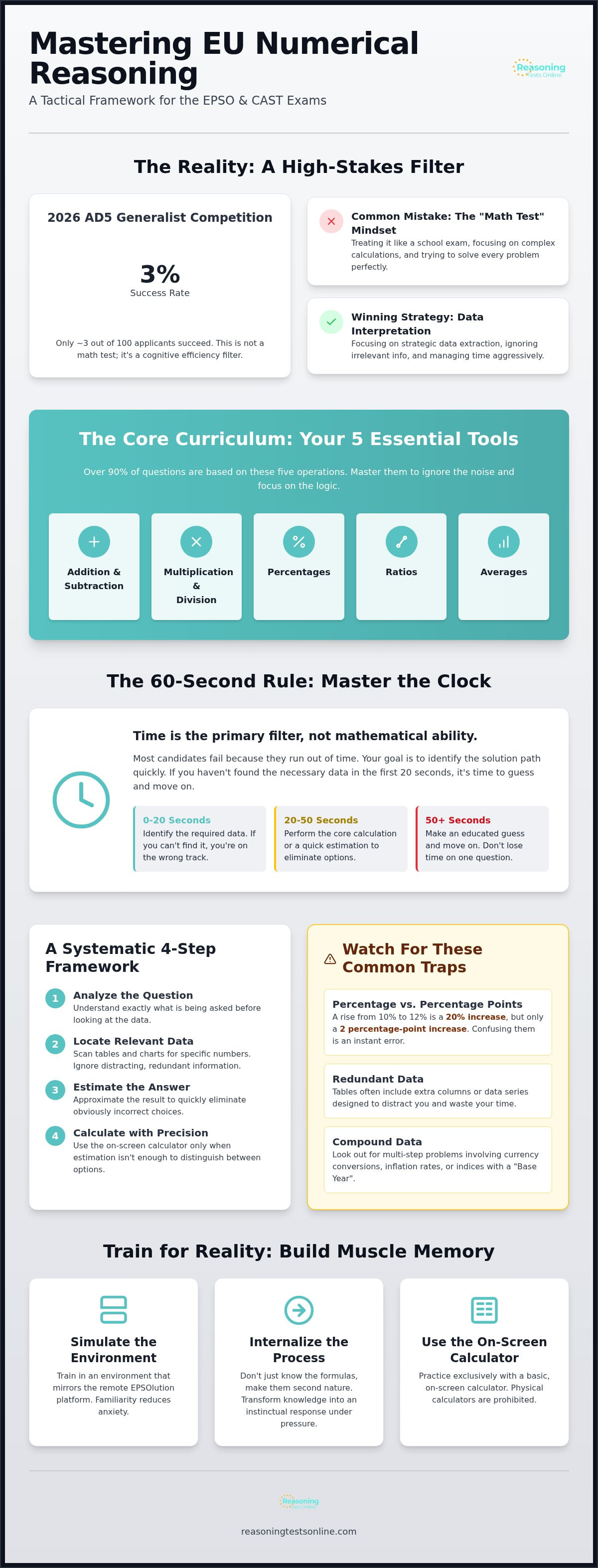
Success in the EU selection process doesn't depend on your ability to perform complex long division; it depends on your ability to ignore irrelevant data. With a success rate of approximately 3% for the 2026 AD5 Generalist competition, the margin for error is non-existent. Most candidates fail because they treat the assessment like a school math test rather than a high-stakes logic challenge. If you feel anxiety over the ticking clock or find yourself confused by the different CAST and AD formats, you're facing the same hurdles as thousands of others.
You don't need to be a mathematician to master numerical reasoning for EU jobs. This guide provides a professional tactical framework to replace guesswork with a systematic approach. We'll show you exactly which formulas are required and how to solve complex table-based questions in under 60 seconds. You'll learn to handle the new EPSOlution remote testing environment with the confidence of an insider. We will break down the data interpretation skills needed to pass the gateway and move toward your career in the EU institutions.
Key Takeaways
- Shift your focus from arithmetic to strategic data interpretation to bypass the most common candidate filters.
- Identify and master the five specific mathematical operations that appear in the vast majority of competition questions.
- Implement the "60-Second Rule" to ensure you never lose critical time on a single complex chart or table.
- Develop a systematic framework for numerical reasoning for EU jobs that prioritizes logical data extraction over raw calculation.
- Transform technical knowledge into muscle memory by training in simulations that mirror the high-stakes EPSO and CAST environment.
The Reality of Numerical Reasoning for EU Jobs
The EU numerical reasoning test isn't a math exam. It's a high-pressure filter designed to measure cognitive efficiency. If you're worrying about calculus or complex trigonometry, you're focusing on the wrong metrics. The 2026 selection model, known as EPSOlution, treats numerical reasoning for EU jobs as a critical gateway. For the AD5 Generalist competition, candidates face a combined pass mark of 10 out of 20 for the numerical and abstract sections. While this sounds achievable, the context is brutal. In the 2026 AD5 cycle, approximately 174,727 applicants competed for only 1,490 reserve list spots. This represents a success rate of roughly 3%.
EU institutions use these tests to manage massive candidate volumes through objective, standardized filtering. In this environment, accuracy is not enough. You must demonstrate the ability to extract relevant data from complex sets while the clock is ticking. The focus has shifted entirely from "math skill" to "data interpretation." You aren't being tested on your ability to calculate; you're being tested on your ability to think under fire. Success comes from preparation rather than luck.
EPSO AD5 vs. CAST: Understanding the Differences
Your preparation strategy depends entirely on the specific competition you're entering. The AD5 Generalist competition is the primary entry point for university graduates into the EU civil service. These tests are now fully remote and proctored. You cannot bring your own phisical calculator, but must use the basic one built into the testing system. You must align your practice environment with the specific rules of your competition to build the right habits.
The Psychology of the Ticking Clock
The 60-to-90 second limit per question is the primary filter. Most candidates don't fail because they can't do the math; they fail because they run out of time. Success requires a shift in mindset. You must move from "solving the problem" to "identifying the solution path." If you haven't identified the necessary data within the first 20 seconds, you should guess and move on. This discipline is what separates successful candidates from the other 97%.
Anxiety is a performance killer. When the timer turns red, your brain's ability to process complex charts degrades. This is why "knowledge" isn't enough. You need muscle memory. By simulating the high-stakes environment repeatedly, you train your brain to remain analytical under stress. You aren't just learning formulas; you're conditioning your nervous system to stay focused when the pressure peaks. Professional coaching replaces this panic with a systematic approach.
The Core Curriculum: Essential Formulas and Data Types
Mastering numerical reasoning for EU jobs requires a focused inventory of mathematical tools. You don't need a degree in statistics. You need to master five specific operations: addition/subtraction, multiplication/division, percentages, ratios, and averages. These five pillars account for over 90% of the questions you'll encounter. The difficulty doesn't lie in the operations themselves but in the complexity of the data sources. You must learn to strip away the noise and find the underlying logic.
EU exams present a strict hierarchy of data. Tables often contain redundant columns designed to distract you. Bar charts test your ability to compare discrete categories, while line graphs track trends over time. Mental training is essential to recognize these patterns instantly. If you spend 30 seconds just figuring out what the axes represent, you've already lost the round. You aren't just reading a graph; you're extracting a specific data point under fire.
For the 2026 EPSO competitions, calculators are prohibited. You are exclusively permitted to use the built-in virtual calculator provided directly within the online exam interface. Knowing when to reach for the tool and when to rely on your logic is a tactical decision that saves seconds. If you can estimate the answer in five seconds, don't waste ten seconds typing it into a keypad.
Percentage Changes and Ratios: The EPSO Bread and Butter
Percentages are the most frequent trap in these assessments. You must distinguish between a percentage change and a percentage point change. A move from 10% to 12% is a 20% increase, but it's only a 2-percentage point increase. Confusing these leads to immediate failure. Ratios require similar precision. Practice converting ratios into fractions quickly to compare datasets without performing long division. If you want to refine these skills, using realistic numerical reasoning tests will help build the necessary muscle memory.
Currency Conversions and Compound Data
Compound problems require multi-step logic. You might need to convert a currency, apply an inflation rate, and then calculate a percentage of the total. Indices and weighted averages often appear in complex tables to measure relative performance. A "Base Year" is a specific point in time used as a benchmark, where the index value is typically set to 100 to allow for easy comparison across different periods. Success in these sections requires a systematic approach to breaking down the problem into logical components before you ever touch a key. You must solve the logic before you solve the math.
The 60-Second Rule: Tactical Speed and Accuracy
In the high-pressure environment of numerical reasoning for EU jobs, time is a weapon used against you. Most candidates fail because they treat every question with equal importance. This is a strategic error. You must adopt the "60-Second Rule": if you haven't identified the solution path within one minute, you must guess and move forward. Staying stuck on a single complex table doesn't just cost you one point; it starves you of the time needed to answer three easier questions later in the test.
Calibrating your internal clock is not a skill you can read about; it's a reflex you must build through repetition. Using realistic EPSO test simulations allows you to develop a sense of rhythm that becomes automatic. You'll learn to recognize the physical sensation of the 60-second mark without looking at the timer. This training transforms a panic-inducing countdown into a tactical tool for decision-making. By the time you reach the actual exam, your pace will be a matter of muscle memory.
A successful session relies on a "First Pass" strategy. Scan the entire section and solve the questions that offer immediate clarity first. Leave the dense, multi-layered charts for a "Deep Dive" only if your time budget permits. This approach ensures you secure the "low-hanging fruit" and reach the pass mark before the clock expires. Every second spent on a dead-end question is a second stolen from your final score.
The Art of Educated Guessing
When the 60-second limit arrives, don't just pick a random option. Use elimination to increase your odds instantly. Identify "distractor" answers that are mathematically impossible based on the visible trends in the chart. If a table shows a steady 5% annual growth, any answer suggesting a 50% increase is likely a trap. Use estimation to find the correct range. If you can narrow the field to two choices, you've doubled your probability of a correct guess in under ten seconds. Cut your losses early to protect your momentum.
Time Management Drills for 2026
Building intensity requires specific training methods designed for the new remote testing environment. Use the "Sprints" method: practice in 5-question bursts where you prioritize speed over perfect accuracy. This forces your brain to skip irrelevant data and focus on core logic. Track your "Time per Correct Answer" as your primary metric for progress. If you are highly accurate but too slow, your system is failing. For a deeper breakdown of these tactics, check our guide on Numerical Reasoning Test Mastery for EPSO AD5 Exams. This disciplined approach replaces exam-day anxiety with a results-oriented routine.
A Systematic Framework for Solving EU Numerical Questions
Stop reading. Start scanning. The numerical reasoning for EU jobs assessment is a data-extraction race, not a mathematics exam. If you treat the prompt like a novel, you'll run out of time. Professional candidates use a logic-first approach to ensure they are solving for the correct variable before they ever touch a calculator. This methodology prevents you from falling for distractors hidden in dense datasets. Standardizing your scratchpad use is equally vital. Use a consistent layout for your notes to prevent simple transcription errors that can ruin an otherwise perfect calculation.
Systematic breakdown is superior to "shortcut" tricks in high-stakes exams. While shortcuts might work for simple arithmetic, they often fail when faced with the multi-layered tables used by EPSO and CAST. You need a reliable system that works every time. If you want to master this methodology, you should practice with realistic numerical reasoning tests that simulate these exact conditions.
Step 1: Identify the Question’s Core Requirement
Your first task is to parse the question text to find the exact variable needed. Ignore the "noise" in large tables. If the question asks for the growth rate of export volumes in 2024, ignore the columns for import values or 2023 data. Pay close attention to the units. Misreading "millions" as "billions" or "percentages" as "absolute values" is a common trap that leads directly to a distractor answer. You must isolate the target data before you begin any mathematical operations.
Step 2: Map the Calculation Path
Determine your sequence of operations before you begin calculating. If you need to find a growth rate, visualize the formula: (New minus Old) divided by Old. Mapping the path first prevents you from getting lost mid-problem. Always verify that the units in your calculation match the units in the answer choices before finalizing your result. This "Unit Consistency" check is your primary defense against conversion errors. By deciding the path early, you reduce the cognitive load during the actual execution phase.
Step 3: Execute and Verify
Perform the calculation with precision. If your result doesn't match any of the multiple-choice answers, don't panic. Quickly re-read the question to ensure you haven't missed a specific condition, such as "excluding taxes" or "per capita." Use the "Last Digit" check to verify your result. If your manual calculation ends in a 4 and the only matching answer choice ends in a 4, you've likely found the correct path. This verification step takes seconds but saves you from the frustration of a missed point.
Mental Training: Building Muscle Memory for Exam Day
Cognitive assessments aren't tests of knowledge. They're tests of reaction. You can't "study" for numerical reasoning for EU jobs in the traditional sense; you must train for it. Success depends on your ability to execute complex operations while under extreme psychological pressure. This requires muscle memory. Just as an athlete doesn't think about their form during a race, you shouldn't have to think about the steps of a percentage decrease formula. It must be an automatic response triggered by the data on the screen.
The only way to build this reflex is by practicing in a timed reasoning test environment. Simulations that mimic the high-stakes exam interface are essential for calibrating your internal clock. You need to move from untimed accuracy to timed mastery. Accuracy is your foundation, but speed is your finish line. If you can't solve the problem within the 60-second limit discussed earlier, your accuracy becomes irrelevant.
Adopt a "Simulation Loop" to maximize your progress. This cycle consists of three stages: Practice, Review Explanations, and Repeat. Don't just solve questions and move on. Dissect the logic of every error to ensure it never happens again. This disciplined approach replaces guesswork with a refined system of logic.
Reviewing the "Why" Behind the "What"
Reading detailed answer explanations is more important than the practice questions themselves. These explanations reveal the underlying logic and the most efficient path to the solution. Use this review phase to identify your recurring logical traps. For many candidates, this includes misreading "of which" clauses or failing to account for base years in indices. Track your performance data from mock exams to adjust your strategy. If you consistently lose time on bar charts, pivot your training to focus on data extraction from that specific format.
Final Preparation: The Week Before the Test
Taper your study during the final seven days. Stop trying to learn new concepts and focus on "warm-up" drills to keep your mental reflexes sharp. Your goal is to maintain your peak, not to burn out before the exam starts. Pay close attention to your physical test environment. Ensure your lighting is adequate, your screen setup is ergonomic, and you have a quiet space free from distractions. The closer your practice environment is to the real experience, the better your outcome will be. Ready to start? View our practice packages and pricing to begin your systematic training for numerical reasoning for EU jobs today.
Secure Your Seat on the Reserve List
Success in the EU selection process is a matter of discipline, not luck. You've learned that passing the numerical reasoning for EU jobs requires more than mathematical knowledge; it demands a tactical system. By implementing the 60-second rule and a logic-first framework, you move from guesswork to precision. You now understand that your preparation must mirror the high-stakes environment of the actual exam to be effective. The shift from calculation to data extraction is the primary differentiator between successful candidates and the rest of the field.
It's time to translate these strategies into results. Our platform provides the tools you need to build the necessary muscle memory. You'll gain access to realistic timed simulations and detailed logic-based explanations across difficulty levels tailored for AD5, AD7, and CAST. Master the EPSO Numerical Test with Realistic Simulations and approach your exam date with the confidence of a professional coach. Your career in the EU institutions is within reach if you commit to systematic preparation. Start your training today and turn the ticking clock into your greatest strategic advantage.
Frequently Asked Questions
Do I need to be good at math to pass the EU numerical reasoning test?
No, you don't need advanced mathematical knowledge to succeed. The test evaluates your ability to extract data and apply basic logic under pressure. While you must be comfortable with percentages and ratios, the complexity lies in the interpretation of the charts rather than the arithmetic itself. Systematic training allows you to master numerical reasoning for EU jobs by focusing on pattern recognition and logical shortcuts instead of pure calculation.
Are calculators allowed during the EPSO or CAST exams?
For the 2026 EPSO competitions, calculators are prohibited; you are exclusively permitted to use the built-in virtual calculator provided directly within the online exam interface. Aligning your practice with this technical constraint is essential for building accurate muscle memory for exam day.
What is a passing score for numerical reasoning in EU jobs?
The pass mark is a combined threshold for the AD5 Generalist competition. You must score at least 10 out of 20 points across both the numerical and abstract reasoning sections. These tests serve as a pass or fail gateway and do not contribute to your final ranking. For CAST selections, the pass marks are determined by the specific profile and function group you are applying for within the institution.
How many questions are in the EPSO numerical reasoning test?
The EPSO numerical reasoning test typically consists of 10 questions. You are generally allocated 20 minutes to complete this section, which reinforces the 120-second average per question. However, the high-pressure environment often makes this feel much shorter. Efficient candidates use the first 20 seconds to isolate variables, leaving the remaining time for the actual execution of the logic-based calculation path while ignoring irrelevant data.
Can I use scrap paper during the computer-based testing?
Under the EPSOlution remote testing model, physical scrap paper is typically prohibited in favor of a small erasable whiteboard. You must check the specific technical requirements for your 2026 proctored exam session. Standardizing how you use these tools is critical to avoid transcription errors. Practice your notation methods during simulations to ensure you can track multi-step problems without losing focus or time. This discipline prevents simple mistakes under pressure.
Is the numerical reasoning test for AD7 harder than for AD5?
The numerical reasoning test for AD7 competitions features higher data complexity than the AD5 level. While the core formulas remain the same, the data sets are denser and require more sophisticated interpretation. AD7 candidates often face more distractor data points designed to test professional analytical depth. Mastery of numerical reasoning for EU jobs at this level requires a more disciplined approach to filtering irrelevant information and managing the 60-second rule effectively.
How long should I prepare for the numerical reasoning test?
Most successful candidates dedicate four to six weeks to intensive preparation. This timeframe allows you to move from understanding the basic formulas to developing the muscle memory required for timed simulations. You should aim for daily sprints to build intensity and consistency. Preparation is about quality rather than quantity; focused review of your logical errors is more valuable than solving hundreds of questions without analyzing why you made a mistake.
What happens if I fail the numerical reasoning part of the EPSO exam?
If you fail to reach the combined pass mark, you are eliminated from the competition immediately. There are no application fees for EPSO or CAST, so you can apply for future selections once a new notice of competition is published. Because the success rate is roughly 3%, failing a single section is the most common reason for exclusion. This makes systematic preparation the only reliable way to protect your candidacy and ensure you move forward.


