

Most candidates fail the 2026 EPSO AD5 competition not because they lack intelligence, but because they treat the exam like a knowledge test rather than a high-speed logic simulation. If you've hit a performance plateau at 70% accuracy, you're likely falling for sophisticated distractor options in abstract reasoning or losing the race against the numerical timer. Relying on intuition isn't enough when the effective qualifying score for Verbal Reasoning often sits as high as 16 out of 20. To improve EPSO test score results, you must transition from solving problems to automating logical verification.
You deserve a preparation strategy that mirrors the intensity of the new EPSOlution digital format. This roadmap moves beyond basic theory to provide the tactical frameworks and mental training techniques required for an elite ranking. We will examine how to build the muscle memory needed to handle the full exam duration without cognitive fatigue. You'll learn a repeatable system for skipping vs. solving and how to neutralize the distractors that keep most applicants on the wrong side of the reserve list.
Key Takeaways
- Identify the 2026 competitive gap to understand why a basic pass mark is no longer enough for a recruitment-eligible ranking.
- Analyze the "Distractor Anatomy" to recognize how incorrect answers are systematically designed to exploit common logical shortcuts.
- Apply the "60-Second Rule" to transition from rushing through questions to using automated logic for better time management.
- Follow a structured 4-week framework to improve EPSO test score results by focusing on deep analysis rather than repetitive volume practice.
- Use realistic simulations with difficulty scaling to build the mental stamina and muscle memory required for the digital testing environment.
Understanding the Competitive Gap: Why Passing Isn’t Enough in 2026
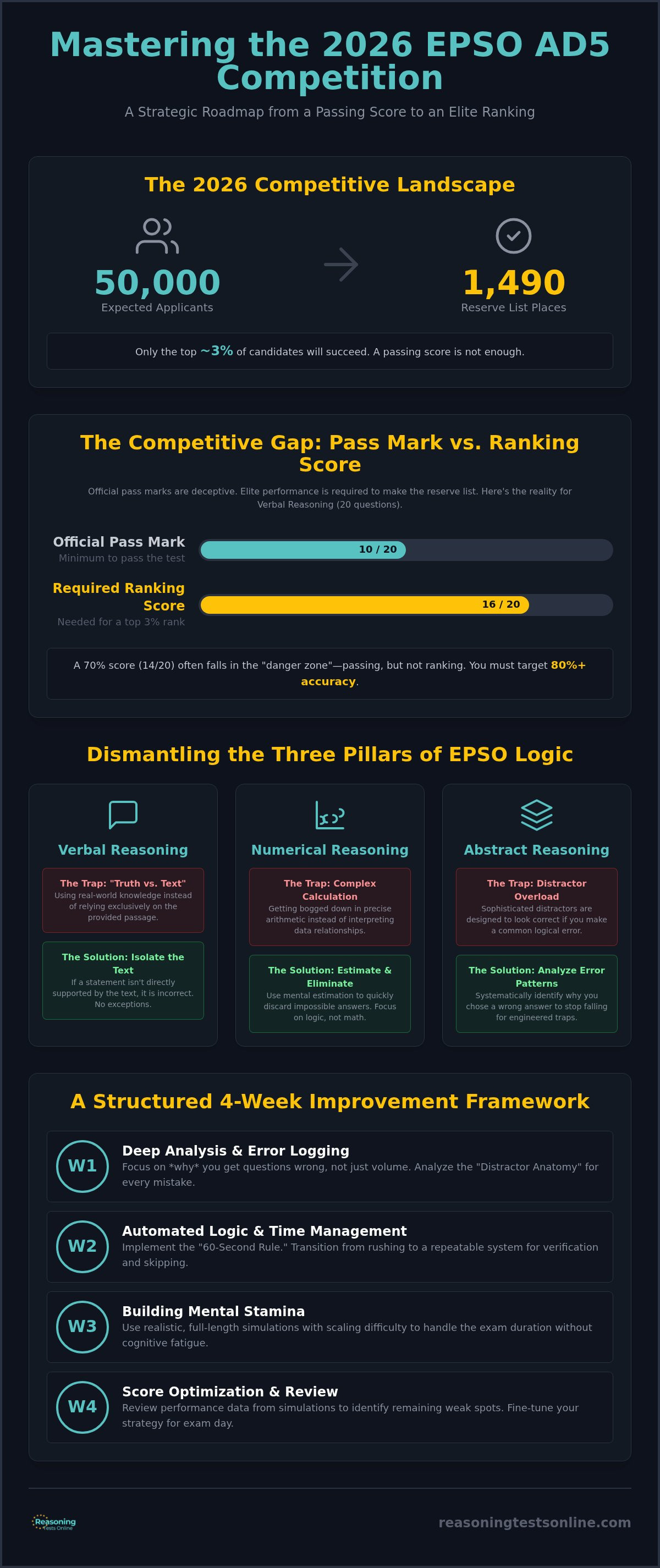
Success in the 2026 competitions isn't defined by meeting a minimum threshold. The European Personnel Selection Office (EPSO) sets pass marks as low as 10 out of 20 for verbal reasoning, but these figures are deceptive. If you only aim for the pass mark, you'll likely fail the competition entirely. The "Competitive Gap" represents the space between merely passing and achieving a score that secures a spot on the reserve list. With up to 50,000 applicants expected for the AD5 Generalist competition, the margin for error is razor-thin. You need a strategy to improve EPSO test score outcomes that targets the top 3% of candidates, not just the pass line.
In the 2026 testing environment, precision is your only currency. A score of 70% might feel like an achievement, but it often leaves you in the "danger zone." This is where candidates pass the test but fail to make the ranking cut. Moving from a passing score to an elite ranking requires a shift from exam survival to score optimization. You aren't just trying to get through the questions; you're trying to outpace thousands of other high-performing graduates who are all chasing the same 1,490 places on the reserve list.
The Reality of the 2026 EPSO Selection Thresholds
The new EPSOlution model relies on digital, remote testing to filter massive applicant pools. While the official pass mark for verbal reasoning is 10/20, historical data suggests the actual qualifying score often lands between 14 and 16. For AD5 and AD7 grades, a 70% score is rarely enough. Competitive ranking requires high-performance targets:
- Verbal Reasoning: 16+ out of 20.
- Numerical and Abstract (combined): 17+ out of 20.
- Consistent accuracy under the pressure of the autumn 2026 CBT phase.
The High Cost of Educated Guessing
Educated guessing is a symptom of a weak logical framework. When you guess, you introduce a cognitive tax that drains your mental stamina for subsequent questions. The goal is to move from "hoping to be right" to "knowing you are right" through systematic verification. If you want to improve EPSO test score performance, you must eliminate the psychological friction of uncertainty. This shift transforms the exam from a stressful survival exercise into a repeatable execution of logic. High-ranking candidates don't rely on intuition; they rely on a system that makes the correct answer the only logical possibility.
Dismantling the Three Pillars: Verbal, Numerical, and Abstract Logic
EPSO reasoning tests aren't isolated challenges. They're a unified assessment of your ability to isolate logical truth under pressure. To improve EPSO test score outcomes, you must master the "Distractor Anatomy." EPSO designers don't pick wrong answers at random. They build distractors that look correct if you make a single common error. While adopting habits that can improve cognitive function builds a strong foundation, you need tactical awareness to survive the 2026 CBT phase. Analyzing your error patterns is the only way to stop falling for these engineered traps.
Verbal Reasoning: Ignoring Outside Knowledge
The biggest trap in verbal reasoning is the "Truth vs. Text" conflict. You must ignore real-world facts and use only the provided passage. Distractors often include "Half-Right" options that start with a true statement but conclude with an unsupported claim. If it isn't in the text, it's wrong. You don't have time to ponder external context. Scan for logical connectors like "only," "never," or "all" to identify common pitfalls. For senior-level candidates, this precision is even more critical, as explained in our EPSO AD7 Prep: Strategic Guide.
Numerical Reasoning: Data Interpretation over Math
These tests don't measure arithmetic skill; they measure data logic. Candidates often fail because they get bogged down in complex calculations. Use mental estimation to eliminate impossible answers quickly. Most multi-layered tables contain noise designed to distract you from the relevant data points. If you're spending more than 30 seconds calculating, you've missed the logical shortcut. Focus on the relationship between variables rather than the raw numbers. If you identify the correct operation, the answer becomes obvious without grinding through the math.
Abstract Reasoning: The Rule of Five
Pattern recognition is a systematic process, not a flash of insight. Use a checklist to scan for five primary variables: color, shape, size, orientation, and movement. Be alert for "Negative Patterns" where the logic is defined by what is absent. You must automate this scanning process to maintain speed. For a deeper dive into complex sequences, consult the Ultimate Guide to Abstract Reasoning. Mastering these pillars requires high-fidelity Verbal, Numerical, and Abstract Reasoning Tests that mimic the 2026 exam environment.
The Speed-Accuracy Paradox: Training Your Internal Exam Clock
Rushing is the fastest way to fail. Elite candidates understand that speed is a byproduct of automated logic, not frantic clicking. If you rush, you miss subtle distractors designed to exploit cognitive shortcuts. If you're too slow, you leave points on the table. To improve EPSO test score performance, you must treat your preparation like athletic training. You don't just want to be right; you want to be right automatically. This level of "Mental Muscle Memory" allows you to navigate the 2026 CBT phase without hitting a wall of mental exhaustion.
The "60-Second Rule" is your hard limit. Most candidates hit a breaking point at the one-minute mark. If you haven't identified the logical path within 60 seconds, you're no longer solving; you're guessing. This is the moment to move on. Guessing at this stage is a tactical error that drains your time budget for easier questions later in the test. You should skip, flag, and protect your remaining time. Detailed strategies for managing your pace are available in our guide on EPSO Exam Time Management.
Building the Internal Timer
Timed drills are essential for calibrating your sense of "spent time." You shouldn't need to look at the clock to know when you've exceeded your budget. Recognize the "Sunk Cost" moment. If you've spent 90 seconds on a single abstract pattern, you've already sacrificed time that could have secured two easier points elsewhere. Shift from passive reading to active solving. Active solving means you are hunting for specific evidence to support or refute a choice, rather than waiting for an answer to appear. This proactive approach is essential to improve EPSO test score results in the 2026 competitions.
Elimination vs. Selection
Selection is a high-energy cognitive task. Elimination is a systematic process of exclusion. It's often faster to identify why four options are wrong than to prove why one is right. Use a "Distractor Filter" to remove obvious traps in under 10 seconds. This technique reduces cognitive fatigue during the grueling 2-hour exam session. By narrowing the field quickly, you lower the mental tax of each question. This preservation of energy is what separates elite performers from those who fade in the final thirty minutes of the exam.
A Systematic Framework for Daily Score Improvement
Most candidates waste hundreds of hours on "Volume Practice." They grind through endless question banks without ever addressing the root cause of their errors. This approach is inefficient and fails to improve EPSO test score results because it reinforces bad habits. Elite preparation requires a 4-week roadmap focused on "Deep Analysis." You must understand exactly why you chose a distractor before you move to the next set. Guesswork is a liability that will be exposed during the high-pressure 2026 competitions.
The most critical part of your routine is the "Post-Practice Review." Dedicate 15 minutes after every session to dissecting your mistakes. Was it a logic gap, a data misinterpretation, or a simple lapse in concentration? If you can't explain the logic behind the correct answer, you haven't mastered the question. Integrating realistic EPSO test simulations into this review cycle ensures your preparation matches the high-stakes reality of the 2026 competition. You are training your brain to recognize patterns, not just memorize answers.
Phase 1: Diagnostic and Accuracy Foundations
Spend the first two weeks identifying your weakest reasoning pillar without emotional bias. Don't assume you're "bad at math" or "slow at reading." Use data from your initial drills to confirm where the points are leaking. Set a strict accuracy benchmark of 90% in untimed conditions. If you can't get it right with unlimited time, you won't get it right under pressure. Categorize question types into "Easy," "Medium," and "Hard." This system allows you to prioritize high-value targets and automate the decision to skip complex patterns that threaten your time budget.
Phase 2: Stress-Testing and Simulation
Weeks three and four focus on mental stamina and environmental resilience. Transition to full-length timed simulations to prepare for the autumn 2026 CBT phase. You must recreate the actual exam environment to build muscle memory. Practice with background noise, screen glare, and limited scratch paper to build resilience. Use detailed answer explanations to bridge logic gaps in real-time. This phase is about stress-testing your systems until the correct logical path becomes your default response. Access our specialized Abstract, Numerical, and Verbal Reasoning Tests to begin your 4-week performance roadmap today.
Beyond Practice: Leveraging Realistic Simulations for Elite Results
Official EPSO sample tests serve as a baseline for understanding the question format, but they're insufficient for elite preparation. These samples are often static and lack the adaptive difficulty of the 2026 "EPSOlution" model. If you want to improve EPSO test score results, you must move beyond basic materials. You need a platform that scales difficulty to push your brain past its comfort zone. This approach prevents the "False Confidence" trap. Many candidates perform well on basic samples only to fail when the real exam introduces complex, multi-layered distractors. Elite results come from stress-testing your logic against the hardest possible scenarios before the clock starts for real.
The Advantage of Simulation Over Sample Questions
The digital interface itself is a critical variable in your performance. Getting used to CBT navigation and the ticking digital timer is essential for building muscle memory. High-fidelity simulations provide a "Logical Audit" for every incorrect answer, which is far more valuable than a simple answer key. This process isn't just about seeing what's right; it's about identifying the systemic failure in your reasoning process. By analyzing simulation data, you can accurately predict your actual exam performance. If you aren't consistently hitting elite rankings in a simulated environment, you're not yet ready for the autumn 2026 CBT phase. For candidates who cannot afford to fail, choosing Reasoning Tests Online provides the strategic advantage needed to secure a reserve list spot.
Final Preparation: The 72-Hour Countdown
The final three days before your exam should focus on system familiarity rather than cramming new concepts. Spend this time reviewing your most successful logical frameworks and mental shortcuts. Avoid starting new, high-difficulty simulations 24 hours before the test. Instead, focus on maintaining your mental stamina and confidence. Managing exam-day anxiety is significantly easier when you've spent weeks in a realistic simulation. You aren't entering an unknown environment; you're simply executing a routine you've already mastered. This level of preparation is the final step to improve EPSO test score outcomes and advance to the 2027 stage of the competition. Secure your competitive ranking with our 2026 EPSO practice packages.
Securing Your Place on the 2026 Reserve List
Success in the 2026 EPSO competitions requires more than just showing up. You've seen that the competitive gap demands elite precision, not just a minimum pass mark. By dismantling the logic of verbal, numerical, and abstract reasoning, you replace intuition with a repeatable system. Automating your internal clock ensures that the 60-second limit becomes a tool for progress rather than a source of panic. To truly improve EPSO test score outcomes, you must transition from passive practice to high-fidelity simulation.
We offer specialized packages for AD5, AD7, and CAST designed to mirror the actual exam environment. Our platform provides realistic timed simulations and detailed logic explanations for every question. Don't leave your career to chance when you can stop guessing and start winning. Master the logic and beat the clock with our realistic EPSO test simulations. The reserve list is within reach for those who commit to a systematic roadmap. Start your training today and turn the 2026 competition into your professional breakthrough.
Frequently Asked Questions
How long does it take to significantly improve an EPSO test score?
It takes approximately 4 to 6 weeks of disciplined training to see a measurable gain. If you follow a structured roadmap, you can move from a 70% baseline to an elite 90% range. Avoid cramming in the final days. Instead, use this period to build the mental stamina required for the autumn 2026 CBT phase. Consistency in daily analysis is more effective than sporadic, high-volume sessions.
Can I use a calculator during the EPSO numerical reasoning test?
You are permitted to use an on-screen calculator provided within the digital testing interface. Physical calculators or external devices are strictly prohibited during the remote exam. Since the on-screen tool can be clunky, you should practice with similar digital simulations to build speed. Use mental estimation for simpler operations to save time for the complex multi-layered tables that define the numerical section.
Is it better to guess or leave a question blank on the EPSO exam?
You should always select an answer because EPSO does not apply negative marking for incorrect choices. A blank screen is a guaranteed zero. If the 60-second rule expires and you haven't solved the logic, make an educated guess and move on. This protects your time budget for easier questions later in the test. Eliminating even one obvious distractor significantly increases your mathematical probability of success.
What is a good score for the EPSO CAST reasoning tests?
A competitive score for CAST reasoning tests is typically 80% or higher, even if the official pass mark is lower. Recruitment in the 2026 context is highly selective. Achieving a score in the top decile ensures you remain visible to hiring services. To improve EPSO test score results for CAST, focus on accuracy in the verbal and numerical sections where the margins for error are most restrictive.
How do I stop running out of time on the abstract reasoning section?
You stop running out of time by automating the recognition of the five core pattern variables: color, shape, size, orientation, and movement. If you don't see the pattern in 45 seconds, you must guess and skip. This prevents the "Sunk Cost" trap that ruins many candidates' scores. High-speed logic is a muscle. You must train it through timed drills that calibrate your internal exam clock before test day.
Are the EPSO tests in 2026 different from previous years?
The 2026 competitions use the "EPSOlution" model, which is fully digital and remote. This eliminates the need for in-person testing at the Brussels Assessment Centre. The focus has shifted heavily toward reasoning skills as the primary filter for the large applicant pool. These tests act as a high-stakes barrier, meaning your preparation must match the specific digital interface and timing constraints of the new remote environment.
How many practice tests should I do before the actual exam?
You should complete between 10 and 15 high-fidelity simulations before your exam date. Doing 100s of questions is less effective than performing a "Deep Analysis" on a smaller, targeted set. Every simulation should be followed by a 15-minute review of your errors. This method builds the muscle memory needed to improve EPSO test score performance without leading to cognitive burnout or the false confidence of easy samples.
What are the most common traps in EPSO verbal reasoning?
The most frequent traps are the "Truth vs. Text" error and the "Half-Right" distractor. Candidates often fail because they use real-world facts instead of the specific data provided in the passage. Distractors are also engineered to include statements that are partially true but logically unsupported by the text. You must learn to ignore outside knowledge and focus exclusively on the provided evidence to maintain an elite accuracy ranking.


