

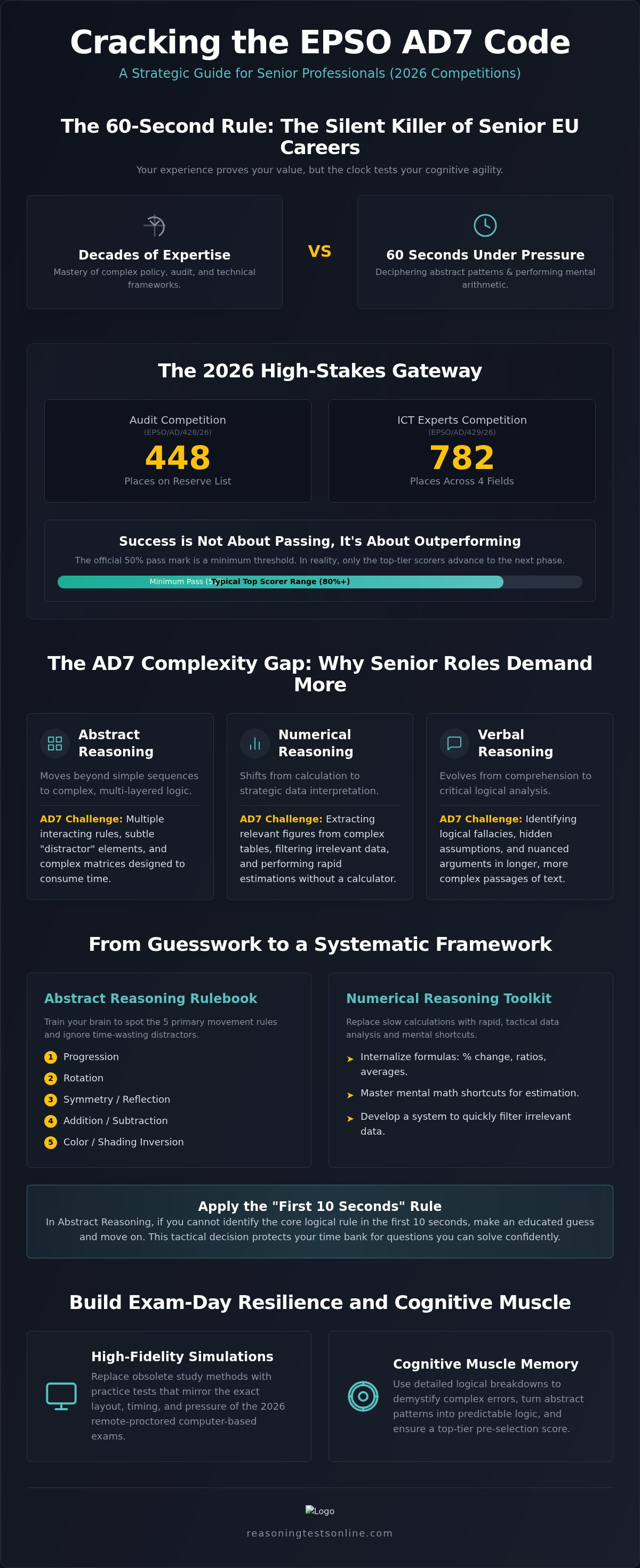
The 60-second rule is the silent killer of senior EU careers. You've spent decades mastering complex policy or audit frameworks, yet your professional advancement now hinges on deciphering abstract shapes and performing mental arithmetic under extreme pressure. It's frustrating to feel like a novice when you're an expert in your field. Effective EPSO AD7 exam prep isn't about working harder; it's about retooling your cognitive processes for tactical speed. You don't need more time; you need a better system.
We understand that balancing a high-level role with intensive study feels nearly impossible. This guide promises a systematic, simulation-driven approach that turns abstract patterns into predictable logic. You'll gain the tools to identify complex sequences instantly and interpret numerical data with confidence, even without a calculator. We'll break down the exact methodology required to ace the 2026 pre-selection phase and secure your place on the reserve list. Stop guessing and start training with the precision of a seasoned insider.
Key Takeaways
- Identify why the 2026 shift toward competency-based testing makes the reasoning gatekeeper even more critical for senior administrator roles.
- Develop a systematic framework for your EPSO AD7 exam prep to decode abstract patterns and numerical data with expert precision.
- Apply the "First 10 Seconds" rule to navigate the 60-second time limit and eliminate exam-day anxiety through tactical decision-making.
- Replace obsolete study methods with high-fidelity simulations that mirror the exact layout and pressure of the 2026 computer-based tests.
- Build cognitive muscle memory using detailed logical breakdowns that demystify complex errors and ensure a top-tier pre-selection score.
Navigating the EPSO AD7 Competition Landscape in 2026
Seniority is a double-edged sword in the EU selection process. While your career history proves your professional value, the European Personnel Selection Office (EPSO) uses reasoning tests as a primary filter for cognitive agility. In the 2026 competition cycle, these tests remain the ultimate gatekeeper for the AD7 Administrator profile. Whether you are targeting the Audit competition (EPSO/AD/428/26) or the ICT Experts path (EPSO/AD/429/26), your decades of experience won't help you solve an abstract matrix in sixty seconds. The reasoning phase is designed to test your ability to process information under extreme stress, a skill that often atrophies in senior roles where deliberation is favored over snap logic.
Professional experience often creates a false sense of security. Many senior candidates assume their analytical background in law, finance, or technology will naturally translate to high scores. This is a common mistake. Reasoning tests are a specific discipline requiring a psychological pivot from "expert" to "candidate." You must stop relying on your professional intuition and start relying on a systematic framework. Effective EPSO AD7 exam prep focuses on building this mental training, treating logic as a muscle that needs targeted conditioning rather than a set of knowledge to be memorized.
AD7 vs. AD5: Identifying the Complexity Gap
The difficulty level scales significantly for senior profiles. In Abstract Reasoning, the patterns involve more moving parts and subtle "distractor" elements that aren't present in entry-level AD5 tests. Numerical Reasoning at the AD7 level moves beyond basic arithmetic. It demands strategic data analysis, requiring you to extract relevant figures from complex tables while ignoring irrelevant noise. Verbal Reasoning passages are longer and more nuanced; they test your ability to identify logical fallacies and hidden assumptions rather than simple reading comprehension. You aren't just looking for the right answer; you're looking for the only logically defensible conclusion.
The 2026 Selection Procedure: A Tactical Overview
The 2026 competitions are highly competitive. For example, the Audit competition offers only 448 places on the reserve list, while the ICT Experts competition has 782 places across four fields. While the official pass marks are often set at 50 percent (such as 10/20 for Verbal Reasoning or 15/30 for field-related tests), these are minimums. In reality, only the top-tier scorers reach the next phase. The shift toward remote testing with online proctoring adds another layer of complexity. You must be comfortable performing in a digital environment where the interface itself can become a distraction if you haven't practiced in a high-fidelity simulation.
Mastering the AD7 Reasoning Trilogy: Logic Over Guesswork
Success at the AD7 level requires more than raw intelligence. It demands a systematic breakdown of the three core reasoning domains. Guesswork is a career-ending strategy in the 2026 EPSO format. If you rely on luck, you'll fall behind candidates who have built cognitive muscle memory. High-stakes competition means every second counts. You need a method that replaces hesitation with instant recognition. Integrating a structured EPSO AD7 exam prep routine ensures you aren't just practicing, but perfecting your tactical response. You must move from passive reading to active, logic-driven analysis.
Pattern Recognition in Abstract Matrices
Abstract Reasoning is often the most intimidating component. The sequences appear arbitrary until you identify the underlying rules. In AD7 matrices, you'll typically encounter five primary movement rules: progression, rotation, symmetry, addition or subtraction of elements, and color inversion. Distractors are frequently embedded to waste your time. These are elements that change in a way that doesn't follow a logical sequence; they draw your eye away from the actual rule. You must train your brain to ignore the noise. Building muscle memory through specialized simulations allows you to spot these patterns in under ten seconds. If you can't identify the rule in that window, you must apply a skip strategy to protect your time bank.
Numerical Tactics for the Time-Crunched Professional
Numerical Reasoning at the senior level isn't about basic arithmetic. It is about strategic data analysis. You'll be presented with complex tables and multi-layered graphs. Your task is to extract relevant figures while filtering out extraneous data. You must internalize essential formulas for percentage change, ratios, and weighted averages before exam day. Mental math shortcuts are your greatest asset. If you can estimate that a value is roughly one-third of another, you save fifteen seconds otherwise spent on precise calculation. Speed comes from knowing what to calculate, not just how to do the math. High-level EPSO AD7 exam prep focuses on this data extraction phase rather than simple computation.
Verbal Reasoning: Precision Under Pressure
Verbal Reasoning tests your ability to differentiate between "True," "False," and "Cannot Say" based solely on the provided text. Senior candidates often fail here by using their professional expertise to fill in gaps. This is a fatal error. If the text doesn't explicitly state a fact, it is "Cannot Say," even if your real-world experience tells you it's true. You must strip away your external knowledge and focus on the logical boundaries of the passage. Every word in the text is a potential trap or a vital clue. Success depends on your ability to remain objective and disciplined under the ticking clock.
The Strategy of Speed: Eliminating the 60-Second Anxiety
The ticking clock is the most formidable opponent you'll face during the AD7 competition. While your daily professional life may reward deep deliberation and thoroughness, EPSO rewards rapid, tactical execution. You have roughly 60 to 90 seconds per question. This timeframe is intentionally designed to induce stress and force errors. Effective EPSO AD7 exam prep isn't just about finding the right answer; it's about finding it within the allocated window. If you spend three minutes on a single complex matrix, you've effectively sacrificed two other potential points. Speed is a skill you must build through disciplined practice.
Implement the "First 10 Seconds" Rule to protect your time bank. Within the first ten seconds of viewing a question, you must decide whether to solve it immediately or skip and return later. If the pattern in an abstract sequence doesn't reveal itself instantly, or if the numerical data looks too dense for a quick extraction, move on. This prevents the cognitive drain that occurs when you stare at a problem without a clear path forward. You don't have the luxury of getting stuck. Every second spent in hesitation is a second lost for a question you could have answered with ease.
Managing cognitive load is essential for a 35-minute sprint. Fatigue sets in quickly when you're jumping between different types of logic. High-fidelity simulation is the only way to prepare for this reality. Practicing with static PDFs is a mistake because it doesn't mimic the screen-based pressure of the computer-based testing (CBT) environment. Your EPSO AD7 exam prep must replicate the exact interface you'll use on exam day to build true resilience. If you aren't training in a timed, digital environment, you aren't truly preparing for the test.
Time Management Drills for Senior Profiles
Avoid the "Speed Over Accuracy" trap by finding your optimal balance. Use these targeted drills to refine your performance:
- Drill 1: The 30-Second Pattern Sprint. Practice identifying the primary rule of an abstract matrix in half the allotted time. This builds the instinctual recognition needed for complex sequences.
- Drill 2: The "Zero Scratchpad" Challenge. Force yourself to perform estimations and basic calculations mentally. Relying too heavily on a scratchpad wastes valuable seconds that should be spent on data interpretation.
Avoiding Common Cognitive Traps
Senior professionals often fall into the "expert trap." You might over-think a simple verbal passage by looking for nuance that isn't there. Stick strictly to the provided text. If a statement isn't explicitly supported by the paragraph, it's "Cannot Say," even if your real-world experience tells you it's true. Don't let your external knowledge cloud your logic. Similarly, avoid "Anchor Bias" in numerical tasks. This happens when you get stuck on the first figure you see rather than looking for the data that actually answers the question. Train yourself to ignore irrelevant noise and focus on the logical core of the problem.
High-Fidelity Simulation: Building Exam-Day Resilience
Static PDF practice is obsolete for the 2026 computer-based testing (CBT) environment. Reading a sequence on paper doesn't prepare your eyes for the glare of a screen or the specific layout of the EPSO testing platform. Success in EPSO AD7 exam prep depends on high-fidelity simulation. You need to train in an environment that mirrors the exact pressure and interface of the real competition. If your practice doesn't look like the exam, your brain won't be ready when the timer starts. Transitioning from a passive study mindset to an active simulation mindset is the only way to ensure your skills translate to the actual test day.
The 'Review and Refine' cycle is where the actual learning happens. Completing a mock test is only 50% of the work. You must spend equal time analyzing every mistake to understand the underlying logic you missed. Use difficulty levels to build confidence progressively. Start with foundational patterns and move toward the complex, multi-rule matrices found in senior-level competitions. This systematic approach replaces guesswork with a refined methodology. Access professional-grade EPSO simulations to begin your high-fidelity training today.
How to Set Up a Realistic Mock Exam
Eliminate all distractions to create a 'Brussels testing room' environment. This means no phone, no music, and no interruptions for the full duration of the test. Use the specific EPSO-style calculator interface rather than a physical device or your phone's app. Familiarity with the on-screen tool saves precious seconds during the Numerical Reasoning segment. Time your simulations for the exact hour of your real appointment to sync your peak cognitive performance with the exam schedule. If you're testing at 9:00 AM, your brain needs to be accustomed to peak logic at that specific time.
Analyzing Performance Data to Target Weaknesses
Use performance data to identify your 'Time-Sink' categories. If you consistently spend over 90 seconds on ratios but solve percentage changes in 40, you know exactly where to focus your drilling. Recognize your 'Accuracy Ceiling.' This is the point where increasing your speed causes your score to plummet. You must find the threshold where you maintain precision without sacrificing the volume of questions answered. In the context of cognitive testing, muscle memory is the instinctual ability to recognize a logical pattern and execute the correct solution without conscious deliberation. Effective EPSO AD7 exam prep turns this instinct into a competitive advantage.
The Result-Driven Path: Why Professionals Choose Reasoning Tests Online
Senior candidates don't have time for trial and error. Your professional advancement depends on a selection process that is often disconnected from your daily expertise. To bridge this gap, you need a systematic framework specifically calibrated for the AD7 Administrator profile. Reasoning Tests Online provides this structure. We replace vague study tips with a results-driven methodology. By focusing on the mechanics of cognitive assessment, we help you transition from an expert in your field to a top-tier candidate in the EPSO pipeline. Success is the result of disciplined preparation, not luck.
Detailed logical explanations are the core of our system. It isn't enough to know you got a question wrong; you must understand the specific logical error you made. Our platform demystifies complex reasoning traps by breaking down every matrix, table, and verbal passage into its component rules. This transparency builds the cognitive muscle memory needed to perform under pressure. When you use our EPSO AD7 exam prep tools, you're benchmarking your performance against a global standard. You gain an insider's perspective on how the 2026 competitions are structured, giving you a decisive edge over less prepared peers.
The Reasoning Tests Online Methodology
Our approach is built on high-fidelity simulation. We provide specialized tests across the three essential domains required for AD7 success:
- Abstract Reasoning Tests: Master the five primary movement rules and learn to ignore distracting elements in complex matrices.
- Numerical Reasoning Tests: Develop the data extraction skills needed to navigate multi-layered graphs and tables without wasting time on manual calculation.
- Verbal Reasoning Tests: Refine your ability to identify logical boundaries and avoid the "expert trap" of using external knowledge.
These simulations mirror the 2026 remote testing environment. Multiple difficulty levels ensure that your training remains challenging as your speed and accuracy improve. This progression is vital for senior profiles who need to scale their skills quickly.
Your Next Steps Toward EU Selection
Integrating EPSO AD7 exam prep into a busy executive calendar requires a tactical schedule. We recommend a focused 4-week preparation block. Dedicate the first week to rule identification and foundational logic. Spend the second and third weeks on timed drills to build speed. Use the final week for full-length mock exams that replicate your specific appointment time. This method ensures peak performance on exam day without overwhelming your professional responsibilities. Consistency is more valuable than cramming. Start your AD7 preparation with Reasoning Tests Online simulations today.
Securing Your Position on the 2026 Reserve List
Success in the 2026 competitions isn't a matter of luck; it's the result of a disciplined, systematic approach to logic. You've learned that mastering the 60-second rule requires more than just professional knowledge. It requires cognitive muscle memory built through high-fidelity simulation. By replacing guesswork with a refined framework, you'll navigate the complex matrices and data sets of the AD7 competition with expert confidence.
Your professional experience is your greatest asset, but only if you can pass the reasoning gatekeeper first. Effective EPSO AD7 exam prep focuses on the "First 10 Seconds" rule and data-driven performance refinement. Don't leave your EU career to chance. Train with tools designed specifically for the senior administrator profile to ensure your score reflects your true potential.
Master the AD7 Reasoning Tests with Realistic Simulations
Take control of your preparation today. With realistic timed simulations, expert AD7 difficulty levels, and detailed answer logic, you'll be ready for the pressure of the testing room. Your path to the reserve list starts with this tactical decision. You have the skills; now get the system to prove it.
Frequently Asked Questions
What is the difference between AD5 and AD7 EPSO exams?
AD7 exams are designed for candidates with several years of professional experience, which is reflected in the increased complexity of the reasoning questions. While the test format is similar to AD5, the density of data and the subtlety of logical "distractors" are significantly higher at the senior level. You'll face more moving parts in abstract matrices and more nuanced arguments in verbal passages that require deeper deduction.
Can I pass the AD7 numerical test without a math background?
Yes, you can pass by focusing on strategic data interpretation rather than advanced calculation. The test assesses your ability to extract relevant figures from complex tables and understand ratios or percentages under pressure. Strategic estimation and mental math shortcuts are more valuable than academic mathematics. Successful EPSO AD7 exam prep prioritizes these tactical analytical skills over raw computation.
How much time should a senior professional spend on EPSO prep?
Aim for 30 to 50 hours of high-quality, focused practice over a four-week period. Senior professionals often lack large blocks of time, so intensity and quality are more important than total hours. Focus on short, 30-minute drills that target your specific weaknesses. Consistency builds muscle memory more effectively than irregular, long-duration study sessions. Quality simulation always beats passive reading.
Are the reasoning tests the same for all AD7 competitions?
The structure of the verbal, numerical, and abstract reasoning tests is standardized across most AD7 competitions, but the field-related components vary. For example, the 2026 Audit competition (EPSO/AD/428/26) includes a field-related multiple-choice test and a written essay. While the reasoning logic remains constant, your preparation must account for these additional, specialized components in the later stages of the selection process.
What is a good score for the AD7 abstract reasoning test?
You should aim for a score in the top 10 to 15 percent of candidates to ensure your progression to the next phase. While the official pass mark is often set at 50 percent, the competitive nature of the reserve list means a bare "pass" is rarely enough. In high-stakes competitions like the 2026 ICT Experts (EPSO/AD/429/26), a top-tier score in abstract reasoning provides a vital competitive cushion.
How do I improve my verbal reasoning speed for EPSO?
Improve your speed by sticking strictly to the provided text and ignoring your external professional knowledge. Senior candidates often lose time by debating the nuance of a passage based on their career experience. If the text doesn't explicitly state a fact, it's "Cannot Say." Training your brain to stay within these logical boundaries prevents the over-thinking that kills your clock during the 35-minute sprint.
Can I use my own calculator during the AD7 exam?
No, you cannot use your own physical calculator during the remote proctored exam. You must use the on-screen calculator provided within the official testing interface. This is why your EPSO AD7 exam prep must include simulations that feature this specific digital tool. Familiarity with the interface prevents technical frustration and saves valuable seconds that are better spent on data interpretation.
What happens if I fail the reasoning part of the AD7 competition?
Failing the reasoning tests results in immediate exclusion from the competition. These tests are the primary gatekeeper; if you don't meet the minimum pass marks or the competitive threshold, your application won't proceed to the field-related or written tests. There is no appeal process for low scores, which makes high-fidelity preparation your only real insurance policy against exclusion.


