

The EPSO CAST isn't a test of raw intelligence; it's a high-speed simulation that rewards interface familiarity over basic logic. Most candidates fail because they treat it like a traditional academic exam rather than a tactical challenge. You're likely feeling the pressure of the eliminatory score thresholds or the complexity of the 2026 remote proctoring environment. It's difficult to interpret complex data when you're fighting an aggressive clock and a rigid computer interface. We understand that anxiety, but success comes from systematic preparation, not luck.
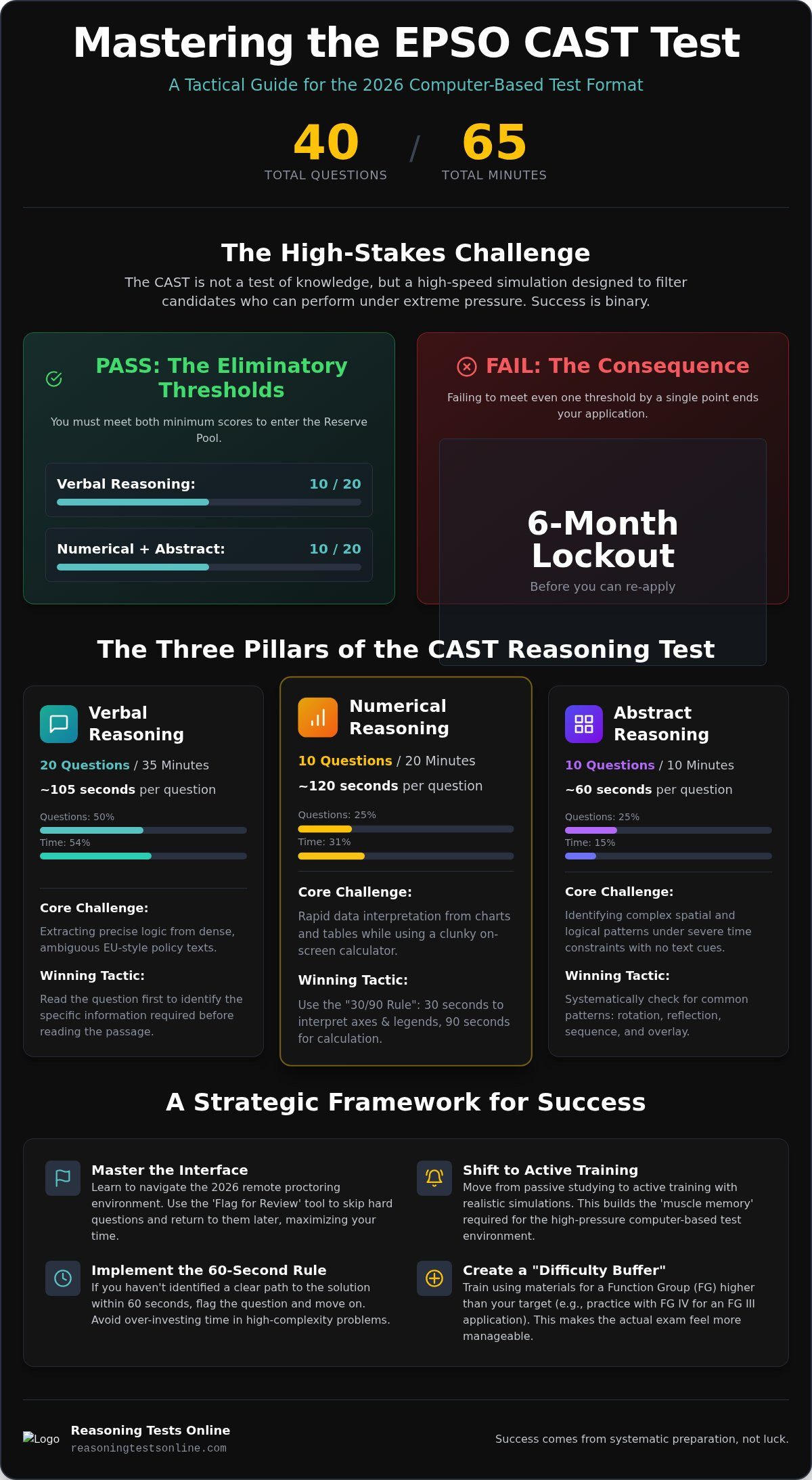
This guide will help you master the exact EPSO CAST test format to replace guesswork with strategic precision. You'll learn how to navigate the 40 multiple-choice questions within the 65-minute limit without losing your composure. We'll preview the specific structure of the verbal, numerical, and abstract sections while providing a framework for managing your time across the entire assessment.
Key Takeaways
- Identify the specific question counts and strict time limits for the three core reasoning pillars to eliminate surprises on exam day.
- Master the 2026 EPSO CAST test format by learning to navigate the remote proctoring interface and the 'Flag for Review' tool efficiently.
- Implement the "First Pass" strategy and the 60-Second Rule to secure easy points and avoid over-investing time in high-complexity questions.
- Shift from passive study to active training by using realistic simulations that build the muscle memory required for the high-pressure CBT environment.
What is the EPSO CAST Selection Tool?
The Contract Agent Selection Tool (CAST) is the primary gateway for professionals seeking non-permanent roles within EU institutions. Managed by the European Personnel Selection Office (EPSO), this procedure doesn't lead to a permanent official status but places you in a "Reserve Pool." Recruitment is continuous. Candidates apply to a database and wait for a specific department to flag their profile. Once flagged, you have as little as two weeks to prepare for the reasoning tests. This short window is why systematic preparation must begin before you receive an invitation.
The stakes are binary. You either pass or you're locked out. Unlike some academic assessments where a high score in one area offsets a low one, the EPSO CAST test format uses strict eliminatory thresholds. You must secure at least 10/20 in Verbal Reasoning and a combined 10/20 in Numerical and Abstract Reasoning. If you fail by a single point, your journey ends for six months. This isn't a test of general knowledge; it's a high-stakes filter designed to identify candidates who can process information under extreme pressure. Success puts you in the pool for ten years, making it a powerful long-term asset for your career.
CAST vs. AD5: Key Differences
The CAST procedure is significantly leaner than the AD5 Generalist competitions. In 2026, the AD5 route remains the "gold standard" for permanent officials, often requiring digital skills tests and EU knowledge exams. CAST strips away the fluff. It focuses purely on three core reasoning skills. This makes it the faster route into the institutions. While AD5 candidates compete for a limited number of spots on a "Reserve List," CAST candidates enter a "Reserve Pool" where multiple departments can recruit them for fixed-term contracts. If you need a foot in the door quickly, the CAST is your primary tactical objective.
The Function Groups (FG) Explained
Complexity scales with the Function Group (FG). While the EPSO CAST test format remains consistent across all profiles, the difficulty of the logic puzzles and data sets varies based on the professional level of the role. Logic is a muscle; if you don't push its limits during training, it will fail you during the live simulation.
- FG I & II: Focused on manual and clerical tasks; features shorter text passages and more straightforward numerical operations.
- FG III & IV: Designed for executive, administrative, and specialist roles; involves complex data interpretation and nuanced logic.
Don't make the mistake of preparing only for your target level. If you're applying for FG III, train using FG IV simulations. Building this "difficulty buffer" ensures that the actual exam feels manageable under the 60-second-per-question pressure. We've seen many candidates fail because they practiced with static samples that didn't match the cognitive load of the real test environment.
The Three Pillars of the CAST Reasoning Test
The EPSO CAST test format is a 65-minute sprint through 40 multiple-choice questions. It's divided into three distinct segments, each testing a specific cognitive faculty. Understanding the raw numbers is your first step toward mastery. You'll face 20 verbal questions, 10 numerical questions, and 10 abstract questions. While the total time seems manageable, the cognitive load shifts dramatically between sections. You must adapt your mental tempo as you move from dense text to complex data tables and finally to abstract matrices.
Verbal Reasoning: 20 Questions / 35 Minutes
Verbal Reasoning is the ability to extract logic from ambiguity. In this section, you're given 105 seconds per passage. This is deceptively generous. The trap lies in the complexity of the EU-style policy texts. They're often dry, technical, and filled with conditional statements. The 'True/False/Cannot Determine' options are designed to exploit your assumptions. If a fact isn't explicitly stated in the text, the answer is 'Cannot Determine.' Don't use outside knowledge. Read the question first to identify the specific logic gate you need to unlock. This prevents you from getting lost in irrelevant details.
Numerical Reasoning: 10 Questions / 20 Minutes
This section focuses on data sets, charts, and statistical tables. You have 20 minutes for 10 questions. We call this the '120-second rule.' Use the first 30 seconds to interpret the axes and legends of the data set. Use the remaining 90 seconds for calculation. The EPSO CAST test format includes an on-screen calculator. It's clunky and requires mouse-click inputs. If you don't practice with a numerical reasoning simulation that replicates this interface, you'll waste time on basic arithmetic. Success here depends on balancing rapid calculation with precise data interpretation.
Abstract Reasoning: 10 Questions / 10 Minutes
The final section is the fastest. You have exactly 60 seconds per pattern. There are no language cues or numbers to guide you. You must identify 'operators' and 'transformations', the hidden rules that govern how shapes move, change color, or disappear. This is often the make-or-break section. Fatigue sets in after 55 minutes of testing, and abstract patterns require peak concentration. If you lose focus for even ten seconds, you'll fail to identify the sequence. Treat this like a high-intensity interval; maintain your mental rhythm until the final second.
The 2026 Remote Testing Interface: A Tactical Overview
The testing environment is no longer a physical center with a proctor walking the aisles. In 2026, your home office is the exam room. This shift transforms the EPSO CAST test format from a simple logic assessment into a test of environmental control and digital proficiency. If your internet drops or your desk isn't 'sterile,' you face immediate disqualification. There's no room for technical error when your career is on the line.
The 'Flag for Review' function is a tactical double-edged sword. Many candidates use it to skip difficult questions, intending to return later. This is a mistake. With only 60 seconds per abstract question, you rarely have a 'later.' Use this function only for questions where you've narrowed the options to two and need a final five-second sanity check at the end. If you're completely lost, make an educated guess and move on. Stalling is the fastest way to fail the timing requirement.
Mastering the On-Screen Tools
The built-in calculator is a notorious bottleneck. It doesn't support keyboard inputs; you must click each digit with your mouse. This adds 3 to 5 seconds to every calculation. If you haven't practiced this specific movement, your numerical reasoning score will suffer. Similarly, use the strike-through tool in verbal reasoning to visually eliminate 'Cannot Determine' traps. These tools assist your logic, but they require muscle memory. Practicing on paper is a tactical error because it fails to simulate the friction of the digital interface.
Remote Exam Etiquette and Technicals
Your proctor is an invisible observer. They monitor your eye movements and ambient noise via your webcam and microphone. If you look away from the screen too often or read questions aloud, they will flag your session for suspicious behavior. Ensure your room is a 'sterile' environment. This means no posters, no extra monitors, and no distractions. Conduct your system checks 48 hours before the exam to eliminate 'disconnection' anxiety. You need your full cognitive bandwidth for the logic puzzles, not for troubleshooting hardware.
Current regulations for 2026 permit the use of physical scratch paper, but you must show both sides to the camera during the check-in process. Don't rely on digital scratchpads if they're provided; they're slow and disrupt your visual focus. Use physical paper for sketching matrices in abstract reasoning and performing quick divisions in the numerical section. This tactile advantage is one of the few variables you can still control in a fully digital environment.
Tactical Time Management: The 60-Second Rule
"Accuracy at any cost" is the primary reason high-potential candidates fail the EPSO CAST test format. In a high-stakes environment, your instinct is to solve every puzzle. This perfectionism is a tactical trap. If you spend four minutes decoding a single complex matrix, you've effectively sacrificed four other questions you could have answered with ease. You aren't just tested on logic; you're tested on your ability to prioritize points under extreme duress. You must treat your time like a finite currency and spend it where the return on investment is highest.
The "First Pass" strategy is your most effective tool. Scan each question for three seconds. If the logic isn't immediately apparent, flag it and move on. This allows you to secure the "low-hanging fruit" first. Once you've banked the easy points, you can return to the more difficult items with the psychological safety of knowing you've already made progress toward the eliminatory threshold. Never leave a question blank. The 1-in-5 probability of a multiple-choice guess is always better than the 0% chance of an empty answer. If you're down to the final ten seconds, click a random option for every remaining item.
The Numerical Triage Method
Identify "Time-Sink" questions immediately. Complex, multi-layered tables with four or five variables are designed to drain your clock. Skip them. Focus on simple percentage changes or direct data retrieval first. In the 20-minute Numerical section, your goal is to secure at least 7 high-certainty answers. This strategy ensures you meet the combined pass mark without getting bogged down in secondary calculations. Skipping to win isn't an admission of defeat; it's a calculated move to protect your overall score. To master this rhythm, you should practice with realistic timed simulations that force you to make these split-second decisions.
Abstract Speed Drills
The 60-second limit for Abstract Reasoning is absolute. We recommend a 30-second rule for initial pattern recognition. If the governing operator doesn't "click" within 30 seconds, you have exactly 15 seconds to eliminate obvious decoys and make a guess. You must move to the next question at the 45-second Hard Limit. This maintains your momentum and prevents the "stalling effect" that leads to clock-watching panic. The final ten minutes of the exam require the highest intensity. If you've trained your muscle memory to recognize transformations quickly, you'll maintain your composure while others are panicking at the 65-minute mark.
Building Muscle Memory with Realistic Simulations
Static sample questions are a relic of the past. They provide the "what" but ignore the "how." In the 2026 EPSO CAST test format, the interface and the timer are as much your opponent as the questions themselves. If you only practice with untimed PDFs, you're conditioning your brain for a slow-paced environment that doesn't exist on exam day. You might understand the logic, but you won't have the speed to execute it.
Under extreme time pressure, your cognitive processing shifts from analytical to reactive. We call this the "Simulation Gap." To bridge it, you must develop muscle memory. You need to reach a point where recognizing a numerical trend or an abstract transformation is an automatic reflex. Detailed explanations replace "intuitive" guessing with "logical" certainty by showing you the specific mechanics of each puzzle. You aren't just learning answers; you're internalizing a system of logic that functions even when the clock is ticking down.
The Reasoning Tests Online Advantage
Our platform provides simulations that mirror the 2026 EPSO interface exactly. We offer difficulty levels for CAST, AD5, and AD7 to push your cognitive limits beyond what the actual exam requires. Our detailed logic walkthroughs teach you how to think, not just what the answer is. We focus on the three core pillars: Verbal, Numerical, and Abstract Reasoning Tests. By training on a platform that replicates the clunky on-screen calculator and the specific navigation tools, you eliminate the friction of the digital environment. You'll enter the exam room with the confidence of a veteran who has already "taken" the test dozens of times.
Your 30-Day Preparation Roadmap
Success is the result of disciplined, systematic preparation. Follow this roadmap to ensure you're ready for the 65-minute sprint:
- Week 1: Focus on untimed accuracy drills. Master the underlying logic of all three sections without the distraction of the clock. Aim for 90% accuracy.
- Week 2-3: Transition to timed sub-tests. Start building the speed required to hit the 60-second Hard Limit. This is where you develop your tactical rhythm.
- Week 4: Execute full-length mock exams. This simulates the 65-minute test-day fatigue. It's vital to ensure your concentration doesn't dip during the final, high-intensity abstract section.
Start your EPSO CAST simulation training today to replace guesswork with tactical precision. Don't leave your EU career to chance. Master the EPSO CAST test format through rigorous, realistic simulation and secure your place in the reserve pool.
Secure Your Place in the EU Reserve Pool
Winning a spot in an EU institution requires more than just high logic scores. It demands tactical mastery of the 2026 remote testing environment and the discipline to manage an aggressive 65-minute clock. You've seen how the eliminatory thresholds make every second count. Success depends on your ability to prioritize easy points and navigate the digital tools without hesitation. If you don't control the interface, the interface will control you.
Understanding the EPSO CAST test format is only the first step. To truly compete, you must bridge the gap between theory and execution. Static study materials can't prepare you for the psychological pressure of a live countdown. You need to train your brain to recognize patterns and process data sets as an automatic reflex. This muscle memory is what separates successful candidates from those who stall under pressure.
Our platform provides the specific tools you need to succeed. You can Master the EPSO CAST Format with Realistic Simulations using our timed drills and detailed logic explanations for Verbal, Numerical, and Abstract reasoning. These simulations mirror the actual CBT environment to ensure you're ready for the live exam. Replace your anxiety with a proven system. You have the intellect; now gain the strategic advantage.
Frequently Asked Questions
What is the passing score for the EPSO CAST reasoning tests?
You must achieve a minimum score of 10/20 in the verbal reasoning section and a combined minimum of 10/20 for the numerical and abstract reasoning sections. Both thresholds are strictly eliminatory. If you fail to meet either mark, you won't be placed in the reserve pool. This binary scoring system means a high score in verbal cannot compensate for a poor performance in the other two modules.
How many times can I retake the EPSO CAST exam?
You cannot be re-invited for testing for the same or a higher function group for a period of six months if you fail. This waiting period is a significant setback for your EU career timeline. It's essential to pass on your first attempt to remain eligible for rolling recruitments. Use this time to refine your logic rather than rushing into another application you aren't prepared for.
Is the EPSO CAST test format the same for all Function Groups?
Yes, the EPSO CAST test format uses a standard structure of 40 multiple-choice questions across 65 minutes for every candidate. While the timing and question counts remain constant, the complexity of the text passages and data sets scales with the Function Group. An FG IV test features significantly more nuanced logic and denser data than an FG II assessment, requiring higher levels of mental training.
Can I use my own calculator during the Numerical Reasoning test?
No, you're strictly prohibited from using your own physical calculator during the numerical reasoning test. You must use the integrated on-screen calculator provided within the CBT interface. Since this tool requires mouse-click inputs rather than keyboard shortcuts, it's slower than a standard device. You should practice with simulations that replicate this specific digital friction to ensure your timing remains on track during the live exam.
What is the difference between CAST and an Open Competition (AD5)?
CAST is a selection procedure for non-permanent contract agents, while AD5 is an open competition for permanent EU officials. CAST puts you in a reserve pool where departments can recruit you as needs arise. Open competitions place you on a reserve list for specific roles. CAST is generally a faster route into the institutions because the selection process is continuous rather than tied to annual cycles.
How long are my CAST reasoning test results valid?
Successful reasoning test results are valid for 10 years for the specific function group you tested for and any lower function groups. This long-term validity makes the CAST a powerful asset. If you pass an FG IV test, you're also considered to have passed for FG I, II, and III. This gives you maximum flexibility when applying for various vacancies across the EU institutions.
Are the CAST tests available in all 24 official EU languages?
You'll take the reasoning tests in your chosen Language 1, which can be any of the 24 official EU languages. This ensures you're assessed on your logic rather than your linguistic proficiency. However, the technical nature of the verbal reasoning passages means you must be comfortable with complex policy vocabulary in your selected language to avoid wasting time on basic comprehension.
What happens if my internet connection fails during the remote test?
If your connection fails, the proctor may disqualify you immediately if the disruption is prolonged or appears suspicious. Remote proctoring regulations for 2026 are strict to prevent cheating. You're responsible for your hardware and internet stability. Conduct a full system check 48 hours before your slot and use a wired connection if possible to minimize the risk of a technical failure ending your candidacy.


