

Most candidates fail the EPSO numerical reasoning sub-test because they treat it like a math exam rather than a logic-driven pattern race. It's frustrating to hit a wall on a complex numerical sequence test question while the countdown timer on the TAO platform fuels your anxiety. You've likely felt the pressure of the 20-minute limit for the AD5 competition, worrying that one "hidden" non-linear pattern will derail your entire score. Success in these high-stakes assessments doesn't come from luck; it comes from disciplined mental training and a repeatable methodology.
This guide will transform your approach by providing a systematic framework to decode any logical structure instantly. We'll show you how to move beyond guesswork and build the muscle memory required to maintain speed under exam conditions. You'll gain a specific set of speed-reading tactics and pattern-matching systems designed to improve your mental agility. We're going to break down the mechanics of the EPSO/AD/427/26 competition so you can secure your place on the reserve list with confidence.
Key Takeaways
- Learn to distinguish between steady growth and explosive jumps to identify the underlying pattern within seconds.
- Master advanced structures like second-order differences and interleaved series to solve even the most complex "hidden" patterns.
- Implement a repeatable 4-step decoding framework to eliminate guesswork and increase your accuracy on every numerical sequence test.
- Build the muscle memory required to execute complex logic under pressure through realistic, timed simulations.
What is a Numerical Sequence Test and Why Does it Matter?
A numerical sequence test is a structured cognitive assessment designed to measure your ability to decode logic within strings of numbers. At its core, every question presents a mathematical sequence where the governing rule remains hidden. Your objective isn't simply to perform arithmetic. You must deduce the underlying logical framework and identify the missing term with surgical precision. If you can't see the rule, you can't find the answer.
EU recruiters, particularly within the European Personnel Selection Office (EPSO), use these tests as high-performance filters. They aren't testing your ability to use a calculator; they're assessing your inductive reasoning. Administrators in AD5 roles must process complex data sets and identify trends under significant time constraints. If you struggle to find order in a number string while a timer is counting down, you're unlikely to thrive in the high-stakes environment of EU policy-making.
For candidates in the EPSO/AD/427/26 competition, these sequences are a critical component of the pre-selection phase. The current format requires you to answer 10 questions in 20 minutes. While two minutes per question seems ample, the complexity of the patterns can quickly lead to time-sink traps. Success requires a transition from passive observation to active, systematic decoding. You don't have time to "try out" different ideas; you need to know exactly what to look for.
The Psychology of Pattern Recognition
The human brain is naturally wired to seek order in chaos. This evolutionary trait is what allows you to recognize faces or predict weather changes. However, in a numerical sequence test, this instinct can become a liability. Without a methodology, your brain will often "hallucinate" patterns that don't exist, leading to the #1 cause of failure: guessing. Logical deduction differs from mathematical calculation because it requires you to identify the "why" before you execute the "how." You must manage your cognitive load to avoid decision fatigue as the test progresses.
Common Exam Environments for Sequences
While this guide focuses on the EPSO AD5 path, you'll encounter these logical puzzles across various professional gateways. Mastery here translates to success in several key areas:
- EPSO AD and AST: These are the standard entry points for permanent EU civil service careers.
- CAST (Contract Agent Selection Tool): Used for selecting specialists for temporary but critical EU roles.
- The TAO Platform: The digital environment where most remote EU testing occurs, requiring specific digital literacy and speed.
- Private Sector Assessments: Top-tier management consultancies often use similar sequences to vet candidates for analytical roles.
The Logic Behind the Numbers: Common Sequence Patterns
Mastering the numerical sequence test requires you to recognize patterns before you even touch your scratch paper. You aren't just looking at digits; you're looking for the architecture of the problem. Understanding The Logic Behind the Numbers allows you to categorize every question into one of four primary families. If you can't categorize the sequence in the first five seconds, you're already losing the race against the EPSO timer.
Arithmetic and Geometric Foundations
Arithmetic progressions are the most common starting point for any logical string. An arithmetic progression is a sequence where each term is found by adding or subtracting a constant value, such as 4, 9, 14, 19, where the difference is always five. In more complex versions, this difference might increase or decrease by a fixed amount. If the gap between terms is relatively small and steady, addition or subtraction is your primary suspect.
If the numbers jump significantly, you're likely dealing with a geometric progression. Use the "Ratio Test" to confirm this. Divide the second term by the first, then the third by the second. If the result is consistent, you've found a multiplication or division factor. These "exponential" jumps are designed to intimidate, but they're easily solved once you identify the fixed multiplier.
Prime Numbers and Power Series
Speed depends on your mental library of "anchor points." You must memorize prime numbers up to 50 for instant recognition. If you don't immediately see that 37, 41, 43, and 47 are primes, you'll waste 30 seconds searching for a mathematical operator that doesn't exist. This recognition is a core part of the mental training needed for the AD5 competition.
Exponential and square series are another favorite for exam designers. You should see 1, 4, 9, 16, 25 and immediately think "N-squared." However, EPSO rarely gives you the raw series. They use variants like (N-squared) + 1 or (N-squared) - 1. If you see the string 2, 5, 10, 17, 26, don't waste time calculating differences. Recognize it as the square series shifted by one. You can build this level of pattern-matching agility by practicing with realistic numerical reasoning tests that simulate the actual exam pressure.
Finally, watch for Fibonacci and summation sequences. In these, the next term depends on the previous two. If the growth seems irregular, check if 3 + 5 = 8 or 8 + 13 = 21. Don't forget factorials either. Seeing 1, 2, 6, 24, 120 should trigger an immediate link to 5!. Identifying these building blocks allows you to solve the numerical sequence test with logic rather than raw calculation.
Advanced Challenges: Second-Order and Interleaved Series
Basic arithmetic will only get you through the first few questions of an EPSO assessment. To secure a place among the 1,490 successful candidates on the AD5 reserve list, you must master the "filters." These are the complex structures designed to drain your time and trigger anxiety. If you encounter a numerical sequence test question where the gap between numbers seems random, you aren't looking at a broken string. You're likely looking at a second-order difference or an interleaved series.
Decoding Second-Order Differences
Don't panic when a simple addition or multiplication rule fails to explain the jump between terms. When the first level of differences doesn't reveal a constant, you must calculate the "difference of differences." This creates a pyramid structure where the logic only becomes visible at the second or even third level. For example, in the series 2, 5, 10, 18, 30, the first differences are +3, +5, +8, +12. These seem irregular until you see the second level: +2, +3, +4. Identifying this "sequence within a sequence" is a hallmark of advanced mental training. If you stop at the first level, you'll fall into the guesswork trap that leads to failure.
Spotting Interleaved and Alternating Patterns
The "Length Clue" is your best tactical advantage for spotting interleaved patterns. If a sequence contains seven or more terms, it's rarely a single linear string. It's usually two independent sequences merged into one. Use the "Look-Back" rule to isolate the logic. Instead of comparing term one to term two, compare term one to term three, and term two to term four. This immediately separates the odd-position and even-position strings. You might find one string is increasing by +5 while the other is decreasing by -2. Isolating these components allows you to execute the logic without the distraction of the "noise" numbers in between.
Be wary of mixed operations that mimic interleaved series. The "Multiply then Add" trap, such as (+1, x2, +3, x4), requires you to track two different mathematical operations that alternate. This is where muscle memory becomes vital. You don't have time to ponder the philosophy of the pattern. You need to recognize the rhythm of the operations instantly. Sometimes, the rule isn't mathematical at all. Logical rules might depend on the sum of the digits or the position of the number in the string. If the math doesn't work, shift your perspective to the digit level. Breaking these tasks into logical components is the only way to maintain accuracy under the 60-second-per-question pressure of the EPSO environment.
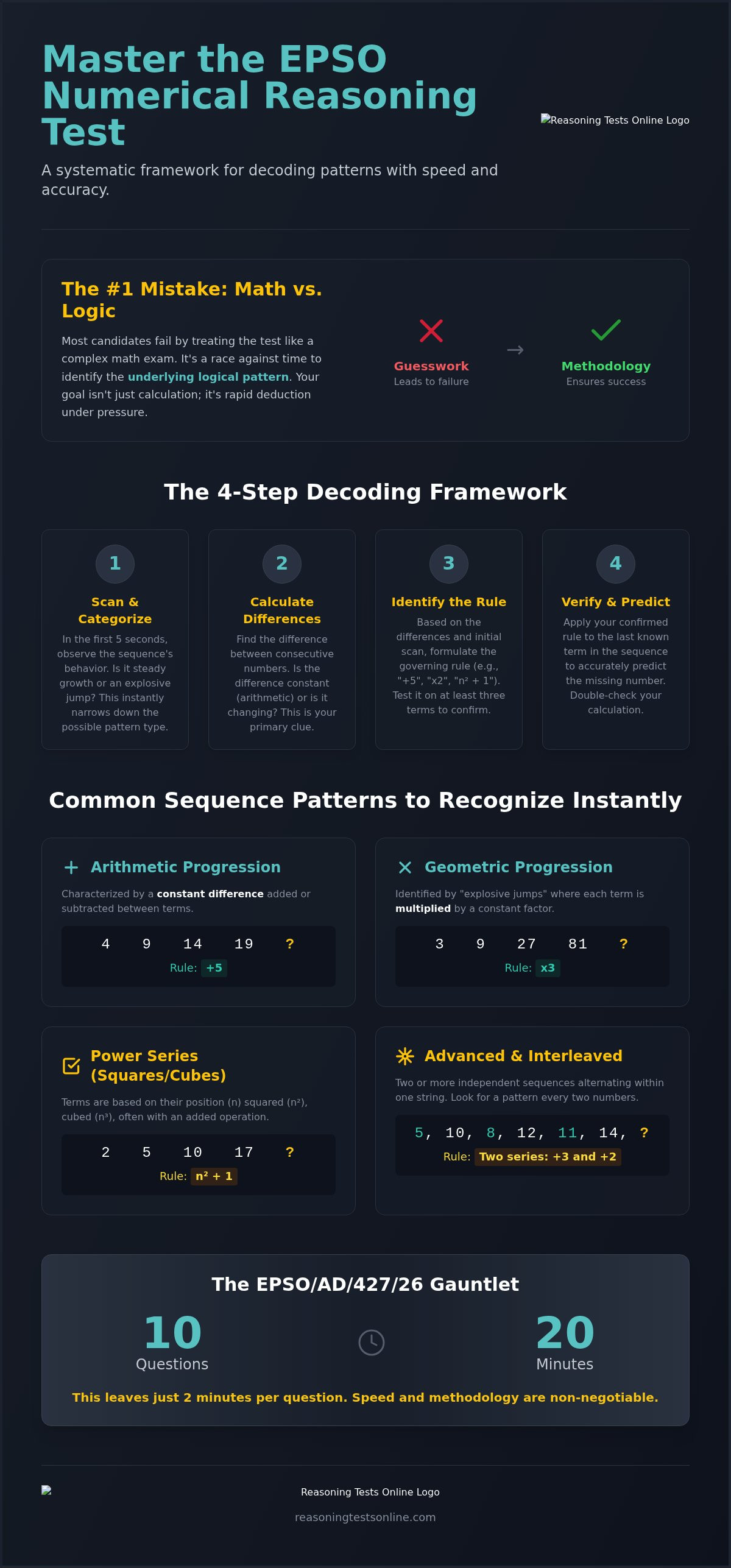
The 4-Step Decoding Framework for Speed and Accuracy
Success in an EPSO numerical sequence test isn't about being a math prodigy. It's about having a rigid system that replaces panic with procedure. When you're facing the 60-second limit per question on the TAO platform, you don't have the luxury of creative thinking. You need a repeatable framework to strip away the complexity and reveal the logic.
- Step 1: Scan the Growth Rate. Look at the first and last terms. Is the growth steady or explosive? Steady growth implies addition or subtraction. Explosive jumps signal multiplication, squares, or factorials.
- Step 2: Calculate the First Difference. Find the gap between the first three terms immediately. This identifies simple arithmetic progressions.
- Step 3: Test for Second-Order Logic. If the first gap isn't constant, check the "gap of the gaps." This exposes the hidden sequence within the sequence.
- Step 4: Verify the Hypothesis. Apply your discovered rule to the final known term. If it produces the correct result, you've found the logic.
The 10-Second Scan: Initial Assessment
Your first move should be a visual categorization of the sequence's steepness. This allows you to eliminate impossible options before you even perform a calculation. If the numbers are decreasing, ignore any answer choices that are larger than the last term. Scanning the whole sequence reveals the trajectory, whereas looking only at the first two numbers often hides the true rule. This high-level view prevents you from getting bogged down in local anomalies that exam designers use as distractors.
Avoiding the "Distractor" Trap
Exam designers are experts at creating plausible but wrong answers. They often include options that result from common mistakes, such as adding when you should have multiplied. If you look at the multiple-choice options before solving the logic, you'll likely fall for one of these traps. You should Improve your reasoning accuracy by solving the logic independently first. Once you have your number, find the match in the list. This logic-first approach is the most efficient way to maintain speed and accuracy. To sharpen these skills, you can practice with Numerical Reasoning Tests that mirror the specific difficulty of the AD5 competition.
Building Muscle Memory: Practicing for EPSO/CAST Success
Passive reading is the fastest route to failure in EU selection procedures. You cannot learn to solve a numerical sequence test by simply reviewing examples in a textbook. Success requires active simulation to bridge the gap between understanding a logical rule and executing it under high-pressure conditions. The EPSO AD5 2026 competition format provides exactly 20 minutes for 10 numerical questions. If you haven't conditioned your brain to identify the logic within the first 60 seconds, you will likely run out of time before reaching the final question.
High-quality simulation software is essential because it mimics the actual TAO assessment platform used in remote testing. Practicing on paper is a common mistake; it fails to prepare you for the digital interface, the on-screen timer, and the specific navigation required during the exam. Use your practice sessions to gather performance data. If you consistently struggle with interleaved patterns or second-order differences, you must dedicate your training blocks to those specific weak points. Tracking your accuracy rates allows you to move from general study to targeted mental training.
From Logic to Instinct
Repetitive practice transforms conscious calculation into subconscious instinct. By running daily speed drills, you create mental shortcuts for common square series, factorials, and prime number distractors. This "muscle memory" is what allows top candidates to remain calm when they encounter a complex string. Don't just check if your answer is correct. You must study the detailed logic-based explanations for every question to correct faulty reasoning patterns. If you understand the specific architecture of every sequence, you'll stop relying on luck and start relying on a system.
Preparing with Realistic Simulations
Computer-Based Testing (CBT) requires a higher level of mental agility than traditional formats. You must manage digital scratchpads and maintain focus while the clock is visible on your screen. You can build this necessary exam-day confidence by using Reasoning Tests Online simulations. These tools provide the realistic environment needed to turn your preparation into a tangible strategic advantage. Before you sit for the actual competition, ensure you have completed enough simulations to make the 4-step decoding framework second nature.
Final readiness checklist for the CAST or AD5 numerical sequence test:
- Can you identify an interleaved series within 15 seconds?
- Have you memorized prime numbers up to 50?
- Is your verification step taking less than 10 seconds?
- Have you practiced on a digital platform that mimics the TAO interface?
Secure Your Place on the AD5 Reserve List
Success in the EPSO/AD/427/26 competition depends on your ability to replace guesswork with a systematic methodology. You now have the 4-step framework to decode any numerical sequence test and the tactical knowledge to spot interleaved or second-order patterns before they drain your time. Mastery is not about raw mathematical talent. It's about developing the mental agility to maintain accuracy under the intense pressure of the 60-second-per-question limit.
True readiness comes from shifting your focus from passive study to active simulation. You must train in an environment that mirrors the actual TAO platform to ensure your logic remains sharp on exam day. Master the EPSO Numerical Sequence Test with our realistic simulations to build the muscle memory you need. Our specialized packages for AD5, AD7, and CAST provide timed simulations and detailed logic-based explanations for every answer.
You've done the work to understand the mechanics of these tests. Now, apply that knowledge through disciplined practice to secure your future in the EU civil service. With the right tools and a results-driven mindset, you can navigate the selection process with total confidence.
Frequently Asked Questions
What is a numerical sequence test exactly?
A numerical sequence test is a logic-based assessment where you must identify the missing term in a string of numbers. It measures your inductive reasoning by requiring you to deduce a hidden rule from the provided data. These tests are a standard component of the pre-selection phase for EU careers.
How much math do I need to know for a numerical sequence test?
You only need a firm grasp of basic arithmetic, including addition, subtraction, multiplication, and division. The challenge isn't the complexity of the math but the logic required to find the pattern. If you can recognize primes, squares, and cubes quickly, you have the necessary foundations for success.
How can I solve a number series faster during an exam?
Use a 10-second visual scan to categorize the growth rate before you start any calculations. Identifying whether the sequence is steady or explosive narrows your search for the correct operator. Building muscle memory through timed simulations will help you recognize these structures instinctively without wasting time on guesswork.
What are the most common patterns in EPSO numerical tests?
Arithmetic progressions and geometric jumps are the most frequent structures you'll encounter. However, the AD5 competition often uses interleaved series and second-order differences to increase difficulty. Mastering these advanced patterns is essential if you want to reach the 1,490 places on the reserve list.
What should I do if I cannot find the pattern in 30 seconds?
Flag the question and move to the next one immediately to protect your time. Getting stuck on a single difficult sequence is a primary reason candidates fail to finish the sub-test. You can return to flagged items later if your 20-minute limit hasn't expired.
Can I use a calculator for numerical sequence tests?
Yes, the TAO assessment platform provides a basic on-screen calculator during the exam. While it's available, you shouldn't rely on it for every step. Mental arithmetic is usually faster for identifying the logical rules behind strings of smaller numbers.
Are these tests the same as numerical reasoning tests?
A numerical sequence test is a specific sub-type of numerical reasoning that focuses on logical strings rather than data interpretation from tables or charts. While general reasoning tests evaluate your ability to handle statistics, sequence tests isolate your pattern recognition and inductive logic skills.
How many questions are usually in a sequence test?
The current EPSO AD5 competition format includes 10 questions to be completed within a 20-minute window. This gives you an average of two minutes per question, but you should aim to solve simpler patterns faster. Saving time on easy sequences allows you to tackle complex second-order problems with more focus.


