

Pattern recognition is not an innate gift; it is a clinical discipline. Most candidates approach the EPSO exam hoping for a moment of sudden insight, only to find their 60-second window has evaporated before they can even identify the first rule. It's a common frustration to spot a single movement but miss the secondary logic that ultimately determines the correct answer. You aren't failing because you lack talent. You're failing because you lack a repeatable process.
This guide will transform your approach to abstract reasoning pattern recognition by replacing intuition with a rigorous, systematic framework. You'll learn how to deconstruct any matrix into its core logical components, ensuring you never miss a hidden rule under pressure. We will examine the specific methodologies required for high-stakes exam success and provide a tactical roadmap to turn guesswork into predictable accuracy. By the end of this article, you will have the tools to approach the test with the calm precision of a seasoned strategist.
Key Takeaways
- Replace intuition with a systematic logic that treats pattern recognition as a trainable cognitive skill rather than a fixed talent.
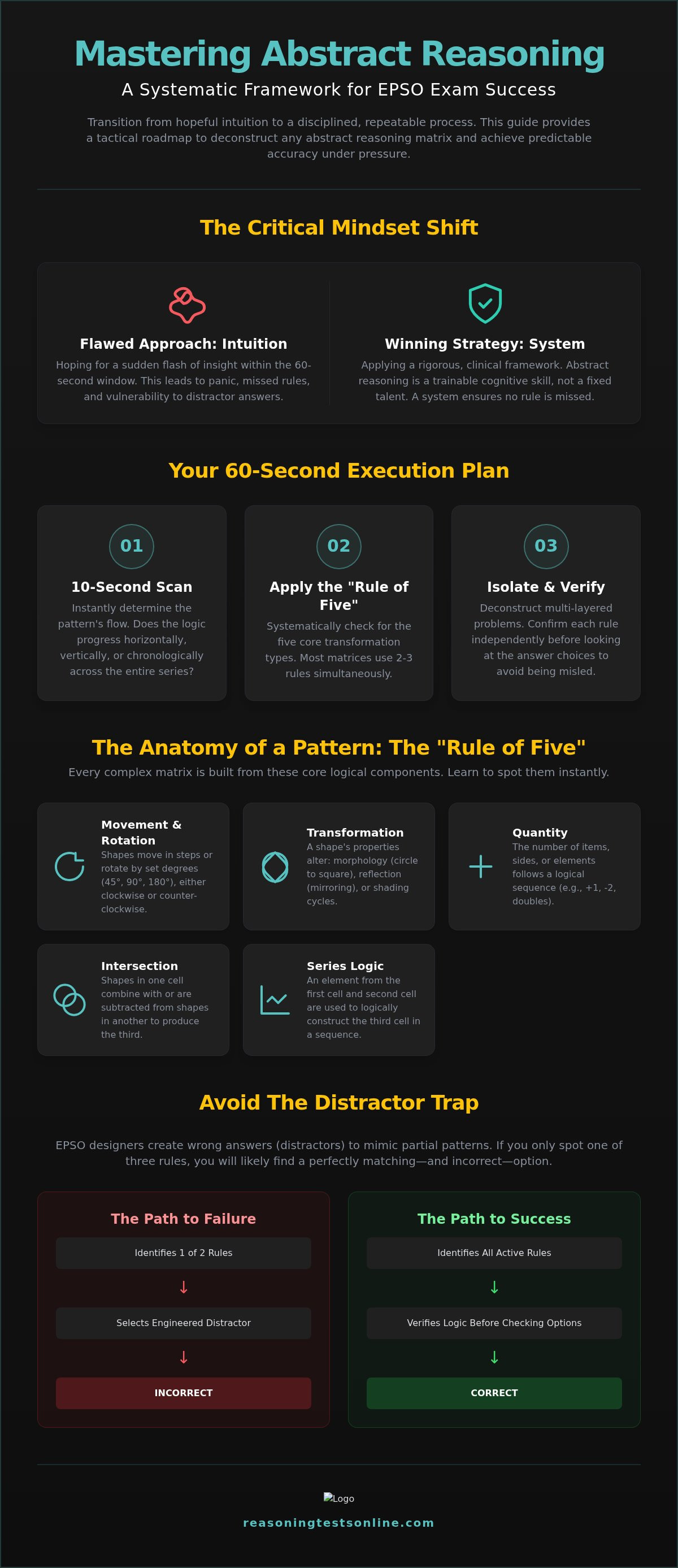
- Learn the "Rule of Five" to accelerate your abstract reasoning pattern recognition by identifying common transformations such as movement, quantity, and intersection.
- Adopt a 10-second scanning protocol to quickly determine if a question requires horizontal, vertical, or chronological analysis.
- Utilize the "Isolate and Verify" technique to deconstruct multi-layered matrices and maintain accuracy within the strict 60-second time limit.
- Transition from theory to mastery by using realistic exam simulations that mirror the exact interface and pressure of EPSO competitions.
Decoding Abstract Reasoning: Why Pattern Recognition is a Trainable Skill
Many candidates view the EPSO exam as a test of an unchangeable IQ. They believe you're either born with the ability to see shapes moving in a grid or you aren't. This is a misconception that costs high-potential applicants their careers. Abstract reasoning pattern recognition is not a fixed trait; it's a cognitive discipline. It is the ability to identify consistent logical rules within non-verbal data, and like any other technical skill, it can be mastered through systematic training.
Success in these exams requires moving beyond intuition. You need a library of mental models. These are pre-defined categories of rules, such as rotation, mirroring, or arithmetic progression, that you can apply to any matrix. When you stop looking for "the answer" and start looking for "the rule," the complexity of the shapes begins to dissolve. This shift in perspective replaces panic with a methodical search for logic.
The Fluid Intelligence Factor
EU institutions prioritize abstract reasoning because it measures fluid intelligence. This is your capacity to solve novel problems and identify patterns without relying on crystallized knowledge or past experience. Unlike verbal or numerical tests that might favor specific educational backgrounds, abstract tests provide a level playing field. They predict how well you'll handle the complex, ambiguous environments common in AD5 and AD7 roles.
Targeted practice doesn't just make you "smarter." It expands your cognitive search space. By exposing your brain to hundreds of variations, you build muscle memory for logic. You learn to filter out irrelevant details and focus on the mechanics of the change. This transition from slow, conscious thought to rapid, instinctive recognition is the hallmark of a successful candidate. It turns a 60-second time limit from a threat into a manageable window.
Why Guessing Fails the EPSO Exam
With a strict limit of roughly 10 questions in 10 minutes, the pressure to guess is immense. However, guessing is a statistical trap. EPSO test designers don't create wrong answers at random. They use distractors specifically engineered to mimic partial patterns. If you identify only one rule out of three, you'll likely find an answer choice that fits that single rule perfectly, leading you straight to a wrong selection.
- Partial Patterns: Distractors often satisfy one rule but violate the second or third hidden logic.
- Visual Noise: Extra shapes are added to distract you from the primary transformation.
- Systemic Decay: Anxiety causes you to abandon your methodology, making you vulnerable to "near-miss" errors.
Mastery means finding the complete rule set before you even look at the options. If you don't have a reliable system to deconstruct the matrix, you aren't competing; you're gambling. Success comes from the discipline to isolate every element before making a final choice.
The Anatomy of a Pattern: 5 Core Rules in Abstract Reasoning Matrices
High-stakes exams don't rely on infinite logic. They utilize a finite set of rules designed to overwhelm the untrained eye. We categorize these into the "Rule of Five." Every matrix you encounter in an EPSO competition will rely on movement, transformation, quantity, intersection, or series logic. Most often, two or three of these rules operate simultaneously. If you only spot the movement but ignore the quantity shift, you will select a distractor. Refined abstract reasoning pattern recognition requires you to isolate each rule before committing to an answer.
Movement and Rotation Patterns
Shapes move with clinical precision. Rotation typically occurs in 45, 90, or 180-degree increments, moving either clockwise or counter-clockwise. You must also watch for the "Leapfrog" movement, where a shape skips exactly one cell or one position in a sequence. Distinguish between external movement, where the shape changes its coordinates within the grid, and internal rotation, where the shape stays in its cell but spins on its axis. If a shape moves two spaces while rotating 90 degrees, you've identified a compound rule.
Transformation and Color Logic
Transformation patterns involve the systematic alteration of a shape’s fundamental properties, such as its morphology from a circle to a polygon or the sequential progression of internal shading through a defined spectrum of intensity. Color logic isn't random; it follows a predictable cycle, such as white to grey to black. Look for symmetry and reflection where the third cell mirrors the first. Identifying these shifts quickly is easier when you practice with specialized abstract reasoning tests that mimic these specific EPSO visual styles.
Arithmetic and Additive Logic
This is the most technical category of the five. Additive logic occurs when elements from the first and second cells combine to create the third. However, the "Exclusive OR" (XOR) rule is a more common challenge. In this scenario, any element that appears in both of the first two cells disappears in the third, while unique elements are retained. You must also track quantity patterns. Count the number of sides, lines, or dots. If the total number of sides in the first two cells equals the number in the third, you've cracked the arithmetic logic.
Mastering these rules turns a chaotic grid into a series of logical checkmarks. Don't look for the "vibe" of the pattern. Look for the mechanics of the change. Once you categorize the rule, the correct answer becomes the only logical possibility.
Matrices vs. Sequences: Adapting Your Logic to Different Formats
You cannot use the same mental gears for a grid that you use for a line. One of the most common pitfalls in abstract reasoning pattern recognition is failing to adapt your strategy to the specific format of the question. While both matrices and sequences rely on the core rules we've already identified, the way those rules manifest depends entirely on the layout. EPSO AD competitions frequently lean toward complex 3x3 matrices, while CAST exams may feature more linear series. Understanding the structural logic of each is the difference between a calculated answer and a frantic guess.
A matrix is a spatial puzzle where logic must remain consistent across multiple axes. A sequence is a chronological narrative where a shape evolves from one step to the next. If you try to read a matrix like a story from top-left to bottom-right without checking the vertical columns, you'll miss the "Two-Way" logic that defines high-difficulty questions. Mastery requires the flexibility to switch your analytical approach the moment a new question loads on your screen.
Cracking the 3x3 Matrix
The 3x3 grid is the standard for testing multi-layered logic. To solve these, you must employ the "Two-Way Check" method. This means any rule you identify in the first row must be verified in the second row and, crucially, checked for vertical consistency in the columns. If a rule only works horizontally, it's likely a distractor designed to lead you to a wrong answer.
- The Null Cell: Sometimes, the third cell in a row represents the "result" of the first two, leading to an empty or simplified cell if an XOR rule is applied.
- Global Patterns: Watch for rules that apply to the entire 9-cell grid rather than individual rows. For example, the total number of black dots might increase by one in every cell regardless of the row.
- Diagonal Logic: In the most difficult EPSO AD7 questions, patterns may occasionally move diagonally. Only look for this if horizontal and vertical checks fail.
Mastering the Series/Sequence
Linear sequences require you to track a "story" of change across five or more frames. Unlike the matrix, which is often self-contained within a row, a sequence is cumulative. You must distinguish between 'A-B-A-B' patterns, where two states alternate, and 'A-B-C-D' progressions, where a shape moves or transforms continuously.
Pay close attention to "wraparound" logic. This occurs when a shape reaches the edge of a cell or the end of a color spectrum and starts over. If a square moves one step right in every frame, in the final frame, it will "wrap" back to the far-left position. You should also be prepared for "Odd One Out" tasks, where the goal isn't to find the next step, but to identify which frame violates the established progression. This requires you to define the rule first, then audit each frame against that definition.
The 60-Second Execution: How to Spot Patterns Under Exam Pressure
The EPSO countdown timer is more than a clock; it's a psychological weapon designed to induce panic. When the seconds start ticking away, your brain's natural tendency is to rush, which leads to the "near-miss" errors we discussed earlier. Developing rapid abstract reasoning pattern recognition requires a tactical execution plan that works when your adrenaline is high. You don't need more time; you need a better protocol for the time you have.
Your first step is the 10-second Scanning Protocol. Instead of trying to solve the puzzle immediately, spend the first ten seconds identifying the "active" elements in the matrix. Look for the most complex shape and the most frequent color. By categorizing the question type before diving into the logic, you prevent your mind from wandering down irrelevant paths. Once you've identified the likely rule type, use the "Isolate and Verify" technique. Pick a single element, trace its logic across the grid, and ignore everything else until that specific rule is confirmed.
Muscle memory in cognitive testing is the subconscious ability to categorize visual transformations instantly, allowing the conscious mind to focus on verifying the logic rather than discovering it. This level of automation is what separates successful candidates from those who run out of time.
The Systematic Elimination Strategy
Looking at the answer choices too early is a tactical error. The distractors are engineered to look plausible to someone who has only found half of the pattern. You should only look at the options after you've identified at least one definitive rule. Use that rule to immediately eliminate three or four of the five choices. If you find yourself staring at a blank grid for more than 15 seconds without a single lead, flag the question and move on. Maintaining your momentum is more important than solving any single difficult item.
Building Cognitive Endurance
Mental fatigue often sets in halfway through the reasoning battery. To combat this, your training must focus on volume and intensity. Practicing 50 questions in a single sitting is significantly more effective than doing 5 questions 10 times throughout the day. You need to experience the "mid-test dip" during your preparation so you can develop the focus needed to push through it on exam day. To build this level of stamina, you should use realistic abstract reasoning simulations that mirror the exact interface and pressure of the EPSO environment. Consistent exposure to these conditions is the only way to refine your abstract reasoning pattern recognition to the point of instinctive mastery.
Beyond Theory: Building Mastery with EPSO-Style Simulations
Theory provides the framework, but simulation provides the success. Understanding the "Rule of Five" is only the first step in your preparation. To survive the official EPSO interface, you must apply these concepts under the exact conditions used by EU selection boards. Reasoning Tests Online serves as a specialist coach, bridging the gap between passive knowledge and active, high-speed execution. Our platform is built to demystify the mechanics of the exam, ensuring your abstract reasoning pattern recognition becomes a reflexive skill rather than a conscious struggle.
Generic prep kits often fail because they don't mimic the specific difficulty curve or the visual interface of the actual competition. Success requires more than just seeing patterns; it requires seeing them while the clock is ticking. By treating your preparation like an athletic endeavor, you move beyond the "innate gift" myth and start building the technical proficiency required for an EU career.
The Reasoning Tests Online Advantage
Our simulations are precisely calibrated for AD5, AD7, and CAST profiles, reflecting the specific complexity levels found in each competition. We provide more than just a score. Every question includes a detailed explanation that deconstructs the underlying logic of the matrix. We show you exactly how to isolate the primary rule and ignore the distractors. This transparency turns every mistake into a strategic advantage for your next attempt.
- Realistic Timed Environments: Practice with the standard 10-questions-in-10-minutes limit to build your pacing and reduce test-day anxiety.
- Logic-Focused Explanations: Learn the "why" behind every transformation to improve your mental models for abstract reasoning pattern recognition.
- Performance Tracking: Identify which rule types, such as XOR logic or complex rotations, are your current weaknesses to focus your training.
Your Path to EU Selection
Mastery requires a transition from accuracy to speed. In your initial training phase, focus on deconstructing matrices without the timer to solidify your understanding of the rules. Once you achieve high accuracy, shift your focus to our timed drills. This environment is where you build the muscle memory required for the real exam. You learn to trust your systematic framework even as the countdown clock reaches its final seconds.
Don't leave your career to chance or intuition. Success in EU competitions is the result of disciplined, systematic preparation. You have the framework; now you need the training ground. Start your EPSO Abstract Reasoning practice today and replace guesswork with a methodology designed for high-stakes results.
Transform Logic into Your Strategic Advantage
Success in EPSO competitions isn't a matter of luck. It's the result of transforming abstract reasoning pattern recognition from a stressful guessing game into a clinical methodology. You've learned that by deconstructing matrices into the Rule of Five and applying a strict scanning protocol, you can bypass the psychological pressure of the 60-second timer. The difference between a candidate who passes and one who fails is the quality of their mental training. If you rely on intuition, you remain vulnerable to engineered distractors. If you rely on a system, you achieve predictable accuracy.
Don't leave your AD5, AD7, or CAST results to chance. Our platform offers specialized verbal, numerical, and abstract reasoning tests designed specifically for the EPSO interface. These timed simulations mimic actual exam conditions and provide detailed logic-based explanations to replace guesswork with mastery. You have the framework; now you need the drills to build the muscle memory required for high-stakes execution. This systematic approach is what turns an overwhelming challenge into a manageable task.
Master Abstract Reasoning with Realistic EPSO Simulations
Your path to a career in the EU institutions starts with the right system. Start your preparation now and approach your exam with the calm precision of a strategist.
Frequently Asked Questions
What is the best way to start learning abstract reasoning pattern recognition?
The most effective starting point is to deconstruct matrices without the pressure of a timer. Focus on isolating a single variable, such as rotation or quantity, before attempting to solve the entire puzzle. Once you can consistently identify individual rules, you should transition to timed simulations. This phased approach ensures you build a solid logical foundation before focusing on the speed required for the exam.
How many patterns are typically used in an EPSO abstract reasoning question?
Most EPSO questions utilize two or three overlapping rules within a single matrix. A common configuration might combine a movement rule with a color progression and a quantity shift. Identifying only one of these rules is a strategic trap that often leads you to a distractor. You must verify every logical component before you select your final answer choice.
Can I improve my abstract reasoning score if I'm not a 'math person'?
Yes, because abstract reasoning pattern recognition is a visual and logical discipline rather than a mathematical one. While some patterns use simple additive logic, the majority rely on spatial transformations and shape morphology. Success depends on your ability to apply a systematic framework to visual data, which is a skill that can be developed through targeted mental training.
What is the difference between abstract reasoning and spatial awareness?
Abstract reasoning requires you to identify the underlying logical rules and sequences that govern a change. Spatial awareness is the ability to mentally manipulate and rotate three dimensional objects. While they overlap, abstract tests are more about the "why" and "how" of a transformation. You're solving a logic puzzle based on consistent rules rather than just visualizing a shape in space.
How much time should I spend on each abstract reasoning question during the EPSO exam?
You should aim for an average of 60 seconds per question to complete the 10-question battery on time. Use a 10-second scanning protocol to categorize the rule type, followed by 40 seconds of isolation and verification. If you haven't identified the complete pattern by the 50-second mark, use the elimination strategy to make an educated guess and move to the next item.
Why do I keep failing the abstract reasoning section even though I understand the rules?
Failure usually happens because of a gap between theoretical knowledge and practical execution under pressure. Understanding the rules is only half the battle; you must be able to apply them instinctively within a strict time limit. If you're struggling, you likely need more realistic simulation practice to build the muscle memory and cognitive endurance required for the actual exam environment.
Are the abstract reasoning tests for AD7 harder than for AD5?
Yes, AD7 questions generally feature more "visual noise" and a higher number of overlapping rules per matrix. While the core logic remains consistent with the AD5 level, the complexity of the transformations is increased to test higher-level fluid intelligence. Your preparation should involve practicing with difficulty levels that specifically match the grade of the competition you are entering.
Does the EPSO CAST exam use the same pattern recognition logic as the AD competitions?
The fundamental logic is identical across all EPSO competitions, including CAST and AD. However, the CAST exam often places a heavier emphasis on linear sequences rather than the 3x3 matrices found in AD5 and AD7 tests. Regardless of the competition format, the core abstract reasoning pattern recognition skills you develop will be applicable to any non-verbal reasoning task you encounter.


