

Relying on raw intuition is the fastest way to fail a senior-level cognitive assessment. You've likely practiced until basic patterns feel like second nature, yet you still find yourself hitting a score plateau or staring blankly at the final five questions as the timer runs out. It's frustrating to realize that the strategies which worked for entry-level exams aren't enough for advanced abstract reasoning tests. At this level, the exam isn't checking your general logic; it's measuring your ability to filter out deliberate distractors while the clock ticks down.
We know the intense pressure of the EPSO AD7 and CAST competitions. You need a system that replaces guesswork with precision. This article provides a professional framework for deconstructing any visual sequence, no matter how complex the matrix. We will explore the "pattern-stripping" method, tactics for building cognitive muscle memory, and the specific time-management shifts required to solve these puzzles in under 60 seconds. It's time to stop guessing and start mastering the mechanics of high-stakes logic.
Key Takeaways
- Identify the shift from simple rotations to multi-layered transformations where color, position, and quantity change concurrently.
- Master the "Component Method" to systematically isolate individual shapes and bypass complex visual distractors.
- Implement the "60-Second Rule" to maintain momentum and ensure you don't run out of time on the final questions.
- Build cognitive muscle memory through high-fidelity simulations specifically designed for advanced abstract reasoning tests.
- Transition from intuitive guessing to a systematic framework for deconstructing any complex visual matrix.
Beyond the Basics: What Makes an Abstract Reasoning Test 'Advanced'?
Entry-level assessments often focus on simple spatial awareness, such as rotating a single shape or identifying a basic sequence. However, advanced abstract reasoning tests operate on an entirely different level of complexity. These exams move beyond basic visual puzzles into multi-layered logical systems where several rules interact simultaneously. If you're preparing for a senior-level position, you aren't just looking for the next shape; you're deconstructing a sophisticated algorithm.
In these high-stakes environments, patterns rarely follow a single rule. Instead, you'll encounter concurrent transformations where color, position, and quantity all change at once. A square might rotate 90 degrees clockwise while its fill color alternates between three shades and its total count increases by a prime number. To make matters worse, examiners include "distractor" elements. These are shapes that appear to follow a pattern but are actually irrelevant to the solution. Their only purpose is to consume your limited time and induce mental fatigue.
Fluid Intelligence vs. Rule Mastery
Many candidates believe that high fluid intelligence, or raw IQ, is enough to pass. This is a common misconception. While fluid intelligence helps you process new information, it often fails when you're under extreme time pressure. Success requires a transition from intuitive "seeing" to methodical "decoding." You shouldn't wait for the answer to jump out at you. Instead, you must apply a specific methodology to strip away the noise. Rule mastery is the ability to isolate variables in a matrix to identify the underlying logic without being misled by visual clutter.
The EPSO AD7 Challenge: Complexity Under Pressure
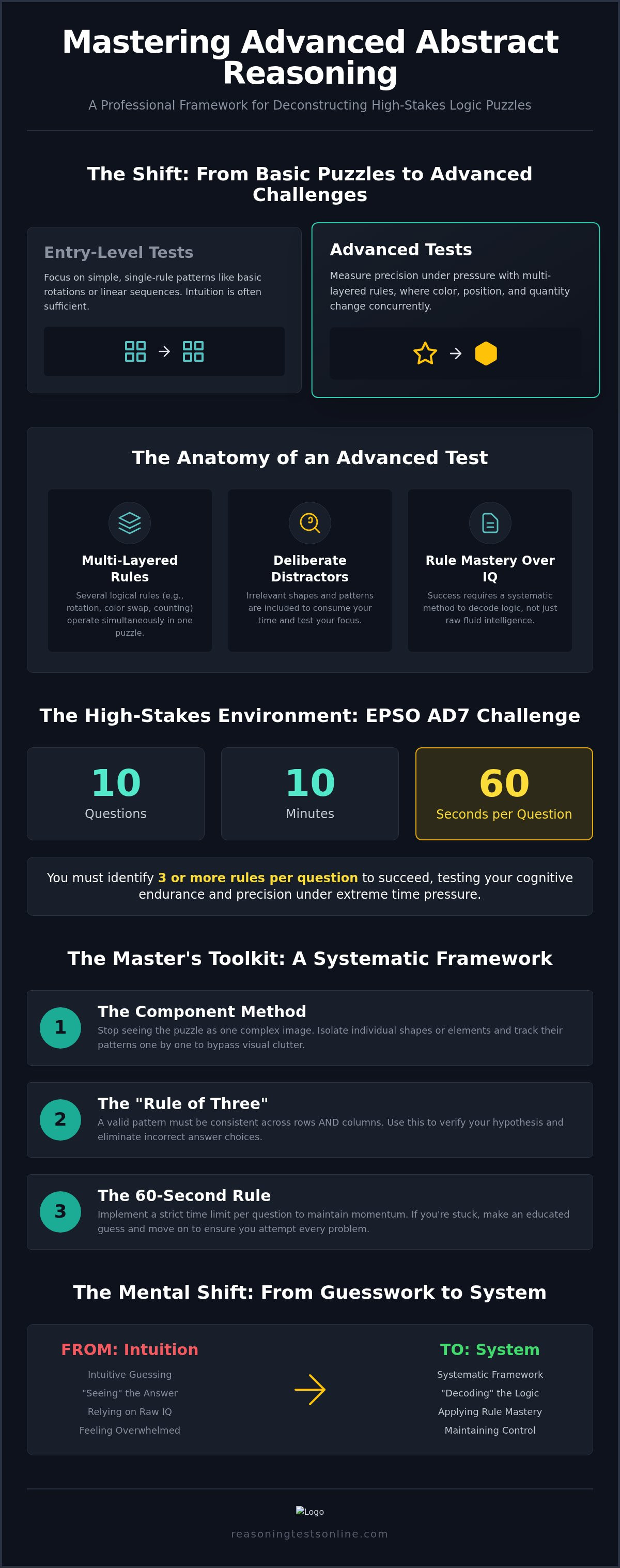
For those targeting the EPSO AD7 Administrator tier or senior management roles, the difficulty spikes significantly. These tests differentiate senior leaders from generalists by testing cognitive endurance and precision. In an AD7 competition, you typically face 10 questions in just 10 minutes. This 60-second window leaves no room for hesitation or trial-and-error. You need to identify three or more rules per question while maintaining perfect accuracy.
Selection boards use these tests because they effectively predict professional problem-solving capability. A candidate who can navigate a complex visual matrix can likely navigate a complex organizational crisis. It's about how you handle information density. By mastering these advanced abstract reasoning tests, you prove you have the mental discipline to filter out distractions and focus on the core variables that drive results.
Decoding the DNA of Complex Visual Matrices
Visual chaos in a 3x3 matrix is rarely random. In advanced abstract reasoning tests, complexity is a deliberate mask designed to hide a series of simple, combined logical steps. To succeed, you must stop viewing the matrix as a single image and start seeing it as a layered data set. Most high-stakes questions utilize at least three distinct rules operating at once. If you only identify two, you'll likely fall for a distractor answer that satisfies the partial logic but fails the complete sequence.
The "Rule of Three" is your primary diagnostic tool. In a standard matrix, the logic must remain consistent across horizontal rows and vertical columns. Occasionally, senior-level exams introduce diagonal consistency to increase difficulty. If a pattern holds true from left to right but breaks when moving top to bottom, you haven't found the primary rule yet. Look for symmetry, overlapping subtraction, or conditional movement where the behavior of one shape is dictated by the presence of another. This systematic approach turns a confusing puzzle into a solvable equation.
Advanced Movement and Transformation Rules
Movement in advanced matrices goes beyond simple clockwise rotation. You'll often encounter progressive rotation, where the angle of change increases with each step; for example, 45 degrees, then 90, then 135. Oscillating patterns are also common, where a shape moves back and forth between two positions while a separate rule dictates its color or size.
Pay close attention to color-swapping logic. In many cases, the "fill" of a shape follows a different trajectory than its "border." You might also encounter the "Ghost Rule," where the pattern is defined by what is missing from a sequence rather than what is present. If you're struggling to find the logic, try practicing with high-fidelity simulations to build the mental agility required for these transformations.
Arithmetic and Numeric Representation in Shapes
At the AD7 or senior management level, shapes often function as numeric placeholders. You aren't just looking at triangles or squares; you're looking at the numbers three and four. Patterns may rely on summing the number of sides, points, or intersections between overlapping lines.
Additive Logic is a frequent hurdle where two shapes in a row combine to form the third. However, the most challenging variation is "Exclusive OR" (XOR) logic. In an XOR pattern, when two shapes overlap, the parts they share in common disappear in the final frame, while the unique parts remain. Spotting these arithmetic rules quickly is the difference between finishing the exam and guessing on the final five questions. Mastery comes from recognizing these "DNA" markers instantly, allowing you to strip away the visual noise and identify the correct solution within seconds.
Strategic Comparison: Diagnostic Tools vs. High-Stakes Simulations
Practicing with generic IQ puzzles might feel productive, but it often provides a false sense of security. There is a massive gap between solving a pattern in a relaxed environment and navigating advanced abstract reasoning tests during an official EPSO competition. Generic tools prioritize "learning the rules" at a leisurely pace. High-stakes simulations, however, force you to perform under the clock, mimicking the exact cognitive load you'll face on exam day. If your practice material doesn't scale in difficulty or replicate the pressure of the AD7 interface, you aren't training; you're just playing games.
Effective preparation requires identifying your specific "logic blind spots." You might be an expert at identifying rotations but struggle with overlapping subtraction or XOR logic. A professional simulation doesn't just give you a score; it provides a diagnostic breakdown of where your methodology fails. When evaluating practice materials, look for three critical factors:
- Accuracy: The patterns must mirror the complexity of current EPSO standards.
- Difficulty Scaling: You need to move from AD5 generalist levels to AD7 administrator complexity.
- Explanation Depth: A correct answer is useless if you don't understand the underlying system that produced it.
Generic Aptitude Tests vs. Exam-Specific Simulations
Practicing with materials that are too easy is a common pitfall. If you're targeting a senior-level position, entry-level puzzles won't build the necessary mental stamina. Interface familiarity is also a hidden advantage. Navigating the computer-based testing (CBT) environment should be second nature before you walk into the assessment center. For those targeting specific tracks, integrating EPSO CAST exam preparation into your routine ensures you're familiar with the exact format and logic patterns used in those competitions.
Accuracy vs. Speed: Finding the Equilibrium
Many candidates fall into the "Accuracy Trap." They spend two minutes meticulously deconstructing a single matrix to ensure they get it right. In an AD7 exam, where you have 10 minutes for 10 questions, this is a failing strategy. You must find an equilibrium where your recognition happens almost instantly. Speed is a byproduct of efficient pattern recognition, not rushing. If your diagnostic scores show high accuracy but low completion rates, you need to shift from logic training to intense speed drills. High-fidelity simulations help you build the muscle memory required to maintain precision while the timer counts down.
The Master's Toolkit: Systematic Elimination and Pattern Recognition
Success in advanced abstract reasoning tests isn't about brilliance; it's about discipline. You need a repeatable protocol that works when your brain is tired and the timer is red. Raw intuition often fails under pressure. Instead, you must rely on a toolkit designed to strip away visual complexity and reveal the underlying logic. This process begins with the Component Method.
The Component Method requires you to isolate one single element within the matrix. If a cell contains a circle, a square, and a line, track only the circle across the sequence. Ignore everything else. Once you find the circle's rule, look at the answer options. Eliminate every choice that doesn't fit that specific rule. Repeat this for the next element. Usually, identifying just two rules is enough to leave only one possible answer. This systematic approach prevents your brain from being overwhelmed by the total image.
You should also employ the End-State strategy. Before looking at the multiple-choice options, try to predict what the final frame should look like. Looking at the answers too early allows "distractor" shapes to plant false logic in your mind. If you can visualize the result, you'll spot the correct answer instantly. This level of precision requires deep mental training. You can access specialized abstract reasoning tests to build the high-volume repetition needed to turn these tactics into second nature.
The 60-Second Drill: Managing the Countdown
Time management is the ultimate differentiator in senior-level exams. In an AD7 competition, you have exactly 60 seconds per question. You cannot afford to get stuck. If you haven't identified at least one rule within 30 seconds, you are in the "danger zone." At 45 seconds, if the logic remains opaque, make an educated guess and move on. Protecting your total score is more important than winning a battle against a single "impossible" question. Learn more about protecting your pace in our guide on EPSO exam time management.
Eliminating 'Distractors' with Surgical Precision
Examiners design distractor options to look "almost correct." They might follow two out of three rules perfectly. To avoid these traps, use Negative Selection. Instead of looking for the right answer, look for reasons why an option is wrong. This shift in perspective makes you more observant of small details like line thickness or subtle color shifts. Focus on the primary rule you've identified. If an option violates it, discard it immediately. By narrowing the field through elimination, you increase your mathematical probability of success even when the full logic remains partially hidden.
Elevating Your Performance with Reasoning Tests Online
Theory is a starting point, but performance is what secures the position. You can memorize every possible logical transformation, yet still fail if you haven't trained under realistic conditions. High-stakes exams like the EPSO AD7 or CAST competitions require more than just knowledge. They demand a level of mental agility that only comes from high-fidelity simulation. Reasoning Tests Online provides the specialized tools you need to bridge the gap between understanding a rule and executing it under pressure.
Our platform doesn't offer generic brain teasers. We provide advanced abstract reasoning tests designed to mimic the exact difficulty scaling of senior-level EU selection processes. By practicing in an environment that replicates the actual exam interface, you eliminate the "surprise factor" on test day. This allows your brain to focus entirely on deconstructing matrices rather than navigating unfamiliar software.
Realistic EPSO Simulations for Every Competition Tier
We provide tailored practice for AD5, AD7, and CAST tiers. Each simulation uses the same time constraints and question density you'll face at the assessment center. For example, our AD7 simulations enforce the 10-question, 10-minute limit to ensure your pacing is perfect. Beyond the timer, our detailed performance analytics allow you to track your progress over time. You can see exactly which patterns, such as XOR logic or progressive rotation, are slowing you down. Start your advanced abstract reasoning practice today to refine your strategy with professional-grade diagnostics.
Detailed Explanations: Turning Mistakes into Muscle Memory
The most effective way to improve is to stop focusing on your score and start focusing on your errors. Our "Deep Explanations" provide a comprehensive walkthrough for every correct answer. We don't just tell you the answer is correct; we show you the exact sequence of rules that led to that conclusion. This transparency helps you build a mental library of common logical patterns, turning every mistake into an opportunity for growth.
Implementing a "Review Loop" is essential for the week before your exam. Spend as much time analyzing your wrong answers as you do taking the tests. This habit builds the cognitive muscle memory required to spot distractors instantly. Use this final checklist to ensure you're ready:
- Review your error logs to identify recurring logic blind spots.
- Complete three full-length timed simulations to cement your pacing.
- Refine your "Component Method" to ensure you can isolate shapes in under 10 seconds.
- Maintain a results-driven mindset; success is a product of systematic training, not luck.
Mastering the Mechanics of High-Stakes Logic
Securing a senior-level position in the EU civil service requires more than general aptitude. It demands a specialized system to decode multi-layered matrices under extreme time pressure. You've learned how to isolate individual components, identify complex XOR logic, and manage the 60-second countdown with surgical precision. Preparing for advanced abstract reasoning tests is no longer a matter of luck; it's a matter of methodology.
By shifting your focus from intuitive guessing to systematic deconstruction, you replace anxiety with confidence. The final step is to refine these skills in an environment that mirrors the real exam. Our platform offers specialized simulations for EPSO AD5, AD7, and CAST tiers. These tools provide the timed pressure and step-by-step logic needed to build true cognitive muscle memory through a no-guesswork methodology.
Master Advanced Abstract Reasoning with Realistic EPSO Simulations
Success is the direct result of disciplined preparation. Take control of your career trajectory by training with the professional tools used by successful candidates. You have the framework; now it's time to perform.
Frequently Asked Questions
What is the difference between basic and advanced abstract reasoning tests?
Basic tests focus on single transformations like simple shape rotation or color changes. Advanced tests move into multi-layered logic where three or more rules (position, quantity, and fill) operate simultaneously. These advanced abstract reasoning tests also include deliberate distractors designed to waste your time and induce mental fatigue. Success requires a systematic deconstruction of these complex variables rather than relying on raw intuition.
How many questions are typically in an EPSO AD7 abstract reasoning test?
An EPSO AD7 abstract reasoning test usually consists of 10 questions to be completed in a 10-minute window. This gives you exactly 60 seconds per question to identify the pattern and select the correct answer. Maintaining this strict pace is the most significant challenge for senior-level candidates. If you spend too long on a single matrix, you risk failing to complete the final section of the exam.
Can you actually improve your score on an abstract reasoning test through practice?
Yes, you can significantly improve your score by building cognitive muscle memory and pattern recognition skills. Systematic preparation helps you transition from "seeing" a puzzle to "decoding" a logical system. Practicing with high-fidelity advanced abstract reasoning tests trains your brain to strip away visual noise and identify underlying rules instantly. It's a trainable skill that rewards methodology over general intelligence.
What are the most common rules found in advanced abstract reasoning matrices?
Advanced matrices frequently utilize Exclusive OR (XOR) logic, arithmetic side-counting, and overlapping subtraction. You'll also encounter conditional movement, where the behavior of one shape depends on the position of another. Other common patterns include progressive rotations or alternating color-swapping logic. Mastery of these specific rules allows you to bypass the visual chaos and find the solution within the 60-second limit.
Should I guess if I cannot find the pattern in an advanced reasoning question?
Yes, you should always select an answer even if you're unsure of the logic. Most high-stakes exams, including EPSO competitions, don't use negative marking. Leaving a question blank is a guaranteed zero. If you can't find the pattern within 45 seconds, use the process of elimination to discard obviously wrong distractors. Make an educated guess and move to the next question to protect your overall score.
How do I manage my time during a 10-minute abstract reasoning simulation?
Implement a strict 60-second drill for every question. If you haven't identified at least one rule within the first 30 seconds, immediately switch to the Component Method to isolate individual shapes. If you reach the one-minute mark without a solution, guess and move on. Effective time management ensures you have the opportunity to answer every question rather than getting stuck on a single impossible pattern.
Is there a specific strategy for solving 3x3 matrices versus 2x2 sequences?
For 3x3 matrices, you must apply the "Rule of Three" by checking for consistency across horizontal rows and vertical columns. The logic must hold true in both directions. For 2x2 or linear sequences, focus on the progressive transformation from one frame to the next. Matrices are generally more complex because they require you to verify the logic across multiple axes simultaneously to avoid falling for distractors.
Why do I keep failing the last few questions of the abstract reasoning section?
Failing the final questions is usually a symptom of poor pacing or mental fatigue. If you spend too much time deconstructing early questions, you'll be forced to rush when the timer turns red. This pressure leads to careless errors and missed patterns. Developing cognitive stamina through timed simulations ensures you maintain the same level of precision and speed from the first question to the last.


