

Speed isn't the primary factor that causes candidates to fail the EPSO selection process. It's the lack of a repeatable system for verification. You've likely felt the anxiety of the ticking clock, watching seconds slip away while you're torn between two identical-looking options. This pressure often leads to inconsistent performance, where your practice scores don't translate to the high-stakes environment of the actual exam. Improving your EPSO reasoning test accuracy isn't about working faster. It's about training your brain to recognize patterns and ignore the "distractor" options designed to trip you up.
We understand the frustration of falling just short of a competitive ranking due to avoidable errors. You're looking for more than just practice questions; you need a strategy. This guide provides the tactical frameworks and mental training techniques you need to eliminate guesswork and achieve elite precision. You'll learn how to replace hope with a systematic approach to logic. We'll preview the specific methodologies used by top-tier candidates to maintain focus and build the muscle memory required for the 2026 CBT phase. It's time to stop guessing and start verifying your way to success.
Key Takeaways
- Understand why a 70% score is a "danger zone" and how to bridge the gap to an elite competitive ranking.
- Learn to dismantle cognitive traps like "half-right" statements and distractors that EPSO uses to mimic correct answers.
- Adopt a repeatable 5-step verification system to maximize your EPSO reasoning test accuracy and eliminate the need for guesswork.
- Apply the "Accuracy-First Principle" to balance the 60-second rule, ensuring logic-driven certainty over rushed guesses.
- Build essential muscle memory using realistic simulations to eliminate interface friction and anxiety during the actual CBT phase.
The Accuracy Gap: Why Most EPSO Candidates Fail the CBT Phase
Many candidates walk into the Computer-Based Testing (CBT) phase believing that "understanding the logic" is enough. It isn't. There is a massive chasm between solving a puzzle in a quiet room and executing under the intense pressure of a ticking clock. Most failures happen because of this execution gap. You might grasp the rules of a syllogism or a pattern in abstract reasoning, but if your process isn't automated, you'll hesitate. That hesitation is where errors begin. When the clock is visible and the stakes are high, your brain defaults to its most practiced habits. If those habits aren't rooted in a systematic framework, your performance will suffer.
Achieving an EPSO reasoning test accuracy of 70% might feel like a solid performance during practice, but in the context of competitive AD5 and AD7 slots, this is the "danger zone." When thousands of high-caliber applicants vie for a limited number of spots on the reserve list, a passing grade isn't the goal. You need a competitive ranking. A 70% accuracy rate usually indicates that your system relies on intuition rather than a repeatable framework. If you're guessing on three out of every ten questions, you're leaving your career to chance. You need to aim for 85% or higher to ensure you remain in the top tier of candidates.
Guessing also carries a hidden psychological cost. Once you make an "educated guess," a subtle spiral of anxiety begins. You start to doubt your previous answers. You rush the next question to make up for lost time. This lack of certainty erodes your focus. To succeed, you must transition from a passive learner who simply reviews material to a strategic test-taker who masters the testing environment. This shift requires a commitment to precision over speed.
The High Stakes of the 2026 EPSO Competitions
The institutional landscape for 2026 has shifted. With the move toward remote testing, the EU institutions have placed a premium on efficiency and precision. Selection is no longer just about what you know; it's about how you process information under stress. Accuracy has become the primary differentiator in the remote era. As the process moves from knowledge-based hurdles to competency-based assessments, your ability to maintain high EPSO reasoning test accuracy determines whether you move to the next stage or exit the competition early.
The Myth of the "Natural" Logical Thinker
Don't fall for the trap of believing that logical reasoning is an innate talent. It's a trained skill. While some may have a slight initial advantage, systematic preparation eventually outperforms raw talent every time. Success comes from replacing instinct with a disciplined methodology. Mental training is the consistent application of logical frameworks to unfamiliar data. By treating your preparation like an athletic endeavor, you build the cognitive muscle memory needed to identify patterns instantly, regardless of the question's complexity.
The Anatomy of an Error: Identifying EPSO Cognitive Traps
Errors in high-stakes testing aren't random accidents. They are engineered outcomes. EPSO examiners use "distractors" to mimic the correct answer, specifically targeting common cognitive shortcuts. If you don't understand the structure of these traps, your EPSO reasoning test accuracy will remain inconsistent. Mastery requires you to see the "wrong" answers as clearly as the "right" ones. You aren't just looking for the truth; you're actively filtering out the noise.
The "Half-Right" trap in Verbal Reasoning is a classic example of this engineering. An option might contain a statement that is factually true in a general sense but lacks evidence within the provided passage. If you select it based on your own knowledge, you've fallen for a distractor. Similarly, Numerical questions frequently include "Red Herrings." These are extraneous data points tucked into complex tables. Their sole function is to bait you into performing unnecessary calculations, wasting precious seconds on data that doesn't matter for the final result.
In Abstract Reasoning, the trap is often your own intellect. Candidates frequently search for convoluted mathematical rules when the solution is a basic horizontal flip. If you find yourself building a three-part logic chain, stop. The simplest rule is usually the correct one. To maintain high EPSO reasoning test accuracy, you must learn to resist the urge to over-complicate. Precision comes from identifying the single, most efficient logic path.
Verbal Reasoning: The Trap of Outside Knowledge
Your professional expertise is a liability in this subtest. If the text discusses a policy area you know well, you might subconsciously fill in blanks that aren't there. You must ignore everything except the pixels on the screen. This is the "Strict Adherence" rule. Watch for absolute qualifiers like "always," "never," or "all." These words often signal a trap because few things in a nuanced EPSO text are absolute. If the text says "most," but the answer says "all," that option is a distractor.
Numerical Reasoning: The Data Misinterpretation Pitfall
Accuracy often dies at the legend. Misreading a chart axis or a table unit causes an immediate failure, regardless of how good your math is. Another common pitfall is the "Intermediate Step" error. This happens when you calculate the first part of a complex problem and stop there, picking the answer that matches your current result. EPSO always includes that intermediate number as a distractor. To avoid these, you can practice with realistic simulations that mirror these specific trap structures. This builds the habit of checking the question one last time before clicking.
Speed vs. Accuracy: Finding the Competitive Sweet Spot
The 60-second rule is often cited as the gold standard for EPSO exams. However, blindly following a clock is the fastest way to sabotage your results. Rushing is the primary enemy of precision. When you prioritize speed over EPSO reasoning test accuracy, you increase the likelihood of falling for the cognitive traps designed to exploit your haste. The "Accuracy-First Principle" suggests a different approach. It's better to provide 15 certain answers than to make 20 hurried guesses. In a competitive field, certainty is your only currency. Guesses don't win slots; verified logic does.
For the 2026 competitions, the distinction between a "pass mark" and a "ranking mark" is critical. Simply reaching the minimum threshold won't secure a place on the reserve list. You're competing against candidates who have optimized their systems for elite performance. Institutions are looking for the top tier of scorers for AD5 and AD7 roles. If the average pass mark is 65%, the ranking mark might be 80% or higher. Guessing on five questions gives you a statistical expectation of only one correct answer. Verifying four questions with certainty gives you four. The math favors the accurate, not the fast. To join the elite, you must embrace tactical skipping. If a question appears overly complex, walk away to preserve your mental energy for high-probability wins.
The ROI of Time Management
Every second spent on a question is an investment. You must evaluate the return on that investment (ROI) instantly. Use the first 5 seconds to categorize a question as low, medium, or high difficulty based on the data density. If it's high, don't engage immediately. Skipping a high-difficulty question is a tactical gain that preserves 90 seconds for two high-probability wins. This approach ensures you don't exhaust your cognitive resources on outliers that carry the same weight as easier items. Efficiency isn't about doing everything; it's about doing the right things correctly.
Building the "Internal Clock"
Relying on the on-screen timer creates unnecessary stress and breaks your concentration. You need to develop an internal sense of time through targeted drills. Practice solving questions in blocks without looking at the countdown. This builds a natural rhythm and allows you to maintain focus even after a difficult item. To refine this skill, use EPSO test simulations that mimic the real interface. This environment helps you develop the muscle memory needed to pace yourself effectively without the panic of the ticking clock. Once your internal clock is calibrated, your EPSO reasoning test accuracy will stabilize because you'll no longer feel the need to rush through the logic.
A 5-Step System to Improve Reasoning Test Accuracy
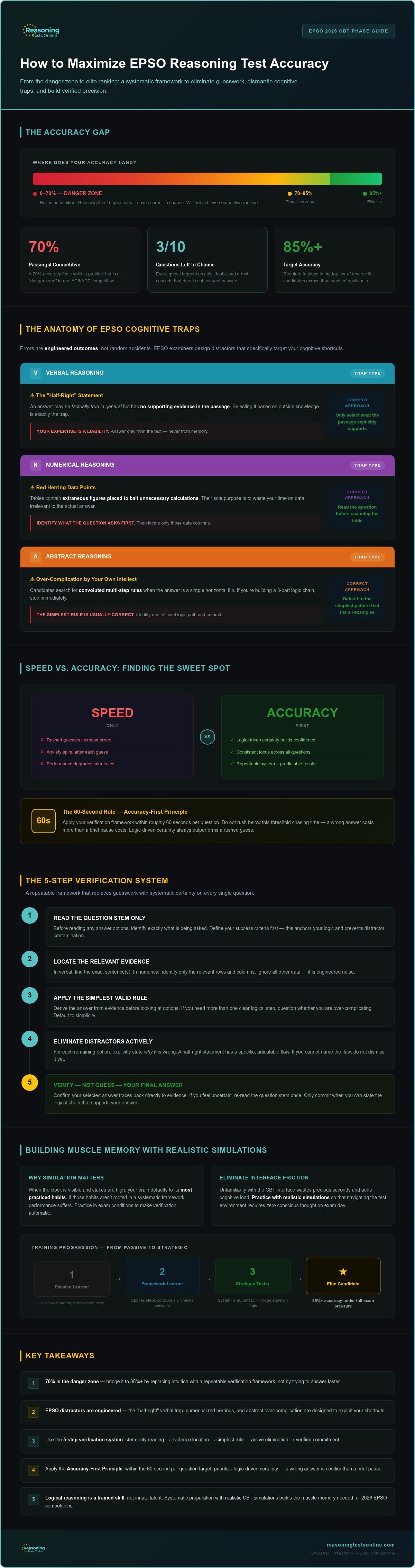
Precision is a protocol, not a personality trait. To achieve elite EPSO reasoning test accuracy, you must replace your intuitive approach with a rigid, 5-step workflow. This system ensures that every choice you make is the result of a logical process rather than a gut feeling. By standardizing your response, you reduce the cognitive load on your brain, allowing you to focus entirely on the data at hand. Accuracy isn't something that happens to you; it's something you build.
- Step 1: The "Clean Read." Read the question stem before looking at the data or text. Know exactly what you are hunting for before you engage with the noise.
- Step 2: Filter and Categorize. Identify the reasoning type. Is this a ratio calculation or a verbal inference? Categorization triggers the correct mental framework for the task.
- Step 3: Systematic Elimination. Stop looking for the "right" answer immediately. Instead, disqualify the options that are mathematically or logically impossible.
- Step 4: The Logic Check. Once you have a candidate answer, perform a five-second sanity check. Does this result align with the scale of the data provided?
- Step 5: Post-Test Analysis. Review every answer, including the ones you got right. This builds the muscle memory needed for the actual exam.
Consistency comes from repetition. You can refine this 5-step protocol using our specialized Abstract, Numerical, and Verbal Reasoning packages, which provide the realistic environment needed to test your new system under pressure.
The Power of Systematic Elimination
Multiple-choice tests are fundamentally games of exclusion. Most candidates waste time trying to prove why an answer is correct. It's often more efficient to prove why the others are wrong. You should aim to narrow five options down to two in under 20 seconds. This reduces the complexity of the final decision. If you encounter a "cannot be determined" option, don't panic. It's rarely a "get out of jail free" card; it's a specific logical category that requires you to prove a lack of sufficient data.
Mastering the Post-Practice Review
Your "Correct" answers also need your attention. Did you get it right because of logic or luck? If it was luck, you haven't truly mastered the question. To maintain high EPSO reasoning test accuracy, you must categorize every error into "Logic," "Time," or "Reading" mistakes. A reading mistake is a failure of focus; a logic mistake is a failure of framework. Track these in a personal "Error Log." Over time, you'll see recurring patterns that allow you to anticipate your own weaknesses before they cost you points on exam day.
Building Muscle Memory with Realistic Simulations
Knowledge is useless if you can't access it under stress. To achieve elite EPSO reasoning test accuracy, you must train in an environment that mirrors the actual exam day. Many candidates fail because they practice in low-stakes, untimed settings using static materials. When they finally face the digital interface, they experience "interface friction." This is the cognitive drain caused by navigating an unfamiliar layout while the clock is ticking. By using realistic simulations, you eliminate this friction. You want the exam interface to feel like an extension of your own thought process, not a hurdle to overcome.
High-difficulty sets play a vital role in this mental training. Think of them as resistance training for your brain. By exposing yourself to logic patterns that are more complex than the average question, you expand your cognitive comfort zone. When you return to standard questions, they feel simpler and more manageable. This transition from untimed practice to "Accuracy Under Pressure" is the final stage of your preparation. It's where you prove that your 5-step system holds up when the seconds are counting down. High EPSO reasoning test accuracy isn't a result of luck; it's a byproduct of rigorous, simulated stress.
The Professional Coach Approach
We treat EPSO preparation like an athletic endeavor. You wouldn't run a marathon without months of consistent, incremental training. Your brain requires the same discipline. Consistency beats intensity every time. Practicing for 30 minutes every day is far more effective than an eight-hour "cram" session once a week. Our simulations at Reasoning Tests Online bridge the gap between theory and execution. They provide the detailed logic explanations you need to refine your frameworks. For a deeper dive into the specific logic you'll face, consult our Ultimate Guide to Abstract Reasoning Patterns.
Your 2026 Preparation Roadmap
Success in the 2026 competitions requires a structured timeline. You can't leave your ranking to chance. Follow this 4-week plan to ensure a rounded, competitive score across all reasoning types:
- Week 1: Diagnostic Phase. Take full-length tests to identify your baseline accuracy and specific logic gaps.
- Week 2: Framework Mastery. Apply the 5-step system to your weakest areas, focusing on Verbal, Numerical, or Abstract logic.
- Week 3: Stress Simulation. Shift to timed blocks. Focus on maintaining precision while the internal clock is running.
- Week 4: Elite Refinement. Review your Error Log and tackle high-difficulty sets to maximize your ranking potential.
Ready to start your mental training? Check our practice package prices to find the right specialized simulation for your institution's requirements. Don't just aim to pass; aim to lead the ranking.
Secure Your Competitive Ranking for 2026
Success in the EPSO selection process isn't a matter of luck. It's the result of disciplined mental training and a refusal to rely on guesswork. You've learned how to bridge the accuracy gap by identifying cognitive traps and applying a repeatable 5-step system. By prioritizing precision over raw speed, you ensure that every answer you provide is backed by verified logic. Your EPSO reasoning test accuracy is the single most important variable in securing a spot on the 2026 reserve list.
It's time to move beyond passive study. You need to build the muscle memory required to execute these frameworks under the pressure of the real exam. Our platform offers specialized difficulty levels for AD5 and AD7 candidates, ensuring your preparation matches the institutional standard. With detailed answer logic for every question and simulations that mimic the 2026 EPSO interface, you'll be ready for any challenge the CBT phase presents.
Master your accuracy with realistic EPSO test simulations and turn your preparation into a strategic advantage. You have the tools and the system. Now, go execute.
Frequently Asked Questions
How can I improve my EPSO reasoning score in a short amount of time?
Focus on high-yield patterns and the systematic elimination of distractors rather than bulk practice. You'll see faster results by analyzing the logic behind your errors than by simply completing hundreds of questions. Use realistic simulations to automate your response and build muscle memory for the specific interface you'll face on exam day.
Is it better to guess or leave a question blank on the EPSO test?
You should always provide an answer because there is currently no negative marking in the EPSO CBT phase. However, you should never settle for a random guess. Use the first 20 seconds to eliminate at least two impossible options. This tactical exclusion increases your probability of success from 20% to 50% even if you're unsure of the final logic.
What is a good accuracy rate for EPSO numerical reasoning?
You should aim for an 85% accuracy rate or higher to remain competitive for AD5 and AD7 institutional slots. While a 65% score might meet the technical pass mark, it rarely secures a high enough ranking to reach the reserve list. Elite EPSO reasoning test accuracy is the primary differentiator between candidates who pass and those who are actually recruited.
How do I avoid falling for distractors in the verbal reasoning test?
Apply the "Strict Adherence" rule by ignoring all outside knowledge and focusing only on the text provided. Distractors often use "half-right" statements that are factually true in the real world but aren't supported by the passage. Watch for absolute qualifiers like "always," "never," or "all," as these frequently signal incorrect, overly broad options designed to trap you.
Can I use a calculator during the EPSO numerical reasoning exam?
Yes, an on-screen calculator is provided within the testing interface. You must practice using an on-screen tool during your preparation to avoid "interface friction" during the real exam. Many candidates lose valuable seconds because they aren't used to clicking buttons with a mouse instead of using a physical keypad.
How many hours should I practice to master the abstract reasoning test?
Prioritize consistency over total hours by practicing for 30 minutes daily for at least four weeks. Mastery in abstract reasoning comes from the rapid recognition of visual patterns, which requires regular, short bursts of exposure. Cramming for eight hours in a single weekend is ineffective because it doesn't allow your brain to build the necessary long-term muscle memory.
What is the most common reason candidates fail the EPSO accuracy check?
The most frequent cause of failure is rushing due to the ticking clock. This panic leads to avoidable errors, such as misreading chart axes in numerical tests or overlooking "except" in verbal questions. By adopting a rigid 5-step system, you replace this emotional reaction with a methodical process that preserves your precision under pressure.
How does the remote testing environment affect reasoning test performance?
Remote testing increases your cognitive load because you must manage technical requirements alongside the exam's logic. This environment can cause your EPSO reasoning test accuracy to drop if you haven't practiced in a similar digital setting. Using simulations that mimic the 2026 EPSO interface ensures that the testing environment feels familiar, allowing you to focus entirely on the questions.


