

Most candidates don't fail the EPSO exam because they lack the intelligence; they fail because they run out of time. You've likely spent hours memorizing patterns, yet the actual exam interface can feel like a foreign language when the clock starts ticking. It's a high-stakes environment where generic practice materials often fall short of the actual difficulty. To succeed, you need realistic EPSO test simulations that replicate the exact logic, timing, and interface of the real EU selection tests.
You already know that inconsistent performance in abstract reasoning or freezing during numerical tables can derail months of hard work. This article promises to show you how to replace guesswork with a systematic approach that builds genuine confidence. We'll explore how to develop the specific muscle memory required to handle the "60-second rule" with total precision. By the end of this guide, you'll understand how to achieve a score well above the pass mark by training in an environment that mirrors the 2026 exam reality.
Key Takeaways
- Understand why professional simulations are superior to basic quizzes by replicating the exact technical environment and navigation of the EPSO exam.
- Learn how realistic EPSO test simulations utilize authentic data and complex logic to prepare you for 2026 exam conditions.
- Develop the cognitive muscle memory needed to master the 60-second rule and ensure the interface doesn't distract you from solving problems.
- Identify your necessary safety margin by aiming for scores at least 15% higher than historical pass marks during your practice sessions.
- Replace guesswork with a systematic approach by using detailed logic explanations for verbal, numerical, and abstract reasoning challenges.
What Makes an EPSO Test Simulation Truly Realistic?
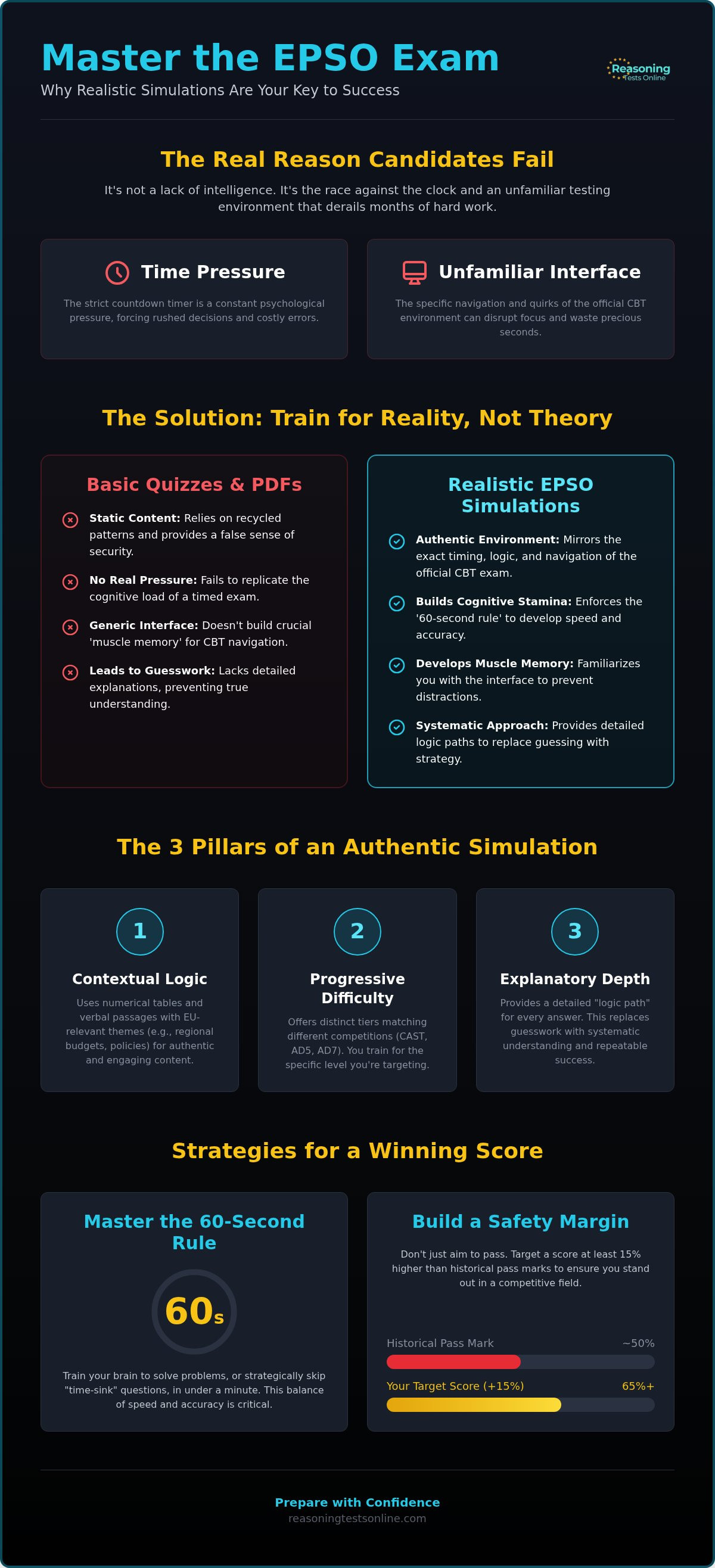
A realistic simulation is more than a collection of practice questions. It is a precise technical environment that mirrors the exact timing, logic, and navigation of the official EU selection exams. For 2026 candidates, the distinction between a casual quiz and a professional exam simulation is the difference between failure and a job offer. While a quiz might test your knowledge, realistic EPSO test simulations test your ability to perform under extreme cognitive load. If you don't practice in the same environment where you'll be tested, you're leaving your results to chance.
Static PDF materials are no longer sufficient for modern competitions. The 2026 candidate pool is highly competitive, and the EPSO interface itself acts as a barrier to those who haven't mastered its specific flow. You need a system that replicates the Computer-Based Testing (CBT) environment. This includes adaptive difficulty levels that reflect the rising standards of the competition. Success in the EPSO competition requires a shift in perspective. You aren't just taking a test; you're competing against thousands of professionals for a limited number of spots. A simulation that remains at a basic level provides a false sense of security. You need questions that scale in complexity, mimicking the way the actual test pushes your mental limits.
The Technical Blueprint of EPSO CBT Simulations
The CBT interface used in Brussels and Luxembourg has specific quirks that can disrupt your focus if you're unprepared. A truly realistic simulation replicates these navigation patterns perfectly. It ensures that the transition between Abstract, Numerical, and Verbal reasoning tests feels familiar. Most candidates struggle with the countdown timer, which serves as a constant psychological pressure. Professional simulations use hand-crafted logic rather than recycled patterns. This ensures you don't rely on memorized answers but actually understand the underlying methodology. This "Result-Driven Approach" ensures that your practice sessions are as demanding as the day of the exam.
Timed Conditions: The 60-Second Reality Check
Time management is the primary reason AD5 and AD7 candidates fail the numerical test. Most people have the mathematical ability to solve the problems, but they lack the speed to do so in under a minute. Using realistic EPSO test simulations enforces the "60-second rule," training your brain to identify and skip "time-sink" questions. These are complex problems designed to drain your clock and induce panic. By practicing in a timed environment, you develop a balance between speed and accuracy. You learn to make split-second decisions about which questions to prioritize, ensuring you maximize your score before the timer hits zero. This transition from accuracy-only practice to a speed-accuracy balance is what separates successful candidates from the rest of the field.
The 3 Pillars of an Authentic EPSO Reasoning Environment
Authenticity in exam preparation isn't a luxury; it's a strategic requirement. If your practice materials don't mirror the specific environment of the European Personnel Selection Office, you're training for the wrong fight. High-quality realistic EPSO test simulations rest on three critical pillars: logical complexity, stratified difficulty, and explanatory depth. These elements ensure that your mental preparation translates directly into a high score on exam day. Without these pillars, you risk developing a false sense of security that shatters the moment the real timer begins.
The first pillar is Contextual Logic. This means using numerical tables and verbal passages that reflect actual EU-relevant themes, such as regional development budgets or environmental policies. When the content feels "real," your brain engages more deeply with the data. The second pillar is Progressive Difficulty. A CAST exam requires a different cognitive approach than a senior AD7 competition. Effective simulations must offer tiers that distinguish between these profiles. Practicing at an AD5 level when you're gunning for an AD7 spot is a recipe for disappointment. Finally, the third pillar is Explanatory Depth. Every answer must provide a "logic path." This replaces educated guessing with systematic understanding, allowing you to replicate your success across different question sets.
Numerical Reasoning: Beyond Basic Math
Numerical tests in the EPSO context are rarely about simple arithmetic. They're about data interpretation under pressure. A truly authentic simulation includes "distractor" data—irrelevant numbers designed to test your ability to filter information quickly. You must learn to identify exactly which figures are needed for the calculation and ignore the rest. To refine these specific skills, you can explore Numerical Reasoning Test Mastery for EPSO AD5 Exams for deeper tactical drills. Mastering this filtering process is the only way to beat the clock consistently.
Abstract Reasoning: Pattern Recognition at Speed
Abstract reasoning is the most common stumbling block for candidates who rely on intuition rather than methodology. Realistic EPSO test simulations replicate the "next in series" and "matrix" formats found in recent notices. You need to build a mental library of patterns including rotation, symmetry, and color progression. By exposing yourself to these patterns repeatedly, you develop the muscle memory required to solve them in seconds. For a complete breakdown of these visual rules, refer to the Abstract Reasoning Tests: The Ultimate Guide. This systematic approach demystifies even the most complex matrices.
Success in these exams comes from preparation, not luck. If you're ready to move beyond generic quizzes, you can access professional EPSO reasoning tests that provide the authentic environment you need to succeed.
Beyond Logic: Building Muscle Memory for the Exam Interface
Success in the EU selection process requires more than intellectual capacity. It demands a result-driven approach where cognitive preparation is treated like an athletic endeavor. You aren't just solving puzzles; you're performing a high-speed mental routine under extreme observation. The "Muscle Memory" effect occurs when repeated exposure to realistic EPSO test simulations makes the digital interface invisible. When the platform becomes second nature, your brain stops wasting energy on navigation and focuses entirely on logic. This shift eliminates interface anxiety, ensuring that your performance on test day matches your actual potential rather than being hampered by technical friction. Professional simulations are a mandatory system to replace guesswork with a predictable, high-performance state.
The Psychology of the EPSO Countdown
The ticking clock triggers a cortisol spike that can cloud judgment and lead to unforced errors. High-quality simulations desensitize you to this pressure by forcing you to operate within strict time limits repeatedly. This desensitization is vital for AD5 and AD7 candidates who face the highest competition levels. A critical tactic is the "First-Minute Strategy." This involves setting a methodical, calm pace during the opening questions to stabilize your heart rate and mental focus. You don't want to rush; you want to be efficient. In this context, muscle memory is the ability to recognize reasoning patterns in under 15 seconds. By training your brain to identify these structures instantly, you bypass the panic phase and move straight into logical execution.
Identifying Systematic Reasoning Errors
Consistent failure in specific test areas usually isn't a sign of low intelligence. It's often a symptom of a flawed methodology. If your scores fluctuate, your system is unreliable. Use simulation analytics to pinpoint your "blind spots," particularly in verbal inference or complex numerical tables. If you consistently miss the same type of abstract reasoning pattern, your current system for breaking down shapes is broken. You need a structured environment to rebuild these habits from the ground up. You can access specialized EPSO Tests Practice Packages to begin this systematic training. Using realistic EPSO test simulations provides data-driven feedback that allows you to replace guesswork with a refined, repeatable logic path. By identifying where your logic fails, you can apply corrective measures before the real exam begins.
Benchmarking Your Score: What the Simulations Reveal
A high score in a relaxed environment doesn't guarantee success in Brussels. Raw scores can be deceptive; you must account for the "test day tax," which includes the psychological pressure and environmental distractions of the actual testing center. By using realistic EPSO test simulations, you gain an objective view of your standing within the competition pool. Your goal is not just to pass, but to achieve a score that places you safely within the top percentage of candidates. This requires a shift from passive practice to active benchmarking, where every session provides data on your readiness.
Establishing a "Safety Margin" is the most effective way to insulate your results against unexpected difficulty spikes. You should aim for a score at least 15% higher in your simulations than the historical cut-off marks for your specific competition. If the typical pass mark is 70%, your target in practice must be 85%. This buffer accounts for the cognitive fatigue that sets in during the final stages of the exam. As the competition date nears, you must transition from "Practice Mode," where you might focus on individual sections, to "Exam Simulation Mode." This means completing full-length, timed batteries of Verbal, Numerical, and Abstract reasoning tests in one sitting to build your mental endurance.
AD5 vs. AD7 Difficulty Benchmarks
Senior administrator roles (AD7) demand a higher level of cognitive agility than entry-level AD5 or CAST positions. Verbal reasoning passages for AD7 candidates often feature more nuanced linguistic traps and complex inferences that require deeper analysis. Similarly, AD7 numerical simulations require significantly faster data synthesis. You aren't just looking for a single number; you're often required to compare multiple data sets across complex tables. Adjusting your strategy based on the specific grade you are targeting is essential. If you are gunning for an AD7 spot, your benchmarking must reflect the increased complexity and tighter time constraints of that competition tier.
The Diagnostic Value of Detailed Explanations
The real value of a simulation lies in the post-test analysis. Don't just acknowledge a wrong answer and move on. Use the "Logic Walkthroughs" provided in professional simulations to reverse-engineer your mistakes. You need to move from "I got it wrong" to "I understand the specific logical trap I fell into." This diagnostic approach allows you to identify whether your errors stem from a lack of knowledge, a failure in methodology, or poor time management. It also helps you refine your "skipping" strategy. Realistic EPSO test simulations teach you to recognize unsolvable or high-risk questions within five seconds, allowing you to bypass them and secure points elsewhere. You can benchmark your performance with professional simulations to identify these logical blind spots before they cost you a spot on the reserve list.
Get Exam-Ready with Reasoning Tests Online Simulations
Serious candidates recognize that the volume of practice questions is secondary to the quality of the underlying logic. Reasoning Tests Online provides realistic EPSO test simulations that prioritize technical accuracy and cognitive challenge over simple repetition. We move beyond basic multiple-choice quizzes to offer a total immersion in the official testing environment. Our platform integrates a precise timed environment with professional analytics that track your progress across every reasoning domain. This "Zero Fluff" guarantee ensures that every minute spent on our platform directly contributes to your final score. You aren't just practicing; you're refining a high-performance system designed to withstand the pressure of the 2026 competitions.
Choosing Your Practice Package
Success depends on a balanced preparation strategy. You must select the right mix of verbal, numerical, and abstract tests based on your specific competition notice. For instance, an AD7 profile requires a heavier focus on complex data synthesis compared to a CAST exam. We recommend starting your simulation training at least six weeks before your scheduled test date. This timeframe allows for the development of the muscle memory required to recognize patterns instantly. It takes time to rewire your logical reflexes and stabilize your performance under the 60-second rule. You can view our EPSO reasoning test pricing and packages to find the configuration that matches your 2026 career goals.
The Path to the Reserve List
Systematic simulation training is the only proven method to bridge the gap between understanding the material and passing the exam. There is a direct correlation between consistent performance in realistic EPSO test simulations and success in the actual pre-selection phase. Preparation is the only antidote to the inherent difficulty of the EU selection process. Luck is not a viable strategy for a career in the European institutions. You must replace guesswork with a reliable, logic-based framework that functions even under extreme time pressure. If you want to secure your place on the reserve list, you must train in the environment where the competition actually happens. Start your realistic EPSO test simulation today and take the first definitive step toward your EU career.
Secure Your Place on the 2026 Reserve List
Success in the EU selection process is a matter of systematic preparation, not luck. You've seen how mastering the exam interface and developing cognitive muscle memory can eliminate the anxiety of the ticking clock. By using realistic EPSO test simulations, you replace guesswork with a methodology that works under high pressure. Achieving a safety margin well above the historical pass mark ensures you remain competitive, regardless of the specific difficulty level on test day.
Reasoning Tests Online offers specialized training for AD5, AD7, and CAST profiles. Our platform provides timed simulations that mimic real CBT conditions, supported by detailed logic-based answer explanations to refine your thinking. Don't leave your career to chance when you can train with the exact logic used by the assessors. Master the exam with realistic EPSO test simulations and approach your test date with total confidence. Your future in the European institutions starts with the right preparation today.
Frequently Asked Questions
How realistic are these EPSO test simulations compared to the real exam?
Our simulations are engineered to mirror the technical environment of the official Computer-Based Testing (CBT) platform. They replicate the navigation, logic, and time constraints you'll encounter in Brussels or Luxembourg. By using realistic EPSO test simulations, you ensure your preparation isn't just about logic but also about the physical and psychological experience of the actual test day.
Can I practice the numerical reasoning tests under the exact EPSO time limits?
Every numerical reasoning simulation on our platform enforces the strict timing of the official competition. This training is essential for mastering the "60-second rule" and learning which questions to prioritize under pressure. You'll build the speed and accuracy balance necessary to complete the test before the countdown hits zero, replacing panic with a methodical approach.
Are the abstract reasoning patterns updated for the 2026 EPSO competitions?
We constantly update our question banks to reflect the matrices and series patterns found in the most recent EPSO notices. Our realistic EPSO test simulations focus on current logic trends, including complex rotations, symmetry, and color progressions. This ensures you're training with relevant patterns rather than outdated material that no longer appears in modern competitions.
Do the simulations provide detailed explanations for incorrect answers?
Detailed logic walkthroughs accompany every question to help you understand the specific methodology required for success. We replace guesswork with a systematic logic path, explaining exactly why an answer is correct and how to avoid common distractors. This diagnostic feedback is critical for correcting systematic errors in your reasoning process and building a reliable system.
How many times can I retake a simulation to improve my muscle memory?
You can retake simulations multiple times to refine your patterns and improve your response speed. Repeated exposure is the key to building the muscle memory that makes the interface feel invisible on exam day. While the logic remains consistent to help you master the rules, the focus is on reducing your reaction time with each attempt.
Do I need to install any software to run the EPSO test simulations?
No software installation is required as our simulations run directly in your web browser. This allows you to practice on any device that replicates the desktop environment of the official testing center. It's a clean, efficient system designed to focus entirely on your mental training without technical distractions or compatibility issues.


