

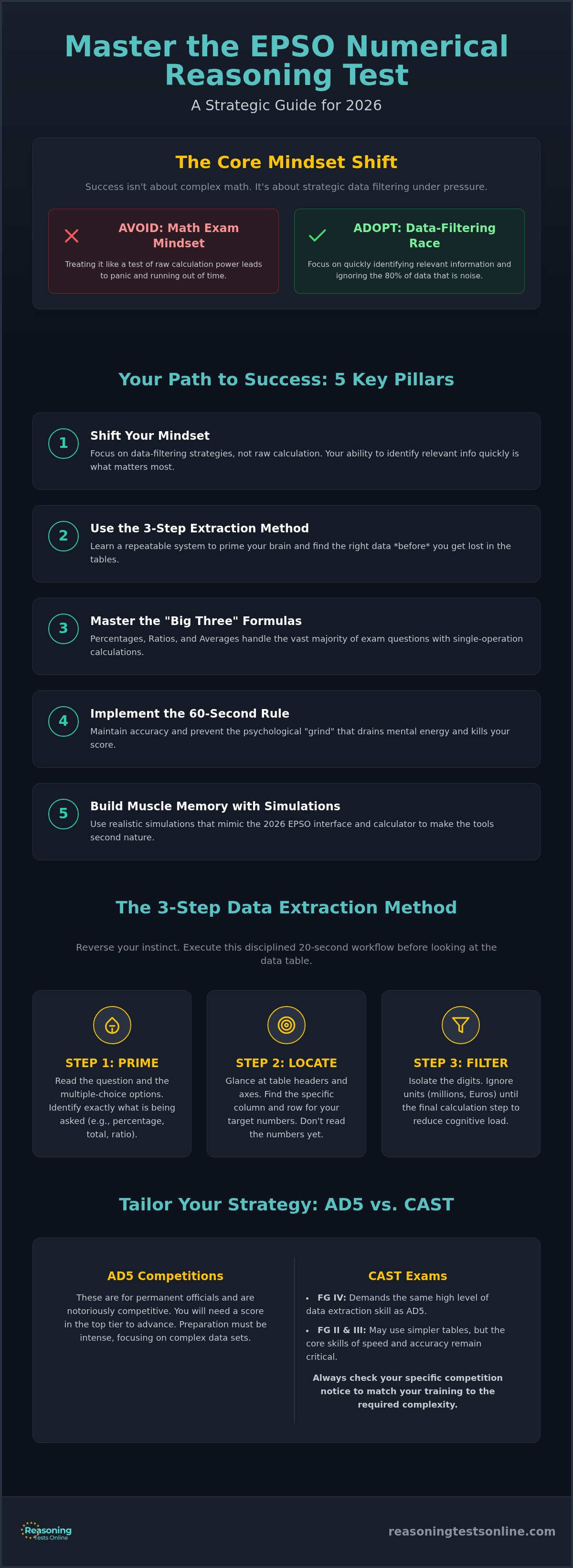
Most candidates fail the numerical reasoning test because they treat it like a math exam rather than a data-filtering race. You've likely felt that surge of panic when a complex table appears and the timer starts ticking down. It's frustrating to know the basic arithmetic but lose the battle against a relentless clock. You don't need to be a mathematician to succeed; you need to be a strategist.
To pass EPSO numerical reasoning in 2026, you must master the art of ignoring irrelevant data. This guide promises to equip you with a repeatable system for solving questions, helping you bypass the math-anxiety trap and secure your EU career. We'll break down the decision-making tactics you need to improve accuracy under pressure and build the calculation speed required for the pre-selection phase.
We will examine how to build muscle memory through realistic simulations and precise methodology. You'll learn how to transform complex tables into simple logical components, ensuring that guesswork no longer dictates your score. This is about replacing panic with a systematic process that works every time.
Key Takeaways
- Shift your mindset from performing complex math to executing data-filtering strategies. Success depends on your ability to identify relevant information quickly rather than raw calculation power.
- Learn a repeatable 3-step extraction method to pass EPSO numerical reasoning by priming your brain before you even look at the data tables.
- Master the "Big Three" formulas; percentages, ratios, and averages; to handle most exam scenarios with single-operation calculations.
- Implement the 60-second rule to maintain accuracy and prevent the psychological "grind" that drains your mental energy and kills your score.
- Build muscle memory by using realistic simulations that mimic the actual 2026 EPSO interface and calculator rules.
Understanding the EPSO Numerical Reasoning Framework
EU institutions don't hire human calculators. They hire decision-makers who can synthesize complex data and reach sound conclusions. This is why the selection process prioritizes numerical reasoning over pure mathematical ability. It's a filter for cognitive agility. In the 2026 EPSO environment, you face a digital interface with a strict time limit. You have roughly two minutes per question. If you spend ninety seconds just finding the right row in a table, you've already lost. Success requires a mental shift. You aren't solving math problems; you're interpreting logic.
The 2026 testing environment is fully remote. This adds a layer of technical pressure that many candidates overlook. You must become comfortable with the specific on-screen calculator and the way data tables are displayed. Passive study is a recipe for failure. To pass EPSO numerical reasoning, you need active EPSO test simulations that build the muscle memory required for this specific interface. The goal is to make the toolset second nature so your brain can focus entirely on the data.
AD5 vs. CAST: Tailoring Your Strategy
The competition you enter dictates the intensity of your training. AD5 competitions for permanent officials are notoriously competitive. You often need a score in the top tier to move forward. CAST exams vary by Function Group (FG). While FG II and III might use simpler tables, FG IV demands the same level of data extraction as the AD5 level. Always check your specific competition notice before starting. Your preparation must match the complexity of the data sets you'll actually face. If you train on materials that are too easy, the real exam will feel like a shock to your system.
Why Traditional Math Skills Aren't Enough
High-school math won't save you here. The biggest trap is trying to be too precise. EPSO tables are designed to overwhelm your cognitive load with irrelevant distractors. If you try to calculate every decimal point, you'll run out of time. Logic beats calculation every time. You'll pass EPSO numerical reasoning by learning when to estimate and when to execute a full calculation. Precision is a liability when speed is the primary metric. Consider these factors:
- Data Filtering: The ability to ignore 80% of a table to find the 20% that matters.
- Estimation: Using rounded numbers to eliminate obviously wrong multiple-choice options.
- Cognitive Fatigue: Managing your energy so you don't panic during the final five questions.
The test measures how you handle the "math-anxiety trap." When the timer turns red, your ability to stay methodical is what separates successful candidates from the rest. It's about discipline, not just intelligence.
The 3-Step Extraction Method for Data Interpretation
Do not look at the data table first. This is the most common mistake candidates make. Your brain needs a target before it enters a field of complex information. To pass EPSO numerical reasoning, you must reverse your natural instinct to "study" the table. Instead, you should execute a disciplined three-step extraction workflow that takes no more than 20 seconds.
Step 1: Prime your brain. Read the question and the multiple-choice options. Identify exactly what is being asked. Are you looking for a percentage increase, a total value, or a ratio? By knowing the goal, your eyes will naturally skip over irrelevant data points.
Step 2: Locate the axes. Glance at the table headers and the vertical axis. Find the specific column and row that contain your target numbers. Don't read the numbers yet; just find their location. If the question asks for "Export growth in 2024," your eyes should only rest on the "2024" column and the "Exports" row.
Step 3: Filter the noise. Isolate the digits. Ignore the units (millions, billions, Euros) until the final step of your calculation. Focus on the raw integers. This reduces the cognitive load on your working memory and allows you to move into the calculation phase with a clear head. This is the most efficient way to pass EPSO numerical reasoning when every second counts.
Identifying Irrelevant Data (The Noise)
EPSO distractors are intentional. They often include extra columns for "Total" or "Average" that aren't required for the specific question. They might also mix units, such as presenting some data in thousands and others in millions. You can sharpen your focus with a simple 10-second header identification challenge. Open a complex table and give yourself ten seconds to point to three specific data points without reading the numbers. This builds the visual scanning speed needed to bypass the "math-anxiety trap" mentioned earlier. Mastering this skill is easier when you practice with realistic EPSO test simulations that mimic these exact distractors.
Mastering Multi-Step Questions
Complex queries are just two or three simple operations stacked together. Don't try to solve the entire problem in one go. Break the question into sub-tasks. If you need to find the difference between two ratios, calculate the first ratio, then the second, then subtract. In the 2026 digital testing environment, you'll need to keep track of intermediate results. Use the on-screen scratchpad or your provided whiteboard efficiently. Write down only the essential intermediate numbers. Before you finalize your answer, perform a quick logic-check. If the question asks for a percentage increase and your result is a negative number, you've made a procedural error. Eliminate obviously wrong answers early to save time.
Essential Formulas and Calculation Tactics
You don't need a degree in statistics to succeed. You need mastery over a handful of high-impact formulas. Most candidates lose time by using inefficient, multi-step calculations. To pass EPSO numerical reasoning, you must condense your arithmetic into single operations. This reduces the risk of input errors on the on-screen calculator and keeps your momentum high.
The "Big Three" of EPSO are percentages, ratios, and averages. For percentage changes, stop using the traditional subtraction then division method. Instead, use the multiplier approach. To find a 15% increase, simply multiply the base by 1.15. If you need to find the original value before a 20% increase, which is a reverse percentage, divide the current value by 1.20. This specific formula is a common stumbling block; memorizing it is non-negotiable. When dealing with currency conversions or inflation, always identify the base year or base currency first to avoid directional errors.
Ratios and Proportions: The EPSO Bread and Butter
Ratios are frequently used to compare performance across different departments or years. The "Unity Method" is your best tool here. If a ratio is 3:5 and the first part equals 150, find the value of "1" by dividing 150 by 3. Once you know one unit is 50, you can solve any part of the proportion instantly. Beware of the "total vs. sub-group" trap. EPSO often provides a ratio for a sub-section of data but asks a question about the entire table. Always verify the denominator before you hit the equals sign. It's a simple check that prevents easy points from slipping away.
Compound Growth and Multi-Year Data
Multi-year growth questions can be time-consuming. If a question asks for the total growth over three years with varying annual rates, don't calculate each year individually. Multiply the growth factors together; for example, 1.05 * 1.10 * 1.08. For large-scale data trends, estimation is often faster than exact calculation. If the multiple-choice options are widely spaced, rounding to the nearest whole number can give you the correct answer in seconds. For a deeper dive into these technical requirements, consult our guide on Must-Know EPSO Numerical Reasoning Formulas. This systematic approach ensures you aren't just guessing; you're executing a proven strategy that builds muscle memory for the 2026 testing environment.
The 60-Second Rule: Time Management and Accuracy
Time is your most scarce resource. To pass EPSO numerical reasoning, you must manage your minutes as carefully as your calculations. Research in cognitive testing shows that accuracy drops significantly after the 90-second mark. When you exceed this threshold, your brain begins to "grind." This is a psychological state where frustration replaces logic. Grinding kills your score because it consumes time that belongs to easier questions later in the test. It's a trap that many high-achieving candidates fall into because they refuse to leave a problem unsolved.
You need a strict decision-making framework. Implement the 60-Second Rule. Use the first minute to evaluate the complexity of the question and the data table. If you don't have a clear path to the solution within 60 seconds, stop. This is where strategic guessing becomes a vital tool. Eliminate obviously wrong answers and make an informed choice. It's better to secure a 25% chance on a hard question than to miss three easy ones because you ran out of time. Mastery is knowing when to fight and when to move on.
Building Cognitive Muscle Memory
Daily speed drills are the only way to reduce mental friction. You need to react to the 2026 interface without hesitation. Your reaction time improves only when you simulate the exact testing environment. Start your preparation by focusing on accuracy in a low-pressure setting. Once you reach an 80% success rate, introduce a strict timer. This transition from accuracy-focused practice to time-pressured practice is essential. It builds the cognitive muscle memory required to maintain a steady pace when the stakes are high.
Analyzing Your Error Patterns
You must identify the root cause of every mistake. Are you failing because of a calculation error or a data extraction error? If you find the right numbers but get the wrong result, your arithmetic needs work. If you use the wrong columns or ignore a unit conversion, your extraction workflow is the problem. Use a "Post-Test Review" system to categorize every error. You can track your progress and identify these patterns using realistic EPSO test simulations. This data-driven approach turns failures into strategic advantages.
To ensure your timing is perfect for the 2026 competitions, start practicing with our specialized Numerical Reasoning Tests to build your speed and confidence.
Strategic Preparation: From Theory to Simulation
Passive reading won't help you pass the exam. You can't memorize your way to a high score. Numerical reasoning is a skill that requires mental training and muscle memory. To pass EPSO numerical reasoning, you must transition from understanding theory to executing logic under pressure. This is an athletic endeavor for the mind. If you don't practice in the exact environment of the test, you aren't preparing; you're just reading. Guesswork has no place in a professional EU career strategy.
Set up a systematic 4-week framework to build your competence. Your first week should focus on the foundations, such as the "Big Three" formulas and the 3-step extraction method. In the second week, prioritize accuracy through untimed practice. By the third week, introduce the 60-second rule and the ticking clock. Your final week should be dedicated to high-difficulty simulations. Practicing on "hard" data sets makes the actual exam questions feel "medium" by comparison. It's about over-preparing so the real test feels manageable and predictable.
Choosing the Right Practice Environment
Paper-based practice is a strategic disadvantage. The 2026 EPSO test is computer-based. You must be comfortable with on-screen data tables and the digital calculator interface. Look for platforms that offer timed simulations and detailed logic explanations for every answer. This transparency allows you to see the "why" behind the "what." You can Explore EPSO Practice Packages and Prices to find a plan that matches your specific competition level and function group.
The Power of the Simulation
The ticking clock is your best teacher. It forces you to develop a rhythm for question-skipping and using the flag-for-review feature. Don't let a single difficult table ruin your momentum. You can use Reasoning Tests Online to replace guesswork with a systematic logical process. This builds the confidence needed to remain calm when the timer turns red. On exam day, run through a final checklist. Ensure your hardware is ready, your calculator interface is familiar, and your mental state is focused. Success comes from disciplined preparation, not luck.
Secure Your EU Career with Systematic Preparation
Success in the 2026 competitions depends on your ability to replace panic with a repeatable system. You've learned that the test is a race of data interpretation, not a math exam. By applying the 3-step extraction method and adhering to the 60-second rule, you protect your score from the math-anxiety trap. The difference between a passing grade and a rejection letter often comes down to the quality of your simulations. You don't need luck when you have a proven methodology.
To pass EPSO numerical reasoning, you must train in an environment that mimics the pressure of the real interface. Guesswork is a liability you can't afford. You need to build the muscle memory required to filter noise and execute calculations with precision. This disciplined approach ensures that you remain calm when the timer begins to count down.
Start Your EPSO Numerical Reasoning Training Now and access realistic 2026 test simulations. Our platform provides detailed answer logic to eliminate guesswork and is trusted by AD5 and CAST candidates worldwide. You have the strategy; now you need the professional tools to execute it. Your career in the EU institutions is within reach.
Frequently Asked Questions
Can I use a physical calculator during the EPSO numerical reasoning test?
No, physical calculators are strictly prohibited. You must use the integrated on-screen calculator provided within the digital testing interface. This is why it is essential to practice with simulations that mimic the 2026 environment. Developing muscle memory for the specific layout and functionality of the digital tool prevents unnecessary delays during the actual exam.
What is a good score to pass the EPSO numerical reasoning section?
To pass EPSO numerical reasoning, you typically need a minimum of 50%, but a "good" score depends on the competition. For highly competitive AD5 profiles, candidates often need 80% or higher to secure their place. You shouldn't aim for the minimum threshold; aim for mastery to ensure your overall ranking remains high enough for the reserve list.
How many questions are in the EPSO numerical reasoning test for AD5?
The AD5 competition usually features 10 numerical reasoning questions. You are typically allocated 20 minutes to solve them, which averages to exactly two minutes per question. This time includes reading the question, extracting the correct data from complex tables, and performing the necessary calculations. Efficiency in your workflow is just as important as mathematical accuracy.
Is the numerical reasoning test different for CAST exams?
Yes, the complexity of the data sets varies by Function Group (FG). While the underlying logic remains the same, FG IV exams are significantly more difficult than FG II or III. To pass EPSO numerical reasoning in a CAST competition, you must ensure your practice materials match the specific difficulty level mentioned in your call for expression of interest.
How can I improve my numerical reasoning speed in two weeks?
Focus on two specific areas: multiplier-based percentage calculations and the 3-step extraction method. Spend thirty minutes each day performing timed "speed drills" on complex tables. By reducing the time you spend looking for data, you leave more time for the actual math. Transitioning to time-pressured practice early is the fastest way to see results in a short window.
What happens if I fail the numerical reasoning part but pass the others?
You will be eliminated from the competition immediately. EPSO requires a pass mark for every individual section of the reasoning tests. Even if you achieve a perfect score in verbal and abstract reasoning, failing the numerical section means you cannot move forward. This is why a systematic approach to your weakest areas is a strategic necessity.
Are there any negative points for wrong answers in the EPSO test?
No, there is no penalty for incorrect guesses. If the timer is about to expire, you should ensure that every question has an answer selected. Use the process of elimination to remove obviously wrong options first. A random guess gives you a 20-25% chance of success, whereas leaving a question blank guarantees zero points.
Do I need to memorize complex formulas for the exam?
No, you only need to master basic arithmetic, percentages, ratios, and averages. The difficulty doesn't come from advanced mathematics but from the way data is presented. You don't need calculus; you need the ability to apply simple formulas to large, distracting tables under extreme time pressure. Mastery of the "Big Three" formulas covers almost every exam scenario.


