

What if the reason you're struggling with abstract patterns isn't a lack of logic, but a failure to see the hidden architecture of the test itself? Most candidates approach high-stakes exams as if they're solving one-off puzzles. This leads to a frantic race against the clock where guesswork becomes the only viable strategy. It's exhausting to review logical reasoning test explanations that only identify the correct answer while leaving the actual methodology a mystery.
You need a repeatable system that replaces intuition with precision. We understand the frustration of running out of time on complex matrices because you're looking for a needle in a haystack. This article promises to decode the systemic rules used in high-stakes selection procedures, giving you the mental frameworks to recognize patterns instantly. We'll explore how to build the cognitive muscle memory required to handle 2026 exam standards, focusing on the specific logic used in professional simulations to ensure you walk into your next assessment with total confidence.
Key Takeaways
- Understand that logical reasoning is about rule extraction rather than puzzle solving to move beyond simple guesswork.
- Learn to use detailed logical reasoning test explanations to isolate single variables within the premise, transformation, and conclusion of every question.
- Discover how the same underlying systemic rules govern abstract, verbal, and numerical tests, allowing you to apply a unified strategy across all domains.
- Shift from passive reading to active mastery by treating logic preparation as an athletic endeavor that builds essential cognitive muscle memory.
- Prepare specifically for high-stakes EPSO AD5 and AD7 standards by training in environments that mimic the real exam interface and time constraints.
Beyond the Answer Key: Why Logical Reasoning Test Explanations Matter
Logical reasoning is the ability to extract consistent rules from abstract information. It's the engine behind every high-stakes assessment. When you're preparing for a career-defining exam, a simple answer key is your worst enemy. It tells you that you failed, but it doesn't tell you how to succeed. A correct answer without a deep understanding of the underlying mechanics is a wasted practice opportunity. You're simply reinforcing a lucky guess rather than building a reliable system.
In competitive environments, the margin for error is razor-thin. You must distinguish between "educated guessing" and "logical deduction." Guessing is a gamble. Deduction is a calculation. Using professional logical reasoning test explanations transforms your study sessions into a diagnostic process. These explanations highlight your mental blind spots, showing you exactly where your internal logic diverged from the test's architecture. By treating every error as a data point, you can identify if you are missing spatial rotations, failing to account for overlapping elements, or misinterpreting conditional statements.
Decoding the Why Behind the What
A logic rule is a consistent transformation applied to data. Whether it's a grid of shapes or a sequence of numbers, the underlying mechanics remain the same. Effective logical reasoning test explanations pull back the curtain on these transformations. They reveal the specific operations used by test designers, such as a 90-degree clockwise rotation, a binary color swap, or a complex arithmetic progression. When you understand the "why" behind a specific question, you stop seeing individual puzzles. You begin to see the universal rules that govern them. This shift prevents you from repeating the same error when the pattern reappears in a different visual format.
The Psychology of Logic: Replacing Anxiety with Systems
Many candidates believe that logic is an innate talent. They think they either "have it" or they don't. This is a fallacy. Logic is a skill refined through systematic training. When you rely on a proven system, you significantly reduce your cognitive load during the actual exam. You don't waste mental energy on panic or confusion. Instead, you're executing a pre-planned strategy. Through repeated exposure to structured explanations, your brain moves from high-effort analysis to rapid pattern recognition. You aren't just learning answers; you're building the cognitive muscle memory required to perform under pressure. Success doesn't come from a flash of brilliance. It comes from the discipline of understanding the system.
The Anatomy of a Logic Question: Extracting Rules and Structures
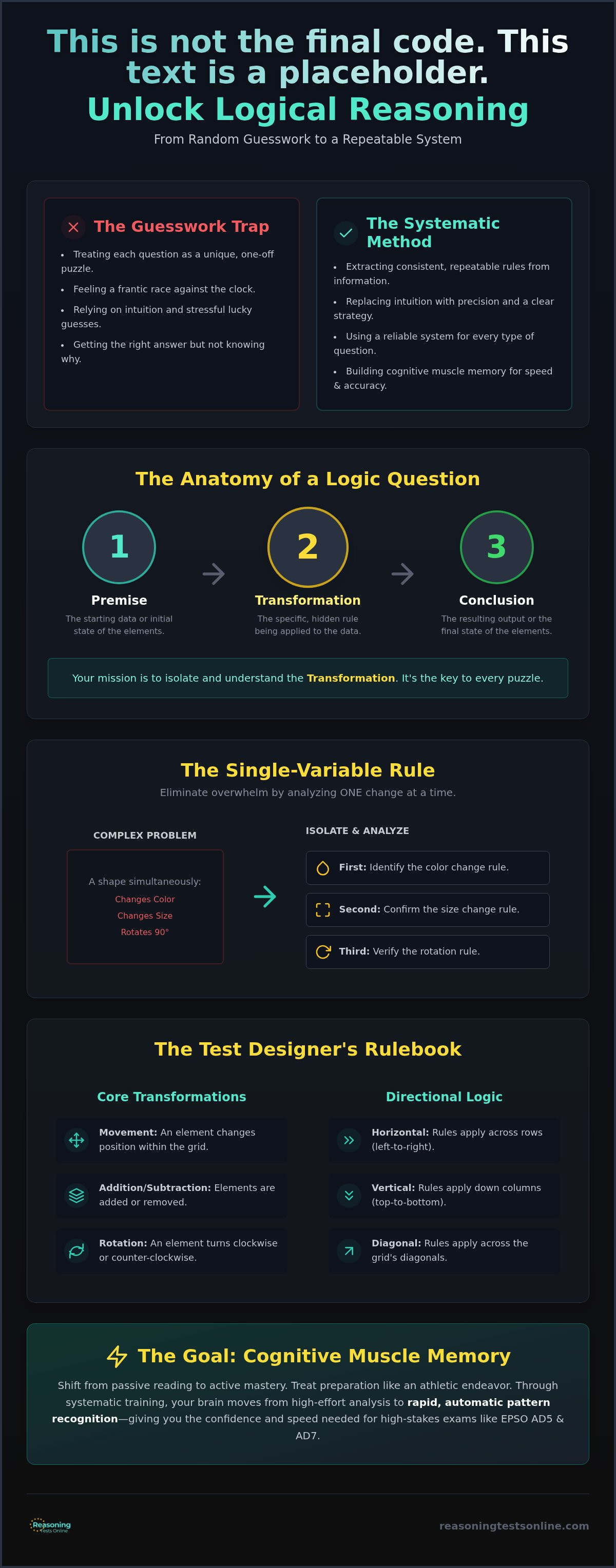
Every logic question functions as a machine with three distinct parts: the Premise, the Transformation, and the Conclusion. The Premise is your starting data. The Transformation is the specific rule applied to that data. The Conclusion is the resulting output. To master these questions, you must isolate the transformation. High-quality logical reasoning test explanations utilize the "Single-Variable Rule." This methodology breaks down complex matrices by analyzing one change at a time. If a shape changes color and rotates simultaneously, you isolate the rotation first. Once that rule is confirmed, you move to the color. This systematic approach eliminates the overwhelming feeling of looking at a complex image all at once.
Directional logic adds another layer to the test architecture. Rules don't just move from left to right. They can operate horizontally, vertically, or even diagonally across a grid. In sophisticated assessments like EPSO tests, these rules are often multi-layered. You might find a horizontal addition rule coexisting with a vertical rotation rule. Understanding this spatial hierarchy is what separates top-tier candidates from those who struggle. You aren't just looking for a pattern; you're looking for the grid's governing laws.
Pattern Identification: The Core of Logical Thinking
Most abstract questions rely on three primary transformations: movement, addition or subtraction, and rotation. Start by scanning the question for the most obvious change. Don't look at the whole grid at once. Pick one specific element in a corner and follow its journey. Once you deduce a potential rule, use the "Check Backwards" technique. Apply your rule to the previous step in the sequence to ensure it remains consistent. If the rule doesn't hold up, it's incorrect. Move on immediately. You can refine this skill by reviewing detailed practice simulations that highlight these specific mechanics.
Identifying Red Herrings and Distractors
Test designers use distractors to exploit your anxiety and drain your time. A distractor is an element that changes but follows no logical rule. It's noise designed to distract you from the signal. In high-tier exams, a shape might change size or color with no discernible pattern while the actual logic is hidden in the number of vertices. You must learn to filter this irrelevant data. If an element doesn't follow a consistent transformation across the first three steps, it's a red herring. Ignore it and focus on the elements that demonstrate a predictable progression. This filtering ability is the hallmark of a disciplined, strategic mind.
Analyzing Logical Reasoning Explanations Across Different Domains
Logic is the common thread connecting all psychometric assessments. Whether you're looking at a grid of rotating triangles or a complex paragraph about EU policy, the underlying cognitive process remains identical. You are extracting a rule from a set of data and applying it to reach a valid conclusion. However, the medium changes how you interact with that logic. Professional logical reasoning test explanations must account for these domain-specific nuances to be effective. They don't just give you the answer; they show you the specific framework required for that particular data format.
Achieving high EPSO reasoning test accuracy requires more than just general intelligence. It demands specific strategies for each domain. In a verbal test, the challenge is linguistic precision. In a numerical test, it's about identifying relationships between data points. While the formats differ, the goal is always the same: identifying the internal consistency of the provided information without letting external biases interfere. Success depends on your ability to switch between these mental modes rapidly.
Abstract Logic: Matrices and Sequential Patterns
Abstract reasoning typically uses two formats: the 3x3 matrix or the sequential series. In a matrix, you solve for a missing piece by identifying rules that apply both horizontally and vertically. Sequential patterns evolve across a linear series of boxes, requiring you to track how elements change from step one to step five. Mastery involves recognizing these patterns instantly. For a deep dive into specific visual rules, consult our Abstract Reasoning Tests Guide. It breaks down the geometric transformations that frequently appear in high-stakes exams, helping you build the necessary visual vocabulary.
Verbal and Numerical Logic: Beyond Basic Literacy
Verbal reasoning isn't a reading test; it's a test of logical inference. You must distinguish between what is "Necessarily True" based strictly on the text and what is merely "Possible" or "Cannot Say." A common mistake is using outside knowledge to answer a question. If the text doesn't explicitly state a fact, you can't assume it's true, even if it's common knowledge in the real world. You must treat the provided text as the only reality that exists for the duration of the question.
Numerical reasoning follows a similar path. It often functions as a test of logic rather than pure mathematics. You aren't just calculating percentages; you're identifying logical fallacies in data interpretation. Effective logical reasoning test explanations in this domain show you how to spot these traps. They teach you to look for what the data actually proves versus what it merely suggests. By focusing strictly on the provided premises, you eliminate the distractions that lead to incorrect deductions. This disciplined focus is what allows you to maintain speed without sacrificing accuracy.
From Passive Reading to Active Mastery: Building Muscle Memory
Mastering logic isn't a passive activity. It's a high-intensity athletic endeavor. Many candidates fail because they treat logical reasoning test explanations like a textbook. They read the solution, nod in agreement, and move on. This is a mistake. Reading the explanation is only 50% of the work. The remaining 50% is building the muscle memory to execute that logic under extreme stress. If you can't identify a rule within seconds of seeing a matrix, you haven't mastered it yet. You need to train your brain to recognize the "skeleton" of the question before you even process the shapes themselves.
To bridge this gap, use the "Reverse-Engineering" method. Take a question you've already solved or seen the answer to. Deconstruct it. Map out the exact path from the premise to the conclusion. By working backward, you learn to see the architectural frameworks that test designers use to build these problems. This process turns a one-off answer into a permanent mental tool. It's about moving from understanding a concept to performing a skill. Consistent logical reasoning test explanations provide the blueprint, but your repetitive practice builds the structure.
The 60-Second Rule: Applying Logic Under Pressure
Time pressure changes how your brain processes information. Under the clock, your prefrontal cortex often gives way to panic, leading to "tunnel vision." You must train specifically for the 60-second window common in high-stakes selection. Practice a "10-second scan" drill. Look at a complex pattern and force yourself to identify at least one moving element in ten seconds. If you can't find the governing logic after 45 seconds, you must have the discipline to abandon that specific path. Guessing based on partial logic and moving to the next question is a strategic victory, not a failure. Speed is a byproduct of a solid system, not a hurried mind.
Developing a Systematic Framework for Every Question
Panic-guessing is the result of having no plan. You need a rigid system to fall back on when the patterns get tough. Follow these three steps every time:
- Step 1: Identify the elements. Count the shapes, colors, and positions. Don't look for logic yet. Just take inventory of the data.
- Step 2: Test a rule. Pick one element and apply a standard transformation like rotation, addition, or color swap.
- Step 3: Eliminate distractors. If an element doesn't follow a consistent pattern, ignore it. Focus on the signal, not the noise.
Maintain a "Log Book" to track your recurring failures. If you consistently miss diagonal translations or arithmetic sequences, that's where your mental training must focus. You can start building this tactical advantage today by accessing our specialized EPSO reasoning simulations to see how your system holds up under realistic conditions.
Mastering the EPSO Standard: Transitioning to Realistic Simulations
Generic practice is a trap for candidates aiming for high-stakes EU careers. Most online platforms provide basic puzzles that fail to simulate the actual complexity of the European Personnel Selection Office (EPSO) standards. If you prepare with entry-level materials, you'll be blindsided by the Administrator level (AD5/AD7) requirements. These exams demand a higher level of cognitive agility and faster processing speeds. Relying on general logical reasoning test explanations won't help when you're facing multi-layered rules and the strict time limits set for 2026. You need simulations that reflect the exact interface and difficulty of the actual selection procedure.
Transitioning from theory to full-length simulations is essential. Analyzing a single question in a relaxed environment is one thing. Maintaining that same logical precision during a timed, 40-question block is another. You must move beyond individual analysis and begin training in a way that mimics the real exam's psychological pressure. This is where your mental training translates into tangible results. It's about ensuring your system holds up when the stakes are highest and the clock is ticking down.
Why Generic Practice Fails EPSO Candidates
Administrator-level tests are specifically designed to filter for high-level analytical talent. They include deeper rule layers and more sophisticated distractors than standard corporate assessments. For example, CAST exams have unique scoring nuances and time constraints that require a specialized tactical approach. If you don't practice under these exact conditions, you won't develop the specific muscle memory needed for the real test interface. General logic tips are a starting point, but exam-specific explanations are the only way to master the nuances of EU career assessments. You need to know not just how to solve a logic problem, but how to solve it within the specific parameters of the EPSO environment.
Implementing Your Strategy with Reasoning Tests Online
Reasoning Tests Online provides specialized simulations for EPSO AD5, AD7, and CAST exams. These aren't just practice questions; they're realistic replicas of the environment you'll face. Every question includes detailed logical reasoning test explanations designed to replace guesswork with a systematic approach. This methodology ensures that you aren't just memorizing patterns but mastering the architecture of logic itself. By practicing with these difficulty levels, you ensure that the real exam feels like just another training session.
You can view Reasoning Tests Online pricing to gain full access to these tools. Systematic preparation is the only way to replace luck with logic. Start your training today to build the confidence required to succeed in high-stakes selection procedures. Don't leave your career to chance when you can master the system and secure your future.
Take Command of Your Logic Strategy
Success in high-stakes assessments isn't about luck; it's about the systematic application of rules. You've learned that mastering the architecture of logic requires moving beyond simple answer keys. By isolating single variables and building cognitive muscle memory, you transform from a passive reader into a strategic expert. This disciplined approach is what allows you to handle the intense time constraints of the 2026 exam cycle without falling into the trap of panic-guessing.
Generic practice won't prepare you for the specific complexities of EU selection procedures. You need logical reasoning test explanations that are tailored to the actual difficulty levels of the AD5, AD7, and CAST exams. Our platform provides the specialized environment you need to refine your skills under pressure. Every simulation mimics real exam conditions to ensure you're ready for the actual interface.
Master your EPSO exam with realistic reasoning test simulations that offer detailed breakdowns for every challenge level. Stop guessing and start executing. Your path to a career in the EU institutions begins with professional, systematic preparation. You have the tools; now it's time to build your advantage.
Frequently Asked Questions
What is the best way to use logical reasoning test explanations?
The most effective strategy is to use them as a tool for reverse-engineering. Don't just check if you were right or wrong. Instead, walk through the explanation to identify the exact point where your logic diverged from the test's architecture. This process helps you internalize the specific transformations used by examiners, turning a single mistake into a permanent mental framework for future questions.
Can I really improve my logical reasoning score through practice?
Yes, logical reasoning is a measurable skill rather than an innate talent. High-stakes exams like the EPSO AD5 require specific cognitive training to handle intense time pressure. By exposing yourself to a wide variety of patterns, you build the muscle memory needed for rapid recognition. Consistent practice with professional logical reasoning test explanations replaces hesitant guesswork with a disciplined, systematic approach.
Why do I struggle with abstract reasoning tests even if I am good at math?
Mathematics and abstract logic engage different cognitive processes. While math focuses on calculation and numerical relationships, abstract reasoning requires spatial manipulation and the extraction of rules from visual data. You might be over-calculating or looking for arithmetic patterns where the actual rule is a simple geometric rotation or a mirror image. You need to shift your focus from numbers to transformations.
How long should I spend analyzing an explanation after a practice test?
You should spend approximately two to three minutes deconstructing every question you missed or guessed. If you can't clearly explain the governing rule to someone else, you haven't mastered it yet. Quality is more important than quantity during this phase of training. Deeply understanding five complex patterns is far more valuable than skimming through fifty questions without learning the underlying mechanics.
What are the most common rules used in logical reasoning matrices?
Most matrices rely on a combination of rotation, movement, and the addition or subtraction of elements. These transformations often occur simultaneously across horizontal and vertical axes. Professional logical reasoning test explanations will isolate these variables one by one. By learning to scan for these specific changes first, you can filter out distractors and identify the correct pattern much faster during the actual exam.
Is it better to guess or leave a question blank on an EPSO reasoning test?
You should always provide an answer because EPSO tests typically don't use negative marking. If you're stuck, use the process of elimination to remove obviously incorrect options. Even if you can't deduce the full rule, narrowing your choices down to two significantly increases your statistical probability of success. Never leave a point on the table by leaving a box empty.
How do I stop overthinking simple patterns in logic tests?
Avoid hunting for complex rules until you've ruled out the basics. Stick to a rigid scanning system that checks for position, color, and orientation in a specific order. Overthinking usually happens when you look at the entire grid at once. If you break the question down into its individual components, you'll find that most "complex" patterns are just two or three simple rules layered on top of each other.
What is the difference between deductive and inductive reasoning in these tests?
Inductive reasoning requires you to find a general rule based on specific observations, which is the core of most abstract reasoning tests. You look at a sequence and determine the pattern. Deductive reasoning involves applying a general premise to reach a specific, logical conclusion. This is more common in verbal reasoning, where you must decide if a statement is necessarily true based strictly on the provided text.


