

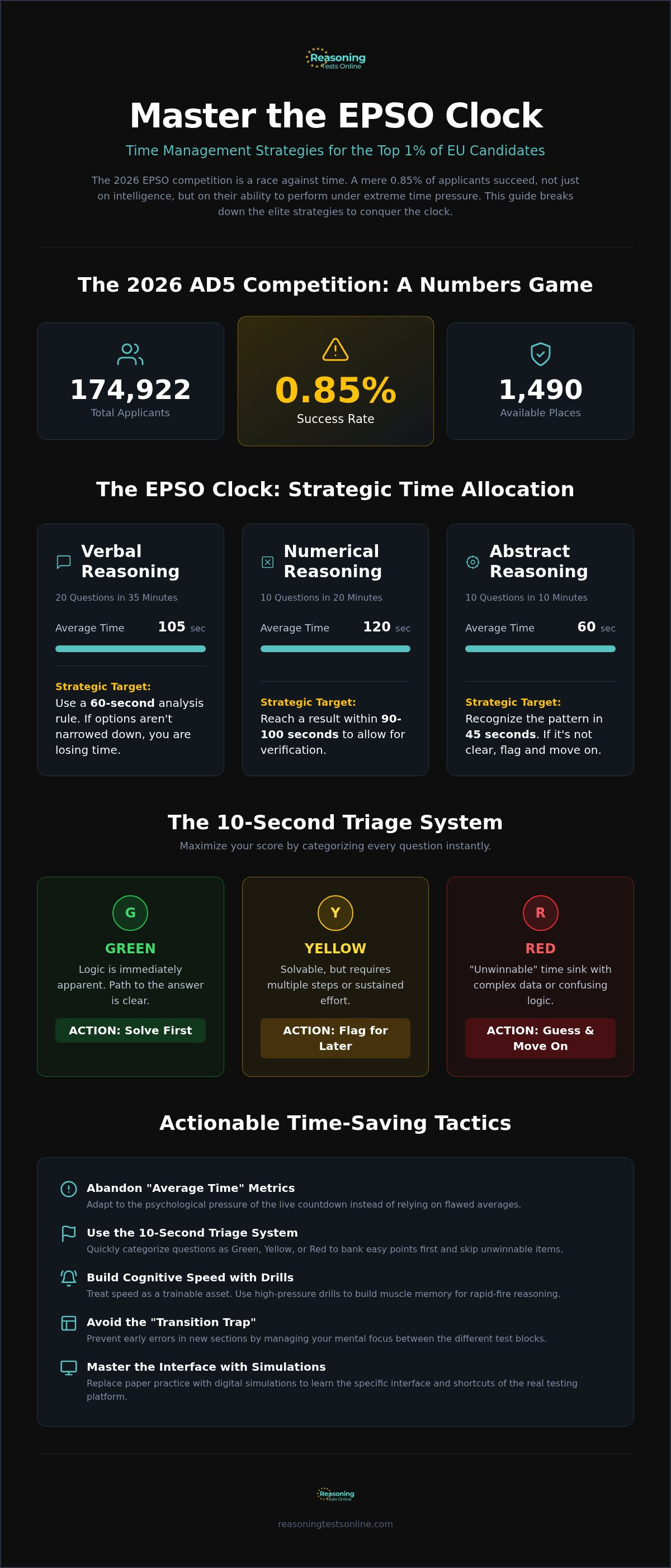
With 174,922 applicants competing for just 1,490 places in the 2026 AD5 competition, your intelligence is rarely the bottleneck; it's your clock. A success rate of only 0.85% proves that even the most gifted candidates fail if they cannot master EPSO exam time management. You've likely felt the frustration of having five questions left when the timer hits zero or the sudden panic that leads to blind guessing on a complex numerical test. It's a high-pressure hurdle that often turns qualified professionals into rejected applicants.
You don't have to be one of them. This guide provides the exact time-allocation frameworks and speed drills used by the top 1% of successful EU candidates to conquer reasoning tests. We will move beyond general advice to establish specific seconds-per-question targets for the 2026 verbal, numerical, and abstract reasoning blocks. You'll learn how to identify "time-sink" questions in under ten seconds and build the mental muscle memory required to maintain peak performance during the second hour of testing. We are breaking down the mechanics of the TAO platform to ensure you replace guesswork with systematic logic and finish with total confidence.
Key Takeaways
- Stop relying on dangerous "average time" metrics and master EPSO exam time management by adapting to the psychological pressure of the live countdown.
- Use the 10-second triage system to categorize questions as Green, Yellow, or Red, ensuring you skip "unwinnable" items to bank easier points first.
- Treat cognitive speed as a trainable asset by using high-pressure speed drills to build the muscle memory needed for rapid-fire reasoning.
- Identify the "Transition Trap" between test blocks to prevent early errors and maintain mental focus during the grueling final stages of the exam.
- Replace paper practice with digital simulations to master the specific interface and keyboard shortcuts used in the real 2026 testing platform.
The EPSO Clock: Understanding the Time-Per-Question Reality
Many candidates approach the European Personnel Selection Office (EPSO) exams with a fatal misunderstanding. They calculate an "average time per question" and assume they're safe. This is a trap. In the 2026 competition, speed isn't just an advantage; it's the primary filter. With 174,922 applicants for the AD5 competition alone, the exam is designed to break your pace. The ticking clock triggers a physiological stress response that impairs logic. Successful EPSO exam time management requires you to move past averages and adopt a strategic, question-specific tempo.
The psychological impact of the countdown timer is real. When you see seconds bleeding away, your brain shifts from analytical reasoning to panic-driven guessing. This "mental fog" is exactly what the test designers intend to measure. They aren't just testing your ability to solve a logic puzzle; they're testing your ability to remain disciplined under extreme pressure. Whether you're a generalist or an AD7 specialist, the fundamental challenge remains the same: you must control the clock before it controls you.
Breaking Down the Seconds: Verbal vs. Numerical vs. Abstract
The 2026 AD5 reasoning tests impose strict limits that demand different cognitive gears. For Verbal Reasoning, you have 35 minutes for 20 questions. That's 105 seconds per question. However, you must use a 60-second analysis rule. If you haven't narrowed down your options within the first minute, you're bleeding time from easier questions later in the block. Numerical reasoning is even tighter. With 10 questions in 20 minutes, you have exactly 120 seconds per item. You must reach a result within 90-100 seconds to allow for data verification. Abstract reasoning is the ultimate sprint. You have 10 questions in 10 minutes. This means your pattern recognition threshold is 45 seconds. If the logic doesn't click by then, you're better off flagging the question and moving on.
The 'Hidden' Time Sinks in the CBT Interface
The digital interface is your second opponent. Practicing on realistic EPSO test simulations is the only way to avoid interface-induced delays. Simple actions like scrolling through a long verbal passage or toggling the on-screen calculator eat 3-5 seconds per question. Over a 40-question exam, that's nearly three minutes lost to administrative friction. You must learn to read the question before the data. Looking at a complex table first is a mandatory time-waster because you don't know what you're looking for. Switch your focus: identify the specific data point required, then hunt for it. This systematic approach reduces the cognitive load and prevents the "switching cost" that occurs when you bounce aimlessly between the text and the answer options.
The Triage Strategy: Categorizing and Skipping Questions
Effective EPSO exam time management is not about answering every question. It is about maximizing your score within a fixed window. High-performing candidates use a 10-second triage system to audit every item before committing their mental energy. Within the first ten seconds, you must classify a question into one of three categories: Green, Yellow, or Red.
Green questions are those where the logic is immediately apparent. You solve these first. Yellow questions are those you can solve but will require sustained effort. Red questions are "unwinnable" time-sinks involving complex data sets or multi-step logic that exceeds your time budget. You must treat Red questions as sacrificial. Flagging them for later is often a mistake; if a question is truly Red, guess immediately and move on to protect the "winnable" points waiting at the end of the test block.
Identifying 'Unwinnable' Numerical Patterns
In numerical reasoning, an "unwinnable" question is any pattern requiring more than three distinct calculation steps to reach a result. If you find yourself three levels deep in a percentage change calculation and the answer isn't in sight, abandon the task. The cost of pursuing a single difficult point is often three easier questions later. If you have two minutes left and five questions remaining, shift to an educated guess strategy. Eliminate the obviously incorrect outliers and pick the most logical remaining choice. This disciplined approach ensures you never leave easy points on the table due to a lack of time.
Verbal Reasoning: The Keyword Scanning Shortcut
Reading every word of a long verbal passage is a recipe for failure. Instead, use keyword scanning to eliminate options. Focus on qualifiers like "all," "never," "sometimes," or "only." These words often signal a logical trap that makes an option incorrect regardless of the passage's general theme. By using these EPSO verbal reasoning tips, you can bypass the dense text and move straight to the logic. If you struggle to maintain this pace, practicing with realistic EPSO test simulations will help you build the visual speed required to spot these qualifiers in seconds. Never treat the passage as a story; treat it as a data set to be mined for specific evidence.
Building Mental Muscle Memory: 3 Essential Speed Drills
Cognitive speed is not a fixed trait. It is a trainable muscle. If you only practice for accuracy, you'll likely fail when the 2026 competition timer starts. The high-stakes environment of the exam changes how your brain processes logic. Mastery of EPSO exam time management requires a deliberate shift from accuracy-focused study to speed-focused mastery. You must use high-pressure simulation in your daily routine to bridge the gap between knowing the answer and finding it in seconds. Use detailed analytics from your practice sessions to track your "Speed-to-Accuracy" ratio; if your accuracy drops below 80% when you accelerate, you've found your current cognitive ceiling.
Drill 1: The Interval Sprint (Numerical)
Set a timer for 10 minutes and attempt eight high-difficulty questions. During the first five minutes, prioritize raw calculation speed over perfection. This drill forces your brain to stop second-guessing every operation. Once the timer ends, analyze your mental process to find where "lag" occurs. Are you losing time toggling the on-screen calculator? Are you misinterpreting the data table headers? Identifying these micro-delays allows you to refine your workflow and eliminate the friction that costs you points in the real exam.
Drill 2: The Pattern Flash (Abstract)
Open an abstract matrix and view it for exactly 15 seconds. Hide the image and immediately describe the core logic, such as rotation, color progression, or size scaling, from memory. This drill trains your brain to stop analyzing individual shapes and start recognizing systems. Refer to the Abstract Reasoning Tests framework to categorize patterns instantly. If you can't identify the underlying movement within 15 seconds, you'll struggle to meet the 45-second threshold required for success on test day.
Drill 3: The Elimination Blitz (Verbal)
Give yourself 20 seconds to read four answer choices and eliminate the two most "impossible" options. Don't look for the correct answer yet. Instead, focus on spotting logical failures and distractor information that doesn't affect the core claim. Follow this by attempting to define the primary argument of a passage in a single sentence within 10 seconds. This blitz sharpens your ability to filter through dense text and isolate the signal from the noise, which is essential for managing the 20-question verbal block efficiently.
Cognitive Load Management: Staying Sharp Across Test Blocks
The EPSO exam is a marathon of sprints. Many candidates master individual question types but fail because they neglect the cumulative mental toll of the 65-minute reasoning session. Success depends on your ability to switch gears between different logical frameworks. The "Transition Trap" is a common phenomenon where error rates spike during the first three questions of a new block. If you move directly from the linguistic complexity of Verbal Reasoning to the data-heavy Numerical block without a pause, your brain remains in the wrong processing mode. Effective EPSO exam time management requires a deliberate 30-second mental reset between these segments to clear your cognitive palette.
Mental fog typically sets in after 45 minutes of intense focus. In the 2026 competition, this fatigue hits just as you reach the Abstract Reasoning section, where pattern recognition must be instantaneous. You cannot afford a sluggish brain during the final 10 minutes. If you feel your concentration wavering, don't try to power through with brute force. Instead, use a brief physical reset. Even in a proctored environment, small adjustments can prevent a total cognitive collapse. Maintaining focus in a distracting testing center requires you to internalize your workflow so deeply that external noises become irrelevant background hum.
Oxygenating the Brain Under Pressure
Your brain consumes approximately 20% of your body's oxygen. Under pressure, most candidates adopt shallow, "chest" breathing, which triggers a fight-or-flight response and slows analytical logic. You must consciously practice deep, diaphragmatic breathing during your simulations. Simple posture adjustments also play a role; sitting up straight with your feet flat on the floor increases alertness and prevents the physical slouch that often precedes mental fatigue. Additionally, stop obsessing over the overall timer. Checking the countdown at the start, the midpoint, and the final two-minute warning is sufficient. Anything more is a distraction that breaks your logical flow. Focus on the question, not the ticking clock.
Nutrition and Hydration Strategies for Exam Day
Your preparation extends beyond the computer screen. The "glucose spike" myth leads many to consume sugary snacks right before the exam, resulting in a devastating mid-test crash. Instead, eat a meal with complex carbohydrates two hours before your appointment. This provides a steady stream of energy for the full duration of the test. Hydration is equally critical. Even mild dehydration can decrease calculation accuracy by 10-15%. However, you must manage your caffeine intake carefully. If you aren't a regular coffee drinker, exam day is not the time to start. If you are, keep your dose consistent to avoid jitters or a sudden drop in focus during the abstract reasoning block. To ensure your brain is ready for the rigors of the 2026 competition, start your mental training with realistic, timed simulations today.
Mastering the Interface: Simulation as the Ultimate Time-Saver
Practicing on paper is a deadly mistake for anyone serious about EPSO exam time management. A physical page allows for tactile scanning and manual notes that simply don't exist in the digital testing environment. The transition from a printed sheet to the proctored interface creates a friction cost that can waste up to 15% of your total time. You need to master the digital interface to ensure your logic isn't slowed by administrative hurdles. Using EPSO test simulations is the only way to reduce interface anxiety and turn the computer into a tool rather than an obstacle.
Your simulation data is a strategic asset. It reveals your personal "Time-Sink" question types; these are specific items where your accuracy is high but your speed is unsustainable. If you spend 150 seconds on a numerical question you eventually get right, you've still lost. The interface allows you to track these metrics with a precision that paper can't match. Mastering shortcut keys and the on-screen calculator's behavior ensures every second is spent on reasoning, not navigation.
Digital Muscle Memory: The Final Frontier
Training your eyes to scan digital tables requires a different focal rhythm. On a screen, your eyes must jump between the question, the data, and the options without the aid of a finger or pen to guide you. You must also master the "Next" button rhythm to avoid accidental double-clicks that skip questions and cause immediate panic. Full-length mock exams are the only way to test your true endurance. They ensure your clicking rhythm remains steady even during the high-pressure final ten minutes of the abstract reasoning block.
Ready to Beat the Clock?
Success in the 2026 competition comes down to the "Triage and Drill" system. You've learned to categorize questions in ten seconds, use speed drills to build muscle memory, and manage your cognitive load across different test blocks. Speed is a skill you develop through systematic, digital-first preparation. It's not a gift you're born with. It's time to replace guesswork with a proven methodology that mirrors the real exam environment. Check our Reasoning Test Practice Packages to start your speed training today and secure your place on the reserve list.
Secure Your EU Career by Dominating the Clock
Success in the 2026 EPSO competition requires more than just knowing the right answers. It demands a sophisticated system for EPSO exam time management that turns the ticking clock into a strategic advantage. By implementing the 10-second triage framework and training with high-pressure speed drills, you replace panicked guessing with calculated precision. You've learned to manage your cognitive load and navigate the digital interface with athletic efficiency.
Don't leave your future to chance. Use our systematic logic training and detailed answer explanations to refine your performance. The difference between a pass and a fail often comes down to the final five questions. Master the clock with realistic EPSO test simulations that mimic actual exam conditions. You have the tools and the strategy. Now, it's time to build the muscle memory that puts you on the reserve list. Success is the direct result of disciplined preparation.
Frequently Asked Questions
How much time do I have per question in the EPSO Numerical Reasoning test?
You have exactly 120 seconds per question for the 2026 AD5 Numerical Reasoning block, which consists of 10 questions in 20 minutes. This budget includes the time needed to interpret complex data tables and perform multi-step calculations. If you aren't nearing a result within 90 seconds, you're likely over-calculating and should prepare to move to the next item.
Is there a penalty for wrong answers in EPSO exams in 2026?
There is no penalty for incorrect answers in the 2026 EPSO competitions. Since there's no negative marking, you should never leave a question blank. If the timer is expiring, ensure every question has a selected option to maximize your score through probability. This is a fundamental rule for maintaining your pace under pressure.
Should I skip the hardest questions or try to solve them in order?
You should always skip the hardest questions to prioritize "winnable" points. Use a triage system to identify "Red" questions that will take more than two minutes to solve. Mastering EPSO exam time management means sacrificing these time-sinks to ensure you have enough time for the easier questions waiting at the end of the block.
How can I improve my reading speed for the Verbal Reasoning block?
Improve your speed by practicing keyword scanning rather than traditional reading. Focus on identifying logical qualifiers like "only," "always," or "sometimes" within the answer choices. This allows you to eliminate incorrect options without reading every word of the passage, which is essential for completing the 20-question block within 35 minutes.
Does practicing on paper help with the computer-based EPSO exam?
Practicing on paper is ineffective because it doesn't build the digital muscle memory required for the computer-based test. The real exam involves specific scrolling, calculator toggling, and screen-eye coordination. Use digital simulations to ensure your EPSO exam time management isn't ruined by interface friction and administrative delays on test day.
How do I manage stress when the exam timer starts turning red?
Manage stress by using diaphragmatic breathing to lower your heart rate and maintain oxygen flow to the brain. If the timer turns red, stop looking at the clock and focus exclusively on the logic of the current question. Obsessing over the countdown only increases cognitive load and leads to avoidable errors during the final minutes.
What is the best way to use the 'Flag' function for time management?
Use the 'Flag' function only for questions you have a high probability of solving with a bit more time. Don't flag "unwinnable" questions that you don't understand; guess and move on immediately. A backlog of flags creates a secondary time-management crisis that can lead to panic as the exam concludes.
Can I use my own calculator during the EPSO reasoning tests?
You cannot use a personal calculator during the reasoning tests. You must use the on-screen calculator provided within the TAO platform. Practicing with this specific digital tool is vital, as its layout and responsiveness differ from physical devices. Mastering the interface's calculator is a key component of a successful speed strategy.


