

Your years of professional experience in policy, law, or administration are likely the biggest obstacle standing between you and a seat on the 2026 EPSO reserve list. It's a counterintuitive truth; the more you know about the real world, the more likely you are to fail. When you're used to analyzing complex documents, you naturally look for nuance and external context. In the high-stakes environment of EPSO verbal reasoning for professionals, that habit is a liability that leads directly to "plausible but unsupported" distractor traps.
You probably find yourself overthinking dense, 200-word passages and watching the 35-minute clock run out before you've reached the final question. It's frustrating to lose points on a test that accounts for 35% of your ranked score simply because you relied on your expertise instead of the provided text. We're going to fix that by treating your preparation like mental training rather than a simple knowledge check.
This article promises to replace your guesswork with a repeatable, systematic logic framework. You'll learn how to strip away outside knowledge and identify the "one true" answer with clinical precision. We will preview the exact methodology needed to improve your speed to under 100 seconds per question, ensuring you stop losing points to the outside-knowledge traps that claim thousands of candidates every year.
Key Takeaways
- Treat the exam as a closed logical system where real-world expertise is a liability rather than an asset.
- Learn to distinguish between explicit statements and necessary inferences to avoid "plausible but unsupported" distractors.
- Master EPSO verbal reasoning for professionals by using a "Search and Destroy" workflow to eliminate wrong answers with clinical precision.
- Build the cognitive muscle memory required to handle 20 dense passages within the strict 35-minute time limit.
- Apply the "Absolute Truth" rule to instantly discard any option that isn't 100% supported by the provided text.
Understanding the EPSO Verbal Reasoning Framework
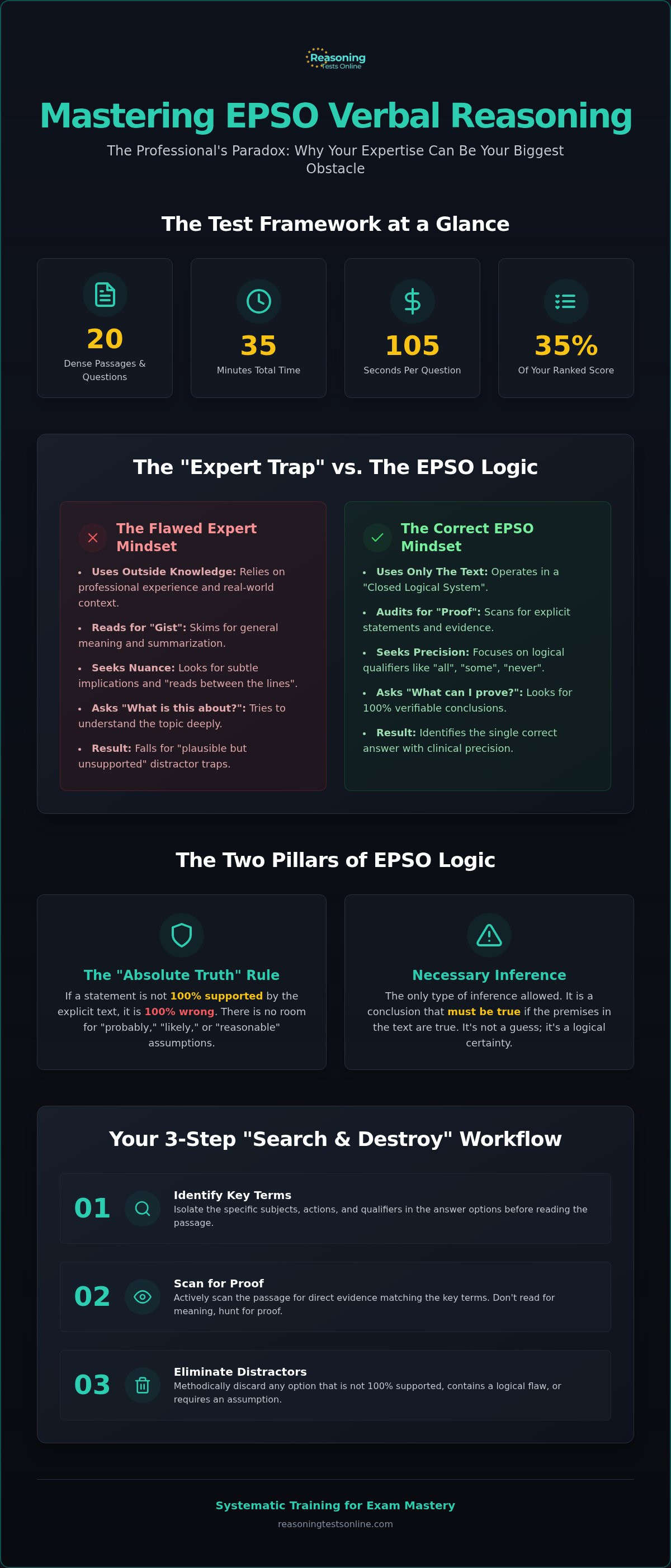
Success in EPSO verbal reasoning for professionals requires a total shift in perspective. You aren't being tested on your ability to summarize a text or your command of high-level English. Instead, the European Personnel Selection Office (EPSO) uses this assessment to measure your capacity for clinical logical deduction. In AD competitions, you must navigate 20 questions in just 35 minutes. That's exactly 105 seconds per question. Your sole objective is to identify the one statement that is 100% supported by the text. In this "Closed-System Logic" environment, external facts, personal experience, and general knowledge don't exist. If a piece of information isn't explicitly in the passage, it's irrelevant. There is no room for "probably" or "likely" in this framework.
The Anatomy of an EPSO Verbal Question
Every question follows a rigid structure designed to test your focus under pressure. You'll face a passage of 150 to 250 words written in dense, formal prose, often covering topics like EU directives or technical reports. Following the text is a standard prompt, such as "Which statement is correct?" The real challenge lies in the four options. One is the absolute truth derived from the text. The other three are carefully crafted distractors designed to exploit your professional intuition. These distractors often sound plausible or reflect real-world policy truths, but they lack direct evidence in the specific passage provided. Identifying these traps is the first step toward mastery.
Why "Reading" is the Wrong Approach
Most candidates fail because they treat the test as a standard reading comprehension exercise. To master EPSO verbal reasoning for professionals, you must treat every passage as an isolated universe. If you skim for general meaning, you'll fall for a trap. Standard reading allows for outside context; EPSO logical inference forbids it. Professionals often look for the "gist," but the test rewards those who look for "proof." You must move away from asking "what is this about?" and start asking "what can I prove?" Skimming for meaning causes you to miss logical qualifiers like "some," "all," "never," or "only." These small words are the difference between a correct answer and a distractor. When you practice on realistic EPSO simulations, you learn to stop reading and start auditing. Every sentence is a set of boundaries. Your job is to stay within them and ignore everything else.
The Logic Behind the Test: Deduction vs. Inference
EPSO doesn't care about your professional opinion or your ability to read between the lines. It cares about formal logic. To succeed, you must differentiate between what is explicitly stated and what is a necessary inference. In the world of EPSO verbal reasoning for professionals, "Absolute Truth" is the only currency. If a statement is 99% likely based on the text, it is 100% wrong. You're looking for the airtight conclusion that cannot be refuted. EPSO frequently uses qualifiers like "all," "some," "never," or "usually" to test your precision. A statement about "most" EU members cannot be used to prove a point about "all" members. Precision is your primary weapon.
You also need to master "Combined Inference." This occurs when the answer isn't located in a single sentence. Instead, it requires linking two separate facts across the passage to form a new, undeniable truth. If sentence A establishes a condition and sentence B describes a result of that condition, the correct answer often sits in the logical bridge between them. By reviewing detailed answer explanations in your training, you can see exactly where your logic might have diverged from the passage's strict boundaries.
Identifying Necessary Inferences
A necessary inference isn't a guess or a "reasonable" assumption. It's a conclusion that must be true if the premises in the text are true. For example, if the text says "All certified auditors must pass the CBT" and "John is a certified auditor," the necessary inference is "John passed the CBT." There is no other logical possibility. You aren't inferring John's mood or his study habits; you're deducing a fact based on a rule.
A Necessary Inference is the only logically unavoidable conclusion derived strictly from the provided text.
Decoding EPSO Distractor Types
EPSO distractors are engineered to look like correct answers to an untrained eye. They exploit the way your brain naturally processes information. Understanding EPSO verbal reasoning for professionals means learning to categorize these traps instantly.
- The "Out of Scope" Trap: These options contain information that is factually true in the real world but is never mentioned in the text. Professionals fall for this most often because they use their expertise to "fill in the blanks."
- The "Generalization" Trap: This takes a specific instance from the text and applies it too broadly. If the text says "one department is efficient," the distractor claims "the entire organization is efficient."
- The "Reversed Logic" Trap: This flips cause and effect. If the text says "High demand leads to price increases," the distractor claims "Price increases cause high demand."
Mastering these distinctions allows you to stop searching for the "right" answer and start eliminating the "wrong" ones with clinical certainty. This shift in mindset is what separates those who pass from those who overthink.
Avoiding the "Expert Trap": Why Professionals Often Overthink
The most dangerous moment in an exam occurs when you see a passage about a topic you manage daily. Whether it's the EU Green Deal, GDPR, or maritime law, your brain immediately switches from "test-taker mode" to "expert mode." You might think, "I know this topic, and the answer is actually X." This is a trap. In the context of EPSO verbal reasoning for professionals, your real-world expertise is often your greatest liability. EPSO isn't testing your policy knowledge; it's testing your ability to follow a specific, narrow logical path. If you choose an answer because it's true in your professional life but isn't explicitly proven in the text, you've fallen for an "Out of Scope" distractor.
Expertise Bias creates a secondary problem known as selective reading. When you're familiar with a subject, you subconsciously skip over foundational facts because they seem obvious. However, EPSO often builds the correct answer on those very same "obvious" premises. To combat this, you must develop the mental discipline to treat every passage as if it were written about a fictional planet. If the text claims that "the sky is green," then for the next 105 seconds, the sky is green. Ignore your career history and focus entirely on the boundaries of the text provided on your screen.
The Danger of Real-World Knowledge
EPSO intentionally selects EU policy topics because they know senior profiles will struggle to remain objective. It's a deliberate psychological hurdle. You might find yourself arguing with the passage or thinking of recent legislative updates that contradict the text. You must resist this urge. Success requires strict adherence to the "Text-Only" Rule: if a fact isn't on the screen, it doesn't exist. You aren't being hired to provide a policy briefing; you're being assessed on your capacity to operate within a closed logical system. If you start "importing" facts from your career, you'll pick the answer that sounds most professional rather than the one that's logically sound.
Mental Discipline for Senior Profiles
To neutralize your personal opinions, shift your focus away from the subject matter and toward the structural "Linker" words. Words like "however," "therefore," "despite," and "consequently" are the true indicators of the correct answer. These terms dictate the relationship between facts, regardless of what those facts are. When you explore our EPSO test simulations, you can practice this shift in focus. By training on realistic content, you'll learn to ignore the familiar subject matter and focus on the logical architecture of the passage. This mental training builds the muscle memory needed to stay disciplined when the stakes are high and the topics are familiar.
5 Tactical Steps to Analyze Complex EPSO Passages
To master EPSO verbal reasoning for professionals, you need a system that eliminates decision fatigue. Guesswork is your enemy. You must adopt the "Search and Destroy" method. This means you aren't looking for the right answer; you're actively hunting for reasons to disqualify the wrong ones. Most professionals fail because they try to understand the entire 250-word text before looking at the options. This approach wastes precious seconds on irrelevant details. By the time you reach the options, you've already forgotten the specific nuances required to distinguish the truth from a distractor.
The Step-by-Step Analysis Framework
Step 1: Read the question and all four options before touching the passage. This primes your brain to act as a filter rather than a sponge. Step 2: Identify keywords in the options. Look for specific nouns, dates, or technical terms that act as anchors in the text. Step 3: Scan the passage specifically for the relationships between those keywords. You don't need to comprehend the prose; you only need to verify the claims. Step 4: Eliminate options with "Extreme Qualifiers" like "always," "only," or "never." These are rarely supported by the nuanced prose of EU documents unless the text is unusually definitive. If an option uses absolute language, it's a high-probability distractor.
When facing "Except" or "Not" questions, mental focus is vital. These questions are designed to trip up fast readers who are scanning for positive confirmation. Mentally rephrase the prompt to "Which of these three is true?" so you can eliminate them and find the outlier. This keeps your logical process consistent even when the question format shifts. It prevents the cognitive "reset" that often leads to errors under pressure.
Time Management for Professionals
The 105-second rule is your hard limit. Spending three minutes on one difficult question is a score killer. It deprives you of the time needed for easier questions at the end of the test. Perform a 60-second check-in. If you haven't eliminated at least two distractors by the one-minute mark, you're overthinking. Make an educated guess between the remaining two, flag it, and advance. The goal is to maximize your total score, not to achieve perfection on every single question. Flagging is a strategic tool, not a safety net for indecision. Only return to flagged items if you have a clear time surplus at the end.
Practice this workflow until it becomes muscle memory. You can build your speed and accuracy by using realistic EPSO verbal reasoning simulations that replicate the high-pressure environment of the 2026 competitions.
Systematic Training: Moving from Theory to Exam Mastery
Understanding the logic of EPSO verbal reasoning for professionals is only the first step. Knowing that you should ignore your expertise is different from actually doing it when the timer is ticking down. Most candidates fail because they rely on passive reading, simply reviewing guides or reading EU news. This approach doesn't build the cognitive reflexes needed for the CBT. You must transition to active simulation. This means practicing in an environment that mimics the pressure, interface, and constraints of the real exam. Mastery isn't about knowing the rules; it's about reacting to logic patterns without hesitation.
Professional candidates often have high comprehension levels but low "logic speed." You might be able to find the right answer in three minutes, but that's a failing strategy in an AD competition. You need to develop mental muscle memory. This allows you to spot "Out of Scope" distractors or "Extreme Qualifiers" instantly. By the time you reach the 2026 testing period, your response to these traps should be automatic. You shouldn't have to debate with yourself; you should see the flaw and move on. Using detailed answer explanations is the most efficient way to diagnose your recurring logical blind spots and refine your approach.
Building Cognitive Muscle Memory
To overcome the dense nature of EU texts, you must incorporate speed drills into your routine. These aren't just about getting the answer right; they're about refining your "Search and Destroy" workflow under stress. After every session, perform a rigorous error analysis. Ask yourself a critical question: Was it a logic error or a time error? If you understood the logic but ran out of time, you need more simulation. If you had time but picked a distractor, you need to revisit the "Closed-System Logic" rules. You can check our practice package prices to find comprehensive verbal reasoning drills designed to sharpen these specific skills.
The Power of Realistic Simulation
Paper-based practice is a common trap for professionals. It fails to prepare you for the specific demands of the CBT interface, such as scrolling through dense text while a countdown clock sits in your peripheral vision. Mimicking the digital exam environment is essential to reduce "Selection Day" anxiety. When the interface feels familiar, your brain can dedicate 100% of its energy to logic rather than navigation. Success in the 2026 competitions requires a balanced preparation strategy. You should also Master Abstract Reasoning Patterns to ensure your performance is consistent across all reasoning modules. A systematic breakdown of every test type is the only way to secure your place on the reserve list.
Securing Your Place on the 2026 Reserve List
Success in the upcoming competitions depends on your ability to unlearn professional habits and adopt a clinical, logical framework. You've seen why outside expertise is a liability in a closed-system test. You now have the tactical steps to dismantle distractors and manage the 105-second pressure. Mastering EPSO verbal reasoning for professionals isn't about reading more policy papers; it's about refining your mental training until every logical deduction is automatic.
Transitioning from theory to mastery requires high-fidelity simulation. You must practice in an environment that reflects the actual CBT interface to eliminate Selection Day anxiety. Our platform provides specialized difficulty levels for AD5, AD7, and CAST profiles. Every question includes detailed logical breakdowns to help you diagnose blind spots before they cost you points. Don't leave your career progression to luck. Build the cognitive muscle memory needed to handle dense EU texts under intense time pressure. Start your realistic EPSO verbal reasoning simulations today and replace guesswork with a systematic advantage. You have the tools and the methodology. Now it's time to execute.
Frequently Asked Questions
What is the pass mark for EPSO verbal reasoning?
The pass mark is typically 10 out of 20 questions. However, for the 2026 AD5 Generalist competition, the verbal reasoning test accounts for 35% of your total ranked score. Simply passing is insufficient; you must aim for a high percentile to secure a spot on the reserve list. High competition among approximately 170,000 applicants means every point is critical for your final ranking.
Is the EPSO verbal reasoning test available in my native language?
You can generally take the test in any of the 24 official EU languages. Most candidates choose their strongest language to ensure they don't miss subtle logical qualifiers or nuances in the text. It's vital to practice in the specific language you intend to use on exam day. This builds the linguistic muscle memory required to process dense information under strict time constraints.
How long should I spend on each verbal reasoning question?
You have exactly 105 seconds per question. This includes reading the 150 to 250-word passage and evaluating four options. If you haven't identified the correct answer within 90 seconds, you should make an educated guess and move to the next item to maintain your pace. Excessive time spent on one question often results in missing easier points at the end of the test.
Can I use my own knowledge to answer EPSO verbal questions?
No, you must never use outside knowledge. The test uses a closed logical system where every correct answer is 100% supported by the provided text. Using real-world expertise is a common trap that leads candidates to pick "plausible but unsupported" options. If a fact isn't explicitly mentioned in the passage, it doesn't exist for the purposes of the test.
What is the difference between AD5 and AD7 verbal reasoning tests?
AD7 tests feature higher complexity in both logic and text density. While the format remains 20 questions in 35 minutes, the distractors in AD7 competitions are more sophisticated. Mastery of EPSO verbal reasoning for professionals at the AD7 level requires a deeper understanding of combined inferences. Professionals at this level must be especially careful not to let their senior-level expertise interfere with strict logical boundaries.
Are the verbal reasoning passages always about the European Union?
The topics are diverse and aren't limited to EU policy. While many passages focus on administration or legislation, others cover scientific discoveries, social trends, or history. The subject matter is irrelevant to the logical process. You must treat every text as an isolated set of facts. This mindset helps you avoid the "Expert Trap" when the topic feels familiar to your career.
How can I improve my reading speed for dense EPSO texts?
Improve your speed by reading the question and options before the passage. This allows you to scan for specific keyword relationships instead of reading for general meaning. You don't need to understand every word; you only need to verify the logic. Regular use of timed simulations is the most effective way to build the cognitive speed required for the 35-minute limit.
What happens if I don’t finish all 20 questions in time?
There is no negative marking for incorrect answers. If you are running out of time, you should fill in all remaining bubbles. A random guess gives you a 25% chance of scoring, whereas a blank answer guarantees zero points. Manage your EPSO verbal reasoning for professionals strategy by flagging difficult questions and moving on to ensure you see every question before the clock stops.


