

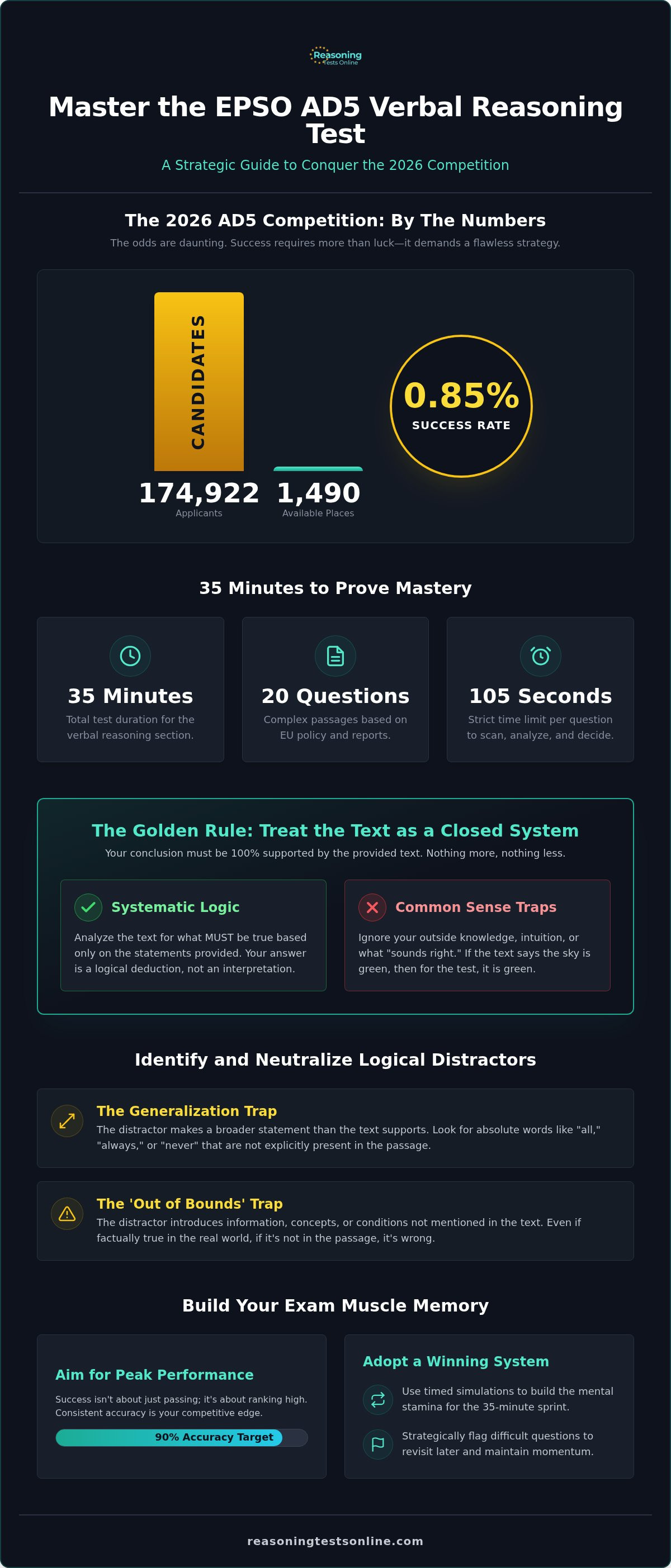
With 174,922 candidates competing for just 1,490 places in the 2026 cycle, your success rate for the EPSO AD5 competition sits at a razor-thin 0.85%. It's a sobering figure that proves luck isn't a strategy. To survive this cut, you need more than general reading skills; you need specific EPSO AD5 verbal reasoning examples that reveal the test's hidden mechanics. You're likely feeling the pressure of the 35-minute clock. Perhaps you've already fallen into the trap of using outside knowledge on a practice test, only to realize the "obvious" answer was wrong.
It's frustrating to see your score stall because you overcomplicate simple logical inferences. This guide provides the tactical walkthroughs you need to stop guessing and start analyzing with surgical precision. We'll deconstruct the specific logic the EU uses, show you how to ignore common sense traps, and help you build the muscle memory required to maintain 90% accuracy under pressure. You'll learn to treat every passage as a closed system where only the text matters, ensuring you stay focused and fast when the clock starts ticking.
Key Takeaways
- Master the 35-minute test format by allocating exactly 105 seconds per question to maintain momentum and avoid the common time-crunch trap.
- Identify and neutralize logical distractors like the 'Generalization Trap' and 'Out of Bounds' information that doesn't exist within the provided text.
- Analyze detailed EPSO AD5 verbal reasoning examples to understand how to deconstruct complex EU policy passages with surgical precision.
- Replace guesswork with a systematic approach that treats every passage as a closed logical system rather than a general reading exercise.
- Build essential exam muscle memory through timed simulations to overcome cognitive fatigue and ensure your accuracy stays above 90% during the high-stakes 2026 cycle.
Decoding the EPSO AD5 Verbal Reasoning Challenge
The EPSO AD5 verbal reasoning test is a computer-based assessment designed to evaluate your ability to think logically under extreme time pressure. It isn't a test of your general knowledge or your ability to summarize a story. Instead, it measures your capacity for logical deduction from specific written passages. The European Personnel Selection Office (EPSO) uses this as the primary gatekeeper for the AD5 Generalist competition. If you don't pass this stage, your journey ends before it truly begins.
There's one absolute rule: the answer must be 100% supported by the text provided. You must ignore everything you know about the world. If the text says the sky is green, then for the purpose of the test, the sky is green. Native speakers often fail because they rely on linguistic intuition. They choose what "sounds right" or what they know to be true in reality. Success requires a systematic logic that replaces these "common sense" traps with objective analysis. Studying high-quality EPSO AD5 verbal reasoning examples helps you internalize this boundary-based thinking.
Verbal Reasoning vs. Reading Comprehension
Understanding the text is only the first step. In standard reading comprehension, you might look for a summary or the author's tone. In an EPSO context, you're looking for what must be true based strictly on the premises provided. A summary captures the main idea; a logical inference identifies a necessary conclusion. When reviewing EPSO AD5 verbal reasoning examples, you'll notice that the correct options never rely on assumptions. You're being tested on your ability to identify the exact boundaries of the information given. If a statement goes even one millimeter beyond the text, it's a distractor.
The Role of Verbal Reasoning in the 2026 AD5 Competition
For the 2026 cycle, the stakes are higher than ever. With a success rate of approximately 0.85%, the reasoning tests act as the first filter in a two-stage process. You aren't just aiming for a pass mark; you're competing for a ranking that allows you to move to the second stage. This section is weighted alongside Numerical and Abstract reasoning. However, verbal reasoning is often where candidates lose the most time. By practicing with realistic Verbal Reasoning Tests, you build the mental stamina to handle 20 questions in 35 minutes without losing accuracy.
Test Structure: 35 Minutes to Prove Mastery
Precision is non-negotiable. The test consists of 20 complex passages, each paired with a single question. You have exactly 35 minutes to navigate this terrain. According to the Official AD5 Competition details, this computer-based test (CBT) evaluates your logical rigor under pressure. You don't have time to ponder. You need a system that allows you to scan, analyze, and decide in a single, fluid motion.
You have 105 seconds per question. This window is smaller than it looks. You must divide this time between scanning the text and evaluating the options. Don't linger on a single sentence. The interface allows you to flag difficult questions and revisit them using the review screen. Use this feature strategically. If a passage is overly technical and stalls your progress, flag it and move on to maintain your rhythm. Success depends on your ability to manage your mental energy across the entire 35-minute block.
Passages aren't random. They focus on EU policy, legislative frameworks, and institutional reports. Expect dense language and bureaucratic terminology. The goal isn't to test your knowledge of the Green Deal or the Digital Services Act. It's to see if you can isolate facts from a complex narrative. The test environment is designed to be distracting; mastering the interface is part of the challenge.
The Anatomy of an EPSO Verbal Question
Every question follows a rigid structure. The passage provides the only evidence allowed. The stem defines the logical task, often asking which statement can be inferred or which is true. Finally, you face four options. One is undeniably true based on the text; the other three are distractors. These distractors are often "Not Supported" or "False." Analyzing high-quality EPSO AD5 verbal reasoning examples is the only way to recognize these patterns before the real exam. You'll learn to spot when an option adds a condition not present in the original text.
Scoring and Performance Benchmarks
EPSO calculates your performance as a percentile. Your raw score matters, but your speed determines your ranking. There's no negative marking for incorrect guesses. However, the true cost of a wrong answer is the time you wasted reaching it. In the 2026 cycle, where the success rate is below 1%, every second counts. You can't afford to guess blindly. You need a methodology that ensures 90% accuracy within the time limit. To sharpen your timing, you should practice with realistic timed simulations that mirror the actual TAO platform environment.
Strategic Analysis: Identifying Logical Traps and Distractors
EPSO doesn't just test your logic; it tests your resistance to linguistic engineering. Success requires you to identify the specific traps designed to trigger your cognitive biases. By studying high-quality EPSO AD5 verbal reasoning examples, you'll see how these distractors operate in a controlled environment. You must learn to recognize these patterns before they drain your time during the live exam.
The 'Generalization Trap' is a frequent hurdle. If the text mentions that "some EU member states" have adopted a policy, a distractor will claim "all member states" have done so. This leap from specific to general is a logical error. Similarly, the 'Out of Bounds' trap relies on your expertise. It presents a statement that's true in reality but absent from the text. If the passage doesn't explicitly state it, the answer is "not supported." You must treat the passage as a closed logical system where outside knowledge is a liability.
Linguistic modifiers also play a critical role. Negative phrasing, such as "except," "unless," or "not," can flip the logic of a sentence entirely. If you scan too quickly, you'll miss these pivots. You should also be wary of absolute statements. Words like "always," "never," and "only" are rarely correct in an EPSO context because they leave no room for exceptions. Relative terms like "often," "sometimes," or "likely" are more common in valid inferences because they mirror the nuanced language of institutional reports.
Passage Analysis: The 'Keywords First' Method
Don't start by reading the passage from start to finish. Scan the question and the four options first. This allows you to identify anchor words, such as dates, specific names, or technical terms, before you commit your attention to the text. Once you have your anchors, you can filter out filler sentences designed to waste your time. You're looking for specific data points, not a narrative summary. This method ensures you stay focused on the evidence required to validate an option.
Logical Deduction vs. Necessary Inference
A necessary inference is a conclusion that must be true if the premises in the text are true. Many candidates fail because they choose "possible" answers. If a statement could be true but isn't strictly proven by the text, it's incorrect. Use the process of elimination to discard these "Possible but not Proven" options immediately. This systematic approach reduces the cognitive load and increases your accuracy under pressure. To refine this skill, you can practice with Verbal Reasoning Tests that provide detailed logic breakdowns for every distractor.
Step-by-Step Verbal Reasoning Examples and Walkthroughs
Passive reading is the enemy of mastery. To pass the 2026 selection tests, you must move beyond looking at the right answer and start auditing the logic behind the wrong ones. This section provides high-quality EPSO AD5 verbal reasoning examples paired with a "coach's walkthrough" to demystify the deduction process. Treat these as a blueprint for your own analysis.
Example 1 Walkthrough: The Environmental Policy Passage
The Passage: While the European Union has committed to a 55% reduction in net greenhouse gas emissions by 2030, current data suggests that only 14 member states are on track to meet their national targets. The remaining 13 states require significant structural reforms in their energy sectors. However, the overall EU target remains achievable if the leading nations exceed their individual quotas.
The Question: Which statement is fully supported by the text?
- Option A: All 27 member states will meet the 2030 target. (Incorrect: The text explicitly states 13 states are not on track.)
- Option B: Structural reforms in the energy sector are the only way to meet targets. (Incorrect: The word "only" creates an absolute statement not supported by the text.)
- Option C: It's possible for the EU to hit the 55% goal even if some states fail their national targets. (Correct: This is a necessary inference from the final sentence regarding leading nations exceeding quotas.)
- Option D: Most member states are currently meeting their targets. (Incorrect: 14 out of 27 is a simple majority, but the text uses the qualifier "only" to suggest this is not an optimal or "most" scenario in a positive sense.)
Example 2 Walkthrough: The Institutional Procedure Passage
The Passage: In the European Parliament, certain legislative proposals require a simple majority to pass, provided that at least one-third of the component members are present during the vote. If this quorum is not met, the vote is postponed to the next session. Currently, the Parliament consists of 720 members.
The Analysis: You must identify the hidden mathematical boundary. One-third of 720 is 240. Therefore, the "boundary of evidence" is that any vote with 239 or fewer members present must be postponed. If an option claims a vote with 230 members was successful, it's logically false based on the provided text.
This systematic breakdown replaces intuition with a repeatable method. You aren't looking for what's likely; you're looking for what's mathematically or linguistically certain. To build the speed required for the 35-minute exam, you should practice with realistic Verbal Reasoning Tests that mirror this level of complexity.
Building Exam Muscle Memory with Systematic Practice
Passive reading of EPSO AD5 verbal reasoning examples is the most common mistake candidates make. It creates a false sense of security. You might understand the logic when it's explained on a page; however, that doesn't mean you can replicate it under the 35-minute pressure of the real exam. Mastery isn't about knowing the theory. It's about building muscle memory. You need to train your brain to recognize logical patterns instinctively, even when cognitive fatigue sets in during the final questions of the block.
Reviewing your mistakes is the only way to close your personal logic gaps. If you consistently fail on 'Necessary Inference' questions, you have a systemic error in your deduction process. You must audit every wrong answer to understand why your brain chose the distractor. This transition from passive education to active EPSO Reasoning Test Preparation is what separates the 0.85% who succeed from the thousands who don't. Luck is not a factor when your system is sound.
Creating a Realistic Testing Environment
Practice as you play. If you're solving questions on paper with a coffee next to you, you aren't preparing for the reality of the TAO platform. You must use digital simulations that mimic the actual EPSO interface. This includes the timer, the flagging system, and the review screen logic. Analyzing your 'Time per Question' statistics is vital. If you spend 150 seconds on one passage, you've effectively stolen time from two others. Identify these bottlenecks early to refine your scanning technique and maintain a steady rhythm.
Next Steps: From Examples to Mastery
Success requires a disciplined daily schedule. Start with accuracy-focused drills to ensure your logical foundation is solid. Once you consistently hit 90% accuracy without time constraints, pivot to speed-focused drills. This phase is about maintaining that precision while the clock counts down. You're training for a high-stakes briefing, not a casual reading session. High-quality EPSO AD5 verbal reasoning examples serve as your initial map, but only consistent, timed simulation will get you to the Reserve List. Don't leave your career to chance.
Systematic preparation replaces anxiety with confidence. View our EPSO AD5 practice packages and pricing to start your professional training today.
Secure Your Place on the 2026 Reserve List
The path to an EU career requires more than intelligence; it demands a tactical system for handling high-pressure logic. You've seen how EPSO AD5 verbal reasoning examples reveal the difference between general comprehension and strict logical deduction. By identifying linguistic traps and respecting the boundaries of the text, you eliminate the guesswork that leads to failure. Success in the 2026 cycle is a result of systematic mental training and building the cognitive endurance to stay accurate when the clock is ticking.
Now is the time to transition from theory to performance. Our systematic preparation framework replaces uncertainty with a proven methodology. You can access realistic EPSO test simulations and detailed answer explanations that mirror the actual exam environment. Don't leave your AD5 aspirations to chance when you can train like a professional. Master the EPSO AD5 exam with realistic timed simulations.
Your preparation today defines your outcome in October. Take control of your performance and start building the muscle memory you need to succeed.
Frequently Asked Questions
Is the EPSO verbal reasoning test hard for native English speakers?
Yes, it's often more difficult because native speakers rely on intuition rather than strict logic. They assume they understand the nuances of the language and skip the formal deduction step. EPSO tests your ability to follow rigid logic, not your vocabulary or general fluency. Native speakers frequently fall for "common sense" traps that aren't explicitly supported by the text provided.
How many questions do I need to get right to pass the AD5 verbal test?
You generally need a minimum of 10 out of 20 to pass the section, but a simple pass isn't enough for the Reserve List. Because the 2026 competition is highly competitive, you should aim for a score of 18 or higher. Your ranking relative to other candidates determines if you move to the second stage of the selection process.
Can I use outside knowledge to answer EPSO verbal reasoning questions?
No, you must never use outside knowledge. The answer must be 100% derived from the provided text. If the passage contains factual errors compared to the real world, you must still treat the passage as the absolute truth. Using external facts is the fastest way to choose a "Not Supported" distractor and fail the question.
What is the best way to improve my speed in the verbal reasoning section?
The most effective method is practicing with realistic EPSO AD5 verbal reasoning examples under timed conditions. You need to develop a "keywords first" scanning technique to locate relevant data quickly. Training with simulations builds the mental stamina required to maintain a pace of 105 seconds per question without losing accuracy as cognitive fatigue sets in.
Are the passages in the actual EPSO exam longer than the examples?
Actual exam passages typically range between 150 and 250 words. While some lower-quality practice materials use shorter snippets, the real test features dense, institutional language. You should prepare using high-quality EPSO AD5 verbal reasoning examples that mirror this linguistic complexity. This ensures you aren't overwhelmed by the text's volume or the technical nature of the topics on exam day.
What happens if I run out of time during the test?
Any unanswered questions will be marked as incorrect by the TAO platform. Since there's no negative marking for wrong answers, you should always provide a guess for every question before the 35-minute timer expires. Use the final 60 seconds to fill in any remaining bubbles if you haven't finished your analysis of the final passages.
How often are the EPSO verbal reasoning tests updated?
EPSO updates its question database periodically to reflect current EU policy themes and institutional changes. The 2026 cycle features a shift toward a two-stage testing process, making the reasoning tests the primary initial filter. While the underlying logical principles remain consistent, the passage topics are refreshed to ensure they remain relevant to contemporary European administrative and legislative challenges.
Can I skip difficult questions and come back to them later?
Yes, the testing interface includes a flagging feature specifically for this purpose. If a passage is taking too long to decode, flag it and move to the next question to protect your momentum. You can use the review screen at the end of the session to return to flagged items if you have successfully managed your 35-minute time budget.


