

The CAST numerical reasoning test isn't a math exam; it's a high-speed data hunt where the clock is your most dangerous opponent. You've likely felt that spike of panic when a complex table appears and you realize you've spent forty seconds just trying to locate a single variable. Most candidates struggle with numerical reasoning for CAST not because they lack mathematical ability, but because they get lost in the noise of the data.
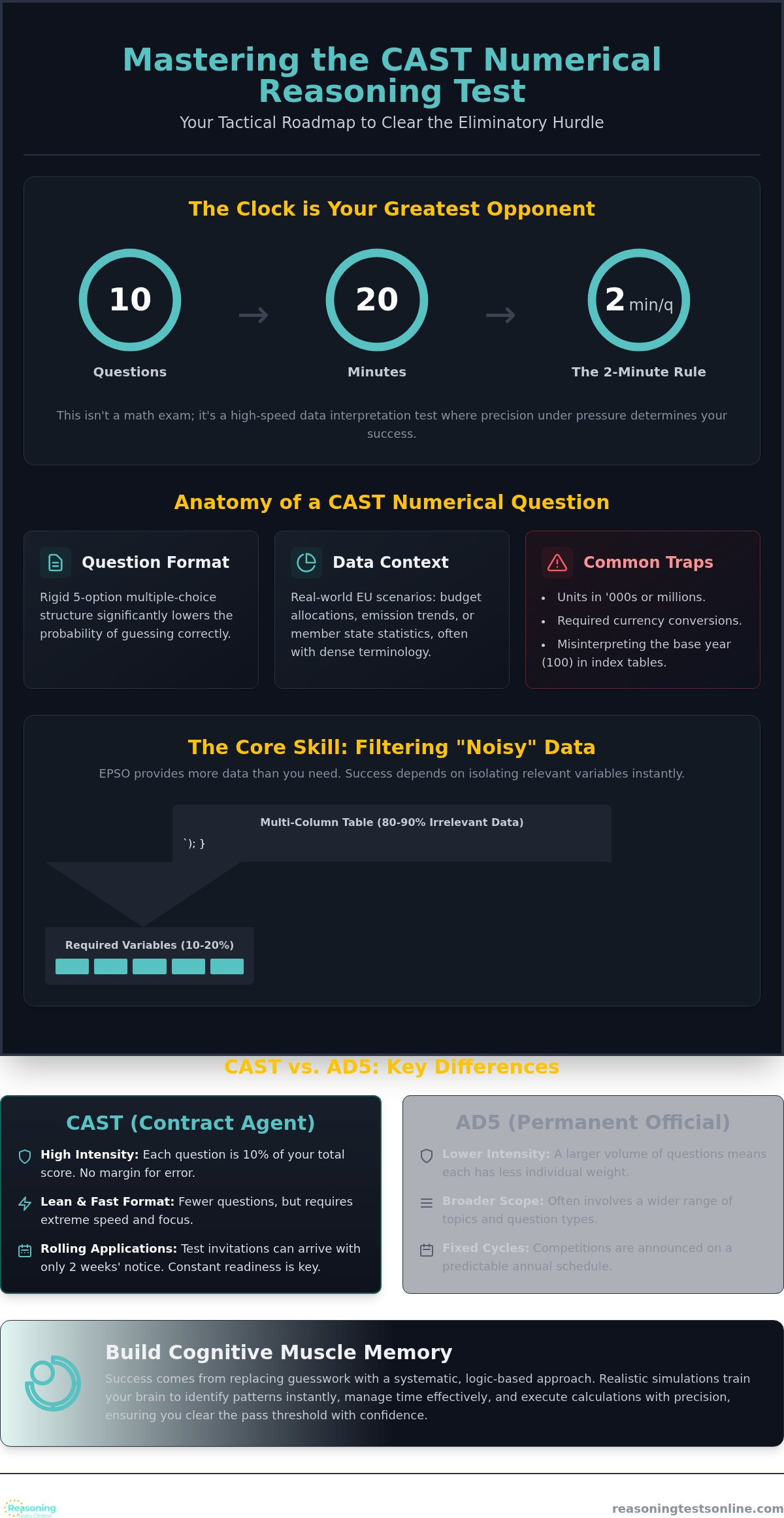
Mastering this assessment requires more than just a calculator. It demands a systematic way to filter irrelevant information and execute calculations under pressure. You need to handle 10 questions in exactly 20 minutes, leaving no room for second-guessing or slow, manual methods. Success comes from replacing guesswork with a disciplined mental framework that prioritizes speed and accuracy in equal measure.
This guide provides the tactical roadmap you need to pass the eliminatory threshold for the 2026 reserve list. We'll show you how to build the mental muscle memory required to identify patterns instantly and manage your time with professional precision. You'll learn to approach every chart with a clear strategy, ensuring your EU career isn't blocked by a manageable logic test.
Key Takeaways
- Understand why numerical reasoning for CAST acts as the primary eliminatory hurdle for your EU career and how to clear the pass threshold with confidence.
- Implement the "2-minute rule" to manage your 20-minute window with tactical precision, ensuring you maximize points without stalling on a single complex question.
- Learn to navigate high-density tables and charts by identifying relevant data points while avoiding common distractor traps designed to waste your time.
- Build cognitive muscle memory through realistic simulations that replace guesswork with a systematic, logic-based approach to data interpretation.
What is Numerical Reasoning for CAST? The Eliminatory Hurdle
The CAST (Contract Agent Selection Tool) numerical reasoning test is the primary gatekeeper for your EU career. It isn't a traditional math exam; it's a high-stakes assessment of your ability to process data under extreme time constraints. In 2026, the format is fixed at 10 questions to be completed in 20 minutes. This gives you exactly two minutes per question to read a table, identify the relevant variables, and execute the correct calculation.
Failure to meet the pass mark ends your candidacy immediately. Your score is more than just a number; it's the metric that determines your visibility to recruiting services. If you want to be shortlisted for a contract agent position, you must treat numerical reasoning for CAST as a tactical challenge rather than an academic one. The test identifies candidates who can remain calm while navigating complex charts, a skill that's non-negotiable in the European civil service.
The Role of Numerical Reasoning in the Selection Process
EU institutions value analytical logic over raw calculation. In a modern office, software handles the math, but humans must interpret the results. The 2026 CBT exams reflect this reality by presenting you with "noisy" data sets. You'll encounter multi-column tables where only 10% of the information is relevant to the question. Success depends on your ability to filter this noise quickly. If you can't isolate the data points you need within seconds, the clock will beat you. This systematic approach is what separates those on the reserve list from those who receive an eliminatory score.
CAST vs. AD5: Identifying the Key Differences
The mental setup for CAST differs significantly from the AD5 permanent official competitions. While AD5 tests often involve a larger volume of questions, the CAST format is leaner and more intense. Every single question represents 10% of your total score, leaving zero margin for error. Unlike the fixed deadlines of AD5 cycles, CAST applications are rolling. You might receive an invitation to test with only two weeks' notice. This creates a permanent need for readiness. You can find more detail on these structural nuances in our EPSO CAST test format 2026 guide. Master the logic now, or you'll be forced to rely on luck on test day.
The Anatomy of CAST Numerical Questions: Tables, Charts, and Traps
Every question in the numerical reasoning for CAST assessment follows a rigid, five-option multiple-choice structure. This format isn't accidental; five options significantly lower the probability of guessing correctly compared to standard four-option tests. The data you'll encounter isn't abstract. It typically mirrors real-world EU administrative scenarios, such as budget allocations for Erasmus+, carbon emission trends, or member state employment statistics. This "EU Policy" context adds a layer of complexity, as the terminology can feel dense and technical.
Success depends on your ability to handle units and currencies with absolute precision. A common mistake is ignoring a table's legend, where figures might be expressed in thousands or millions. If you miss this detail, your final calculation will be off by several orders of magnitude. You must also remain vigilant about currency conversions. If the data is provided in Euros but the question asks for a value in a different currency based on a provided exchange rate, the conversion is often the final, fatal step where candidates lose points.
Common Data Interpretation Formats in 2026
Modern CBT exams prioritize multi-year growth tables and index-based questions. When you see an index table, identify the base year immediately. In these scenarios, the base year is always set to 100. Any value above or below this represents a relative change, not an absolute figure. You'll also face complex bar charts where data is stacked or clustered. Don't let the visual noise distract you. Focus on the axes and the legend first. If you don't understand what the "Y" axis represents before you start calculating, you'll likely select a distractor answer designed to catch those who rush.
The Art of Spotting Distractors and Irrelevant Data
EPSO intentionally provides more data than you need. A table might contain eight columns of fiscal data, but the question only requires information from two. This tests your "data filtering" skills. Before you touch your calculator, isolate the specific variables required for the calculation. If you try to process the entire table, you'll exceed your two-minute window. Logic is your filter; use it to discard irrelevant rows immediately.
Be especially careful with the "percentage point" trap. A move from 10% to 12% is a 2 percentage point increase, but it's a 20% increase in relative terms. Distractor options will always include both results to punish candidates who confuse these concepts. To sharpen these filtering skills, you can practice with realistic numerical reasoning tests that simulate these exact administrative traps. Developing this mental muscle memory is the only way to ensure accuracy when the clock is ticking.
The 2-Minute Rule: Tactical Time Management for CAST
The 20-minute limit for the CAST numerical reasoning test isn't just a constraint; it's the defining feature of the assessment. With 10 questions to solve, you have exactly 120 seconds per item. In the high-pressure environment of numerical reasoning for CAST, this time shouldn't be viewed as a limit but as a strategic luxury you must manage with surgical precision. If you spend three minutes on one question, you aren't just losing time; you're actively sabotaging your chances on the next two. Success requires a disciplined cadence that prevents panic from setting in during the final five minutes of the sprint. Mental fatigue is real. A rigid time-management framework keeps you focused when your brain begins to tire.
Allocating Your 120 Seconds: A Tactical Breakdown
Tactical success relies on a structured workflow for every question. Don't start calculating immediately. Use the first 15 seconds for a high-level scan of the table legend, the axes, and the specific question prompt. This prevents the common error of calculating the wrong metric or using the wrong year. From 15 to 45 seconds, focus on isolating the necessary data points and selecting your formula. The execution phase happens between 45 and 105 seconds. This is where you use the on-screen calculator or mental math to derive the result. Finally, reserve the last 15 seconds for verification. Checking your decimal places and confirming the units before selecting an answer prevents avoidable errors that trigger eliminatory scores.
Overcoming the "Stuck" Phase: When to Move On
You will encounter a question that doesn't click instantly. Recognizing this "time-sink" early is vital. If you haven't identified the correct formula or data set by the 60-second mark, you're officially stuck. Don't let your ego dictate your strategy. Success in numerical reasoning for CAST depends on your ability to let go of a failing attempt. Use the "flag" function in the CBT interface to mark the question and move on immediately. This preserves your mental energy for easier points later in the test. If you must move on, try to make an educated guess by eliminating distractors that are mathematically impossible. A blind guess is a last resort, but it's better than leaving a blank. Remember, the goal is to pass the threshold for the reserve list. You don't need a perfect score; you need a strategic one.
Mastering Numerical Reasoning for CAST: A Step-by-Step Training Plan
Stop treating practice as a repetitive chore. To achieve mastery, you must shift your focus from simply "doing questions" to analyzing the underlying logic of every data set. In the 2026 interface, you'll have access to an on-screen calculator, but over-reliance on it is a tactical error when studying numerical reasoning for CAST. Use mental math for quick estimations to eliminate obviously wrong distractor answers. Reserve the calculator for the final, precise execution. This hybrid approach, combined with a personal formula cheat sheet for quick recall, keeps your pace high and your logic sharp.
Step 1: Isolate the Calculation Types
Mastery of numerical reasoning for CAST requires fluency in a few core operations. You don't need advanced calculus; you need secondary school math applied with professional speed. Focus your drills on percentage increases and decreases until the calculation becomes an automatic reflex. If you can't calculate a 15% growth rate in your head within five seconds, you aren't ready for the real environment. Master weighted averages and ratios, as these appear in almost every administrative budget scenario. Define percentage change as "the difference divided by the original value" to ensure you never flip the formula under pressure.
Step 2: Develop the "Scan-Identify-Execute" Loop
Speed comes from a repeatable process. Train your brain to follow a "Scan-Identify-Execute" loop for every item. Spend the first 15 seconds locating the specific row and column you need. Don't touch your calculator yet. Identify the required operation first. If the question asks for a per capita value, you know it's a division problem. If it asks for total growth, it's multiplication. To refine this workflow, you can browse our EPSO test preparation packages for targeted drills that isolate these specific skills before you attempt full simulations. This isolation training prevents you from making the same data-entry errors repeatedly.
Step 3: Simulate the Pressure Environment
Practicing without a timer is a waste of your resources. It builds a false sense of security that evaporates the moment the real clock starts. You must build "exam stamina" by completing full 10-question simulations in a single sitting. This trains your brain to handle the mental fatigue that often peaks around question seven or eight. For a complete preparation strategy that covers all bases, consult our Abstract Reasoning Tests guide to ensure your logic skills are sharp across all disciplines. Consistency in a timed environment is the only way to replace luck with mastery. Practice like you play, or you'll fail when it matters.
Realistic Simulations: Why Muscle Memory Beats Luck
Luck is a luxury you cannot afford when your EU career is on the line. To pass the eliminatory threshold, you must move beyond passive study and develop cognitive muscle memory. This is the ability to react to data patterns instinctively without the delay of conscious thought. When you face the numerical reasoning for CAST, the clock doesn't allow for deep contemplation. You need a system that triggers the correct logical response the moment a table appears on your screen. This level of readiness only comes from repeated exposure to realistic test conditions.
The Computer-Based Testing (CBT) interface is as much a part of the challenge as the math itself. In the 2026 remote testing environment, you must be comfortable with the on-screen calculator and the specific digital layout of the data. Practicing with paper and pen creates a false sense of security. Simulations ensure that the first time you navigate the real interface isn't the day of your exam. This technical familiarity prevents the interface-induced panic that causes many candidates to lose precious seconds during the 20-minute sprint.
Detailed answer explanations are the most critical part of your training. It isn't enough to know that you got a question wrong; you must understand the 'why' behind the logic. A professional preparation system breaks down every solution into punchy, digestible steps. This clarifies whether your error was a calculation mistake, a data extraction failure, or a misunderstanding of the prompt. By analyzing these explanations, you replace guesswork with a systematic methodology that works every time.
Performance analytics provide the final piece of the tactical puzzle. They allow you to isolate your specific weak points, whether you struggle with ratios, weighted averages, or multi-year growth tables. Instead of repeating what you already know, you can focus your energy on the specific areas that threaten your score. This targeted preparation ensures that every minute of your training contributes to a higher accuracy rate and a faster response time.
The Reasoning Tests Online Advantage
Our simulations are designed to mimic the high-stakes environment of the CAST exam with absolute fidelity. We don't just provide questions; we provide a professional coaching experience that demystifies complex logic. By moving through multiple difficulty levels, you transition from anxiety to authority. Systematic repetition builds the mental stamina required to maintain peak performance throughout the entire numerical reasoning for CAST assessment. We focus on the 'why' so you can master the 'how' under pressure.
Ready to Secure Your EU Career?
The path to the reserve list is paved with disciplined preparation. In the week before your test, focus on your personal formula cheat sheet and complete at least three full-length simulations to keep your muscle memory sharp. Ensure your testing environment is sterile and your internet connection is stable for the remote CBT. If you are ready to stop guessing and start mastering the logic, view our CAST practice packages and pricing to begin your tactical training today.
Securing Your Place on the 2026 Reserve List
The path to an EU career requires more than basic mathematical skills; it demands a systematic mastery of data interpretation under extreme pressure. You've seen how the 2-minute rule and aggressive data filtering separate successful candidates from those blocked by eliminatory scores. By focusing on cognitive muscle memory and the specific logic of the CBT interface, you transform a daunting hurdle into a manageable tactical exercise. Don't leave your numerical reasoning for CAST results to chance when the competition for contract agent positions remains high.
True readiness comes from training in an environment that mirrors the real exam. Our platform provides a realistic CBT interface simulation and expert-level difficulty settings to ensure you aren't surprised on test day. Every question includes detailed logic-based explanations to help you refine your methodology and eliminate guesswork. It's time to replace anxiety with a results-driven preparation strategy.
Master the CAST Numerical Test: Start Your Simulation Now and take the final step toward securing your professional future in the European institutions. You have the tools and the strategy; now execute the plan with confidence.
Frequently Asked Questions
Is the CAST numerical reasoning test difficult?
The test is challenging because it evaluates logic under extreme time constraints, not advanced mathematics. You have only 120 seconds per item to parse complex tables. Most candidates struggle with the "noise" in the data rather than the calculations. If you don't have a systematic approach to filter irrelevant information, the difficulty increases significantly. Success depends on your ability to remain calm while navigating the digital interface.
How many questions do I need to get right to pass the CAST numerical test?
You must achieve a combined score of at least 10 out of 20 for the Numerical and Abstract Reasoning sections. This means a low score in one can be offset by a high score in the other. However, aiming for the bare minimum is a risky strategy. High scores increase your visibility to recruiting services. Treat 10/20 as the absolute floor, not your target.
Can I use a calculator during the EPSO CAST numerical reasoning test?
You are provided with an on-screen calculator within the CBT interface for the 2026 exams. Physical calculators are not permitted. You should practice specifically with a digital calculator to build speed and accuracy. Many candidates lose time because they aren't used to clicking buttons on a screen. Integrating this tool into your mental training is essential for mastering numerical reasoning for CAST.
What is the best way to prepare for CAST numerical reasoning in a short time?
Focused, timed simulations are the most effective way to prepare when time is limited. Don't waste hours on theory; start doing questions under real 20-minute constraints immediately. Analyze every mistake using detailed explanations to understand the logic you missed. This builds the muscle memory needed to identify calculation types instantly. Efficiency is more important than the total number of hours you spend studying.
Are the numerical reasoning tests for CAST different from AD5?
The formats differ in volume and scoring weight. While AD5 competitions often involve more questions, numerical reasoning for CAST is a leaner, 10-question sprint. The CAST version focuses heavily on your ability to extract data from administrative tables. Because every question represents 10% of your section score, the margin for error is much smaller than in permanent official competitions.
What happens if I fail the numerical reasoning part of the CAST exam?
Failing results in an eliminatory score, which prevents you from being placed on the reserve list for that profile. Your candidacy for that specific selection procedure ends immediately. However, failing one profile doesn't necessarily block you from others. You'll need to wait for a new invitation to test again. This high-stakes nature is why systematic preparation is mandatory for anyone serious about an EU career.
How often can I retake the CAST numerical reasoning test?
If you fail the reasoning tests, you typically have to wait six months before you can be re-invited for the same profile and grade. CAST is a rolling selection process, so you can keep your CV in the database. You might be invited by a different service for a different profile sooner. Always check the specific rules in your call for expression of interest to confirm current 2026 timelines.
Do I need to know specific EU formulas for the CAST exam?
You don't need to memorize complex EU-specific fiscal formulas. The math required stays at a secondary school level, focusing on percentages, weighted averages, and ratios. The challenge is applying these basic tools to complex, multi-year data sets. You must be able to calculate growth rates and currency conversions quickly. Mastery comes from logic and speed rather than advanced mathematical knowledge.


