

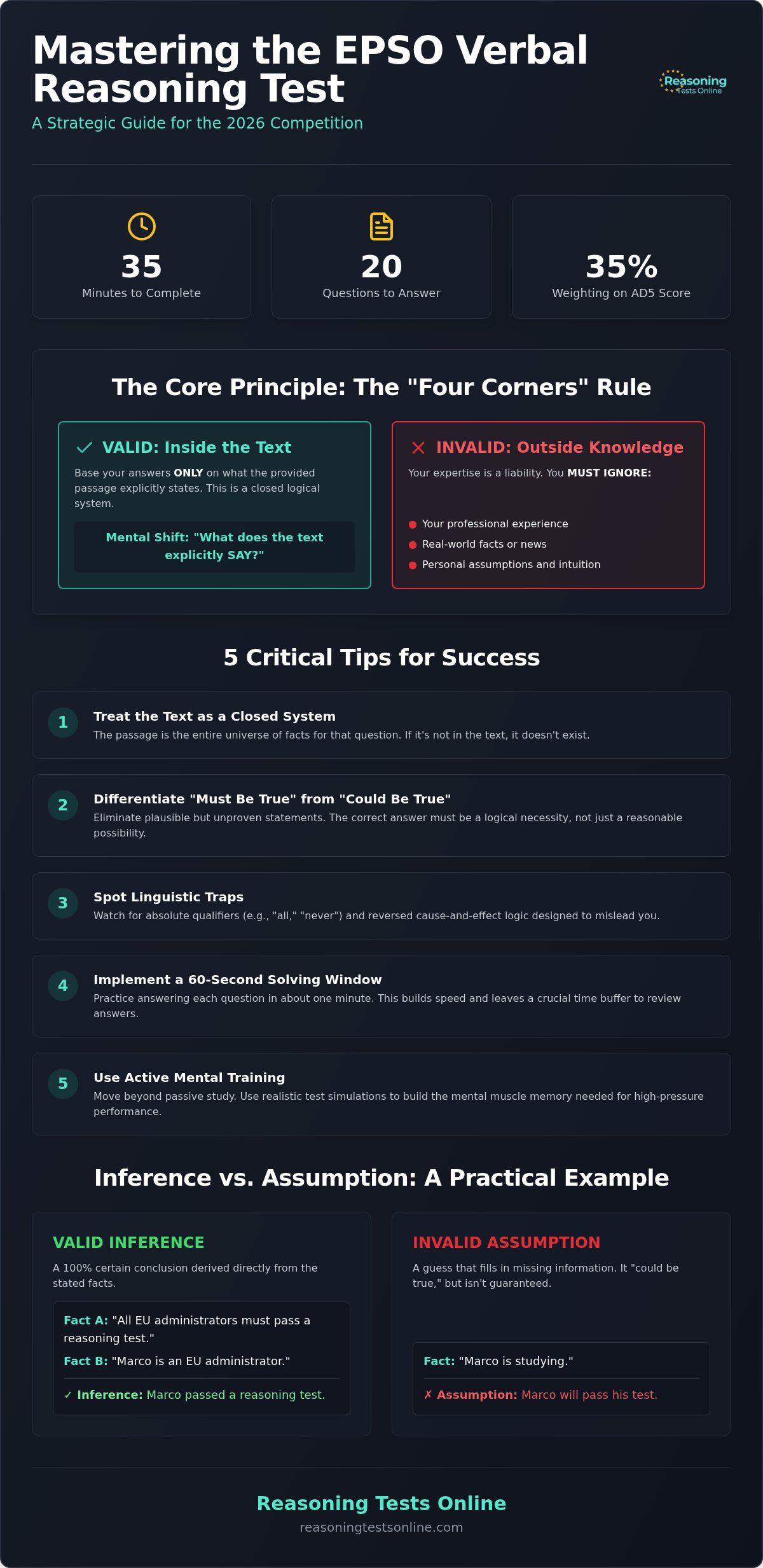
In the EPSO verbal reasoning test, your professional expertise is often your greatest liability. You might find yourself debating a statement that feels true based on your career experience, yet the text never explicitly supports it. This "real-world" trap is exactly why many candidates fail to reach the 10/20 pass mark or run out of time with five questions still remaining. Mastering these EPSO verbal reasoning tips is about unlearning your intuition and adopting a clinical, evidence-based mindset. It's a high-stakes environment where the 35% weighting of this test can make or break your chance at an AD5 starting salary of €6,152.
We understand the frustration of second-guessing whether a statement "must be true" or merely "could be true." You'll learn the exact logical frameworks and time-management strategies needed to pass the EPSO verbal reasoning test with confidence. This guide breaks down the 35-minute sprint into manageable steps, showing you how to treat the exam like a closed-system logic game. We'll preview the specific tactics used by successful candidates to improve speed without sacrificing accuracy. By building the mental muscle memory required for the 2026 competition, you'll be prepared for the 10 March 2026 application deadline and beyond.
Key Takeaways
- Treat the text as a closed system where outside knowledge is a liability that leads to logical errors.
- Differentiate between "must be true" and "could be true" statements to eliminate distractors with clinical precision.
- Apply specific EPSO verbal reasoning tips to spot linguistic traps like absolute qualifiers and reversed cause-and-effect logic.
- Implement a methodical 60-second solving window per item to ensure you finish all 20 questions within the 35-minute limit.
- Transition from passive study to active mental training using simulations that replicate the actual test interface and pressure.
What Makes EPSO Verbal Reasoning Unique in 2026?
The 2026 competition cycle has redefined what it takes to succeed. The European Personnel Selection Office (EPSO) uses verbal reasoning not to measure your vocabulary, but to assess your ability to process complex information under pressure. It's a formal logic assessment. You must deduce the only valid conclusion based solely on a provided text. Outside facts are irrelevant. In fact, they are often dangerous to your final score.
For the AD5, AD7, and CAST competitions, your "Language 1" proficiency is merely the baseline. Professional C1 proficiency is the starting point, not the goal. Success depends on your ability to strip away nuance and find the logical core. These EPSO verbal reasoning tips focus on this transition from reading to reasoning. In the 2026 landscape, the verbal test accounts for 35% of the final combined score for AD5 candidates. You aren't just reading; you are filtering data for logical necessity.
Logic vs. Attainment: Why Experts Often Fail
Subject matter experts often struggle because they know too much. If a text discusses EU environmental policy and makes a statement that contradicts your professional knowledge, you must ignore your expertise. The "Four Corners Rule" dictates that the provided text is the only source of truth for the exam. You must shift your mindset from "What do I know?" to "What does the text explicitly say?". This discipline prevents you from choosing answers that are true in reality but false within the specific context of the test.
The Structure of an EPSO Verbal Question
Every question follows a rigid architecture. You face a passage of 150 to 250 words, followed by a question stem and four distinct options. Only one option is logically certain. The other three are distractors designed to exploit common cognitive biases. This model ensures consistency across the multi-lingual environment of the EU. For a deeper look at how this applies to high-level careers, see our guide on EPSO Verbal Reasoning for Professionals. Using these EPSO verbal reasoning tips will help you identify the single correct answer without falling for "plausible" but unsupported claims. You have 35 minutes to navigate 20 of these structures. Accuracy is your priority, but speed is your survival mechanism.
Decoding the "Must Be True" Rule
The core of every EPSO verbal question is a hierarchy of truth. You aren't looking for the most likely scenario or a reasonable conclusion. You are searching for logical necessity. In this environment, absolute certainty is the only valid currency. A statement "must be true" only if it is impossible for it to be false based on the provided text. Staying within the "scope" means treating the 250-word passage as the entire universe. If a fact exists outside those four corners, it doesn't exist for the purpose of the test.
One of the most effective EPSO verbal reasoning tips is to strictly ignore "could be true" statements. These are plausible, realistic, and often align with your personal values. However, if the text doesn't provide direct evidence to prove them, they are incorrect. This distinction is where many candidates fail. They select an option because it sounds right in a real-world context. In the 2026 competitions, distractors are engineered specifically to sound like common sense while lacking textual support.
Inference vs. Assumption
A valid inference requires zero additional information. It is a direct logical extension of the facts. For example, if the text states "All EU administrators must pass a reasoning test" (Fact A) and "Marco is an EU administrator" (Fact B), then the inference "Marco passed a reasoning test" is a logical necessity. An assumption, by contrast, fills a gap that the text left open. During high-pressure moments, your brain naturally tries to bridge these gaps to save time. You must resist this. If the text says "Marco is studying," don't assume he will pass. Stay within the boundaries of the provided data.
The "Outside Knowledge" Trap
Your professional background is a double-edged sword. While it helps you read faster, it often forces you to import facts that aren't in the passage. You must treat your brain like a blank slate before every question. If a text about digital skills in 2026 contradicts a news article you read yesterday, the text wins. This strategy is similar to standard Civil Service verbal test preparation, where staying within the "scope" is vital for success.
The most "obvious" real-world answer is frequently the incorrect distractor. To see this in action, review our EPSO AD5 Verbal Reasoning Examples to identify how logic overrides intuition. If you want to refine this skill, you should practice with realistic simulations that mirror the actual exam logic. Using these EPSO verbal reasoning tips ensures you remain disciplined and focused on what is explicitly written. Every question is a fresh start where your only tools are the words on the screen.
5 Critical EPSO Verbal Reasoning Tips for Higher Accuracy
Success in the EPSO verbal reasoning test isn't about being a fast reader. It's about being a precise logic editor. To achieve a score that secures your place on the reserve list, you must recognize the specific linguistic engineering used to create distractors. These EPSO verbal reasoning tips focus on the most common traps found in the 2026 competition cycle.
- Mastering Qualifiers: Pay close attention to words like "always," "some," "never," and "often." These terms define the logical boundaries of a statement. If the text says "most" policies fail, an option stating that "all" policies fail is logically incorrect.
- Spotting Reversed Logic: Distractors often swap the cause and effect described in the passage. If the text says "increased digital literacy leads to better remote work outcomes," an incorrect option might claim "better remote work outcomes lead to increased digital literacy."
- The Out-of-Scope Distractor: These options are true in the real world but are never mentioned in the passage. If it isn't in the text, it isn't the answer.
- Generalization Traps: A specific example in the passage cannot support a broad conclusion. If the text mentions a successful pilot program in one department, you can't infer that the entire organization is successful.
- The "Half-Right" Trap: These options are the most dangerous. They often begin with a verbatim quote from the text but end with an unsupported or invalid conclusion. You must read every word of an option before selecting it.
Keyword Mapping for Faster Scanning
Don't read the passage first. Identify "anchor words" in the question stem and options. These are typically nouns or specific technical terms that are difficult to paraphrase. Once you have your anchors, scan the text for synonyms or paraphrased logic rather than exact word matches. Accuracy improves when you verify the linkage between these keywords. Does the text connect the two concepts in the same way the answer option does? If the relationship is different, the option is a distractor.
The Process of Elimination (POE)
Finding three wrong answers is often faster and more reliable than searching for the single "perfect" one. If you can logically disqualify three options based on the traps listed above, the fourth must be correct by default. When you have only 10 seconds left, use a "Smart Guess" by eliminating any option with absolute qualifiers like "never" or "always;" these are statistically less likely to be the "must be true" answer. To build the necessary speed, you should view our EPSO test simulations to practice these EPSO verbal reasoning tips in a realistic environment.
Managing the Clock: The 60-Second Strategy
In the EPSO verbal reasoning test, 20 questions in 35 minutes sounds generous. It isn't. When you factor in the time needed to read and parse dense non-fiction prose, each item offers a maximum of 105 seconds. However, if you use the full 105 seconds on every question, you'll have zero margin for error. One complex passage on EU regulatory frameworks could derail your entire session. Successful candidates don't just work fast; they work with a tactical buffer.
Adopt a 60-second execution target for the majority of items. Use these EPSO verbal reasoning tips to strip the logic from the text within one minute, leaving a 45-second reserve for the most difficult questions. If a passage is too dense to parse after two readings, "park" it. Mark a placeholder answer, flag the question, and move on immediately. It's better to secure points on the final five questions than to fail because you spent four minutes on a single logic trap. Since the 2026 competitions are proctored remotely, you must practice on a screen. Reading digitally is often slower than reading on paper, and you cannot physically underline keywords.
Speed Reading for Logic, Not Pleasure
Don't read for pleasure or general understanding. Train your eyes to skip descriptive adjectives and focus on logical operators. Words like "but," "therefore," "however," and "consequently" are the true anchors of the passage. The "Question First" approach is often the most efficient for EPSO. By reading the question stem and options before the text, you give your brain a specific logical target. This prevents you from wasting time on interesting but irrelevant details that don't contribute to the "must be true" conclusion.
Mental Stamina and the Fatigue Wall
Cognitive fatigue is a significant factor in the verbal reasoning test. Most candidates experience a measurable drop in accuracy after question 15. Your brain tires of the constant formal logic requirements, leading to "lazy" assumptions. You can counter this by using timed simulations to build endurance. Treat your preparation like an athletic endeavor where you push your focus further each week. If you're ready to begin this mental training, check our practice package prices to find the right level for your profile. You should start practicing with realistic verbal reasoning tests immediately to ensure your speed matches the 2026 requirements. Building this muscle memory is the only way to stay calm when the timer turns red.
Systematic Preparation: Building Verbal Muscle Memory
Passive reading is the enemy of progress. Simply reading magazines or news articles won't prepare you for the clinical logic of the 2026 selection tests. To succeed, you must transition to active analysis. One of the most effective EPSO verbal reasoning tips is the "Why is this wrong?" drill. After completing a practice set, don't just celebrate the correct answers. Spend double the time explaining exactly why every distractor was invalid. This process forces your brain to recognize the engineering behind the traps rather than relying on a vague sense of what feels right.
Your preparation should follow a structured 4-week progression. During week one, ignore the clock entirely and focus on 100% accuracy. In week two, analyze your error patterns to see if you consistently fail at reversed logic or generalization traps. Week three introduces timed drills to bridge the gap between logic and speed. By week four, you should perform full-length simulations that replicate the 35-minute pressure of the actual exam. This systematic approach ensures that your logical reasoning becomes a reflex rather than a conscious effort.
Why Simulation Trumps Static Practice
Static practice on paper lacks the psychological weight of a live countdown timer. When the clock turns red, your logical reasoning capabilities often degrade. Simulation software mimics this high-stakes environment, training you to maintain focus when your cognitive resources are low. Detailed answer explanations act as a virtual coach, correcting your thought process in real time. Regular exposure to complex logic structures under timed conditions builds the cognitive muscle memory required to process information automatically during the high-stakes environment of the actual exam.
Final Checklist Before Exam Day
Before the 10 March 2026 application deadline for the AD5 competition, confirm the specific requirements for your profile. While the pass mark is 10/20, your goal should be a high ranking to ensure you reach the reserve list. Remember the "No Guessing Penalty" rule. EPSO doesn't deduct points for incorrect answers, so you must never leave a blank. If you have five seconds left, fill in every remaining bubble. Maintain a results-driven mindset and trust the system you've built. If you've trained with realistic simulations, the real test is just another session. You can access our specialized simulations to finalize your preparation. Accuracy is a choice; speed is a habit. Master both, and the reserve list is within your reach.
Secure Your Place on the 2026 Reserve List
Success in the EPSO competition isn't a matter of luck or linguistic talent. It's the result of disciplined mental training and a clinical approach to formal logic. By mastering the "Must Be True" rule and isolating yourself from outside knowledge, you'll eliminate the intuition-based errors that derail most candidates. These EPSO verbal reasoning tips provide the framework to navigate the high-pressure 35-minute environment of the 2026 exams with precision.
You've learned to identify trap answers, manage the per-item clock, and build the muscle memory needed for the AD5, AD7, and CAST profiles. Now, you must translate this theory into performance. Our platform provides realistic timed simulations and detailed logic explanations for every question to ensure you never repeat an error. We offer specialized packages tailored specifically to your competition level. Start your EPSO Verbal Reasoning practice today and replace guesswork with a systematic strategy for success. The reserve list is waiting for those who prepare with purpose.
Frequently Asked Questions
How much time should I spend on each EPSO verbal reasoning question?
You have 105 seconds per item, but you should aim for a 60-second execution target. This creates a 45-second buffer for dense passages that require multiple readings. Speed is a byproduct of efficient logic rather than rushing. Use the extra time to verify complex linkings in the text. Practicing with a live countdown timer helps build the necessary pace to avoid the common trap of running out of time.
Can I use outside knowledge if the text is about a topic I know well?
No, you must never use outside knowledge during the test. The "Four Corners Rule" dictates that the provided text is the only universe that exists for the duration of the question. If a statement is true in the real world but unsupported by the passage, it is logically false. Professional expertise is often a liability that leads to incorrect assumptions. You must strip away your intuition and focus solely on the explicit evidence.
Is there a penalty for wrong answers in the EPSO verbal reasoning test?
There is no penalty for wrong answers in the verbal reasoning test. Because EPSO doesn't deduct points for incorrect choices, you should never leave a blank answer on your screen. If you're running out of time or facing an impossible logic chain, select a placeholder for the remaining questions. This strategy ensures you maximize your score potential by taking advantage of the statistical probability of a correct guess.
What is the best way to improve my speed in verbal reasoning?
The best way to improve speed is through systematic mental training using realistic simulations. Focus on identifying logical operators like "but" or "therefore" rather than reading for pleasure. These EPSO verbal reasoning tips emphasize building muscle memory so you recognize common logic traps instantly. Consistent practice on a digital interface prepares you for the specific challenges of remote proctoring where you cannot physically underline text or keywords.
Are the verbal reasoning tests the same for AD5 and CAST exams?
The logic remains identical, but the difficulty levels and question counts vary between AD5 and CAST profiles. AD5 competitions generally involve more complex syntax and denser passages than CAST exams. Regardless of the specific competition, the underlying requirement to deduce "must be true" conclusions remains the core assessment criteria. Training on higher difficulty levels ensures you're prepared for the most challenging logic structures regardless of your profile.
Should I read the text first or the questions first?
You should read the question stem and the four options before the text. This "Question First" strategy gives your brain a specific logical target to search for. Instead of processing every irrelevant detail in the passage, you scan specifically for anchor words and logical relationships. This method reduces the need to re-read the entire text multiple times, which is the primary cause of time management failure for many candidates.
How can I distinguish between a "Must be true" and a "Could be true" statement?
A "Must be true" statement is a logical necessity that is impossible to be false based on the text. A "Could be true" statement is merely plausible or likely but lacks definitive evidence. If you can imagine a single scenario where the statement is false despite the text being true, it is not the correct answer. You must look for absolute certainty rather than probability to eliminate the distractors effectively.
Does practicing in English help if I am taking the test in another EU language?
Practicing in English helps refine your logical framework, but you should ideally train in the language you've chosen for the exam. While the underlying logic is universal, subtle linguistic nuances in qualifiers like "some" or "often" are critical for accuracy. Our platform offers multiple difficulty levels and detailed logic explanations to ensure your EPSO verbal reasoning tips translate effectively to your specific testing environment and language choice.


