

The EPSO CAST isn't an intelligence test. It's a high-speed logic game where the clock is your primary opponent. Many candidates walk into the exam hall expecting their natural aptitude to carry them through, only to be blindsided by the relentless time pressure and the complexity of abstract patterns. It's easy to feel overwhelmed by the confusion between EEI and EPSO requirements or to see your scores fluctuate wildly during self-study. You've likely felt that sinking feeling when a pattern won't click while the seconds tick away.
Mastering your CAST exam reasoning practice requires more than just repetition. It demands a systematic methodology that replaces guesswork with tactical muscle memory. In this guide, you'll discover the exact tactical framework and professional practice resources needed to pass the EPSO CAST reasoning tests with total confidence. We'll break down the logic behind numerical, verbal, and abstract reasoning to ensure you achieve a score well above the pass mark. This is your roadmap to feeling calm, prepared, and ready to secure your place in the 2026 EU selection process.
Key Takeaways
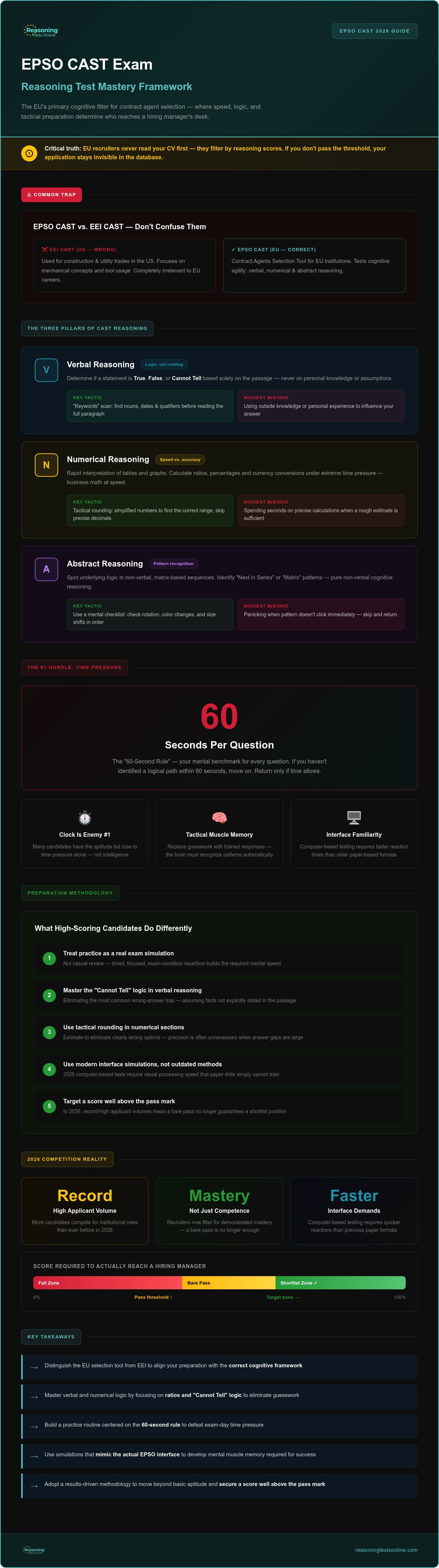
- Distinguish the EU selection tool from other exams to align your preparation with the correct cognitive framework.
- Master verbal and numerical logic by focusing on ratios and "Cannot Tell" logic to eliminate guesswork.
- Build a CAST exam reasoning practice routine centered on the 60-second rule to defeat exam-day time pressure.
- Use simulations that mimic the actual EPSO interface to develop the mental muscle memory required for success.
- Adopt a results-driven methodology to move beyond basic aptitude and secure a score well above the pass mark.
Understanding the EPSO CAST Reasoning Requirements
The EPSO CAST (Contract Agents Selection Tool) serves as the definitive gateway to a career within the European Union institutions. It's a rigorous pre-selection process designed to identify candidates with the cognitive agility required for diverse roles across the EU. However, many candidates stumble before they even begin. If you search for "CAST exam," you'll likely encounter materials for the US-based EEI test used for construction and utility trades. This is a common trap. The US version focuses on mechanical concepts and tool usage, which are entirely irrelevant to your EU ambitions. Your focus must remain exclusively on the EPSO cognitive framework.
Success in this phase is mandatory. Reasoning tests act as the primary filter for candidate shortlisting. EU recruiters don't start by reading your CV; they start by looking at your reasoning scores. If your results don't meet the required threshold, your application remains invisible in the database. Effective CAST exam reasoning practice is the only way to ensure your profile actually reaches the desk of a hiring manager.
The Three Pillars of CAST Reasoning
The exam evaluates three distinct cognitive domains. Each requires a specific tactical approach to master:
- Verbal Reasoning: You must analyze complex text fragments to determine if a statement is true, false, or if the information is simply not present. This isn't a reading test; it's a logic test.
- Numerical Reasoning: This section demands rapid data interpretation. You'll work with tables and graphs to calculate ratios, percentages, and currency conversions under extreme time pressure.
- Abstract Reasoning: You are tasked with identifying the underlying logic in non-verbal, matrix-based sequences. You must spot the patterns and predict the next step in the series.
Why 2026 Candidates Face Higher Competition
The landscape for EU recruitment is shifting. In 2026, the volume of applicants for institutional roles has reached record highs, making the talent pool more crowded than ever. A simple pass mark no longer guarantees a spot on the shortlist. Recruiters now look for candidates who demonstrate mastery, not just basic competence.
Testing interfaces have also become more sophisticated. Computer-based testing now requires faster reaction times and better visual processing than previous paper-based iterations. If you rely on outdated study methods, you'll likely fall behind. You need a dedicated CAST exam reasoning practice strategy that utilizes modern simulations to build the necessary mental speed. Success comes from preparation, not luck.
Core Components of CAST Reasoning Practice
Effective preparation requires a deep dive into the specific mechanics of the EPSO testing environment. You aren't just learning to solve puzzles; you're training your brain to recognize logical structures under extreme pressure. High-performing candidates treat their CAST exam reasoning practice as a simulation of the actual event. This means moving beyond casual review and adopting a systematic approach to each of the three core domains.
Verbal Reasoning: Beyond Reading Comprehension
Verbal reasoning is often misunderstood as a simple reading test. In reality, it's an assessment of formal logic. You must determine if a statement is "True," "False," or if the text provides "Cannot Tell" levels of information. The most common mistake is using outside knowledge or personal experience to influence your choice. If the passage doesn't explicitly state a fact, you cannot assume it's true. Use the "Keywords" technique to scan for specific nouns, dates, or qualifiers before reading the entire paragraph. This saves time and keeps your focus on the logic rather than the narrative.
Numerical Reasoning: Speed-Accuracy Tradeoffs
In the numerical section, the clock is your biggest hurdle. You'll face complex tables and multi-layered charts that require you to extract data and perform calculations quickly. For 2026, the focus remains heavily on business-related math: ratios, percentages, and currency conversions. To maintain speed, you must master tactical rounding. If an answer choice is far apart from others, use simplified numbers to find the correct range. Don't waste seconds on precise decimals when a rough estimate leads you to the correct option. Building this mental agility through simulated tests is the only way to balance accuracy with the ticking clock.
Abstract Reasoning: Cracking the Code
Abstract reasoning tests your ability to spot patterns in non-verbal sequences. Whether you're looking at a "Next in Series" or a "Matrix" logic question, you need a mental checklist to avoid panic. Start by checking for simple movements: rotation, color changes, or symmetry. If the pattern isn't obvious, look for the "one-off" rule where a single element changes independently of the others. By breaking the image down into its logical components, you eliminate the need for guesswork and find the solution through deduction.
Mastery comes from practicing all three sections in a single session. Fatigue is a real factor in the CAST exam. Your ability to maintain focus in abstract reasoning often drops after a grueling verbal section. Training in a realistic, timed environment builds the cognitive endurance needed to perform at your peak from the first question to the last.
The '60-Second Rule': Why Speed is Your Biggest Hurdle
The clock is not just a timer. In the EPSO selection process, it's a weapon used to separate the prepared from the merely talented. Most candidates fail not because they lack the intelligence to solve the problems, but because they lack the speed. You have roughly 60 seconds per question across the reasoning sections. This strict ratio creates a psychological pressure cooker. When you see the seconds ticking down, your brain's executive function can stutter. This leads to unforced errors on questions you would easily solve in a relaxed environment. High-stakes testing is as much about emotional regulation as it is about cognitive ability.
Unprepared candidates often fall into the trap of 'Time Drain' questions. These are problems that look deceptively simple but require multiple steps or complex data extraction. Identifying these drains early in your CAST exam reasoning practice is essential. You must learn to recognize when a question is designed to anchor you in place, stealing time from three easier questions further down the line. Success depends on your ability to maintain a steady rhythm despite the mounting pressure.
The Danger of Over-Analysis
Spending two minutes on a single question is a mathematical failure. Even if you get the answer right, you've effectively sacrificed the opportunity to answer another question entirely. You must develop a 'Point of No Return.' This is the moment, usually around the 45-second mark, where you decide to either commit to a final calculation or execute an educated guess. Educated guessing is a skill that must be trained. It involves the rapid elimination of logically impossible options to increase your statistical probability of success. It's a tactical maneuver, not a sign of defeat. Developing an instinct for question difficulty allows you to allocate your time where it yields the highest return on investment.
Building Cognitive Endurance
Think of your preparation as mental athletics. You are building muscle memory. Your brain should recognize a percentage increase or a matrix rotation automatically, without the need for deep conscious thought. This level of fluency only comes from consistent, high-fidelity simulations. Fatigue is your silent enemy during the final 15 minutes of the exam. As your glucose levels drop and mental strain peaks, your accuracy will naturally decline unless you've trained for endurance. Practicing in an environment that mimics the actual EPSO interface reduces test-day anxiety. When the real exam begins, your brain should feel like it's simply performing another familiar drill. Consistency in your CAST exam reasoning practice ensures that your performance remains stable even when your energy begins to wane.
Effective Practice Resources and Tactical Drills
Static study guides are a relic of the past. If you're relying on passive reading or flashcards, you're preparing for a test that doesn't exist. The EPSO CAST is a dynamic, computer-based assessment that requires active, simulation-based training. You need to transition from merely knowing the material to executing it under intense pressure. This is where a structured CAST exam reasoning practice routine becomes your primary competitive advantage. Success isn't about how much you study, but how effectively you simulate the challenge.
Step 1: Baseline Assessment
Start your preparation by taking a full, timed diagnostic test. This isn't about your initial score; it's about the data. Analyze your 'Time per Question' profile to see where your logic stalls. Are you losing three minutes on a single abstract matrix? Is your verbal scanning too slow to catch qualifiers? Use the latest 2026 EPSO pass mark data to set realistic target scores that place you well above the minimum threshold. You need a clear starting point to measure your progress accurately.
Step 2: Targeted Skill Drills
Once you've identified your weakest pillar, dedicate 30-minute blocks to specific patterns or formulas. If numerical reasoning is your bottleneck, drill percentage changes and currency conversions until they're automatic. Use 'untimed' mode initially to master the underlying logic without the stress of the clock. Once the logic is sound, reintroduce the timer to build speed. Leveraging realistic EPSO test simulations is the only way to bridge the gap between theory and the reality of the exam hall.
Step 3: Full-Length Simulation
Replicate the actual CAST environment as closely as possible. This means no phone, no music, and strict adherence to the time limits. This is the time to refine your 'skip and return' strategy. If a question doesn't click within 30 seconds, move on and secure points elsewhere. Analyze your performance trends over 5 to 10 full-length mocks to ensure your scores are stabilizing at a high level. Consistency in your CAST exam reasoning practice is what builds the mental stamina required for the final hour of the test.
The most critical part of this process happens after the timer stops. You must review your incorrect answers more thoroughly than your correct ones. A correct answer might be a lucky guess, but an incorrect answer is a map to a mental blind spot. Use detailed answer explanations to diagnose exactly why your logic failed. Did you miss a qualifier in the text? Did you misinterpret a pattern rotation? Correcting these specific errors is how you build the accuracy needed for a top-tier result. Ready to begin your training? You can select your specialized CAST package and start your tactical drills today.
Elevate Your Performance with Targeted CAST Simulations
Intelligence alone won't secure your spot in the EU institutions. You need a dedicated environment that replicates the specific cognitive strain of the EPSO selection tool. Generalist platforms often dilute their focus by covering hundreds of different exams, from US utility tests to generic corporate assessments. This lack of specialization is a liability for EU candidates. Your CAST exam reasoning practice must happen on a system designed specifically for the high-stakes EPSO ecosystem. Success is a result of tactical training, not just aptitude.
Why Reasoning Tests Online Beats Generalist Platforms
Interface fidelity is the cornerstone of effective preparation. If your practice tool doesn't look and feel like the EPSO testing platform, you'll waste precious seconds on exam day adjusting to the layout. Reasoning Tests Online provides high-fidelity simulations that mirror the actual interface you'll encounter in 2026. Our question banks are updated to reflect the latest competition standards, ensuring you're not training with obsolete logic or outdated data sets. By preparing for the 'worst-case scenario' through increased difficulty levels, you ensure the actual exam feels manageable by comparison. View our CAST reasoning practice packages to find the right tactical fit for your career goals.
The Path to Success: From Practice to Placement
Consistent training on a specialized platform transforms conscious effort into automatic pattern recognition. When you encounter a complex abstract sequence or a dense verbal passage, your brain shouldn't have to search for a methodology. It should already be there. This is the results-driven approach: replacing anxiety with a systematic process. This mental training builds the muscle memory required to maintain accuracy even when the clock is ticking down. It's about developing the stamina to perform at your peak throughout the entire session.
Knowing you've mastered the logic provides a psychological edge that no static study guide can offer. You'll walk into the testing center with the confidence of an insider who understands the hidden mechanics of the selection process. As an independent provider, we focus exclusively on giving you the tools to succeed where others fail. Don't leave your EU career to chance by using generic, non-specialized materials. Start your CAST training now and secure your place in the 2026 talent pool.
Secure Your Future in the EU Institutions
The path to a successful EU career is paved with logical precision and tactical speed. You've seen how the 60-second rule can dismantle an unprepared candidate's strategy. Relying on innate intelligence is a risk you don't need to take. By shifting your focus to high-fidelity simulations and systematic error analysis, you transform your preparation from a chore into a definitive competitive advantage. Success in these competitions is earned through disciplined, realistic training that mimics the actual testing environment.
Dedicated CAST exam reasoning practice is the only way to ensure your scores meet the high standards of the 2026 selection process. Reasoning Tests Online provides realistic EPSO test simulations and detailed answer explanations for every question to help you diagnose and fix mental blind spots. Trusted by thousands of EU exam candidates, our platform replaces guesswork with a professional, results-driven methodology. It's time to stop wondering if you're ready and start knowing you are.
Master the CAST with our specialized reasoning practice packages. Your preparation starts today. You've got the tools; now execute the plan with confidence.
Frequently Asked Questions
What is the difference between EPSO CAST and EEI CAST?
The EPSO CAST is the Contract Agents Selection Tool used exclusively for European Union institutional recruitment. In contrast, the EEI CAST is a US-based assessment for construction and skilled trades. Candidates often confuse them because of the identical acronym. If you're applying for a role in Brussels or Luxembourg, you must focus on the EPSO cognitive framework. Practicing with EEI materials will leave you unprepared for the logic required by EU recruiters.
How many questions are on the CAST reasoning test?
The standard reasoning test consists of 10 questions for Verbal, 10 for Numerical, and 10 for Abstract reasoning. These are administered during the pre-selection phase. While the number of questions is relatively low, the time limit is extremely tight. Each section is timed independently. You must maintain a high level of accuracy and speed to ensure your total score meets the requirements for the talent pool database.
Can I use a calculator during the CAST numerical reasoning exam?
You're permitted to use an on-screen calculator provided within the EPSO testing interface. Physical, handheld calculators are strictly prohibited in the exam hall. This makes it essential to incorporate the on-screen tool into your CAST exam reasoning practice. Learning to navigate the digital calculator's layout while reading complex data tables can save you several seconds per question. Speed with the interface is just as important as mathematical accuracy.
What is a passing score for the EPSO CAST reasoning tests?
For most profiles, the pass mark is 10 out of 20 for the combined Verbal and Numerical sections, and 5 out of 10 for Abstract reasoning. However, achieving the minimum score rarely guarantees a job offer. Recruiters use these scores to shortlist the top candidates from a massive database. You should aim for a score of 80% or higher to remain competitive in the 2026 selection process.
How long should I practice before my CAST exam date?
Most successful candidates dedicate two to four weeks of consistent daily training before their exam date. This timeframe allows you to move from understanding basic logic to developing the muscle memory required for the 60-second rule. If you start too late, you won't have enough time to analyze your errors and fix mental blind spots. A structured approach over 20 days is usually sufficient to stabilize your scores.
Is abstract reasoning the hardest part of the CAST?
Abstract reasoning is often cited as the most challenging section due to its non-verbal nature and strict time limits. Unlike verbal or numerical tasks, you can't rely on language skills or basic math. You must identify complex movements, rotations, and color changes in seconds. Many candidates find that their CAST exam reasoning practice needs to focus heavily on this area to overcome the initial confusion caused by dense sequences.
Are the CAST practice tests on Reasoning Tests Online updated for 2026?
Yes, all simulations and question banks on the platform are fully updated to meet 2026 competition standards. We monitor EPSO updates closely to ensure our interface fidelity and question types reflect the current testing environment. You won't be practicing with obsolete materials. Our focus is on providing high-quality, relevant drills that prepare you for the exact difficulty levels and logical patterns used in the latest EU selection procedures.
What happens if I fail the reasoning part of the CAST?
If you fail the reasoning tests, your application won't proceed to the recruitment stage. You'll remain in the EPSO database, but you won't be eligible for shortlisting for that specific profile. There is typically a six-month cooling-off period before you can retake the tests for the same profile. Failing is a significant setback, which is why systematic preparation is vital to ensure you pass on your first attempt.


