

With a success rate of just 3% for the EPSO AD5 Generalist competition, relying on natural logic is a strategy for failure. Most candidates freeze when they realize a standard non-verbal reasoning test online doesn't prepare them for the 10-question, 10-minute sprint of the actual exam. You've likely felt that panic during timed simulations or struggled to see the logic behind a shifting sequence of shapes.
It's frustrating to waste time on generic tests that don't reflect the technical traps EPSO sets. We promise to help you master the specific patterns and logic required to pass high-stakes exams using professional-grade simulations. You'll learn how to develop the mental muscle memory needed to recognize complex rules instantly and maintain accuracy under intense pressure.
This article provides a systematic breakdown of abstract reasoning mechanics and tactical advice for elite time management. We'll explore how to replace guesswork with a structured methodology so you can secure your spot in the top percentile of your competition.
Key Takeaways
- Identify the "Difficulty Gap" that causes high-performing candidates to fail when transitioning from generic quizzes to professional EPSO simulations.
- Master the five core logic variables—rotation, size, color, symmetry, and movement—to decode complex abstract matrices instantly.
- Build the necessary muscle memory to execute the "Scan-Identify-Eliminate" workflow under intense 60-second-per-question pressure.
- Practice with a professional non-verbal reasoning test online to ensure your preparation mirrors the exact timing and technical difficulty of the 2026 exams.
- Shift from guessing to mastery by using detailed logic explanations that reveal the systematic mechanics behind every pattern shift.
Why Generic Non-Verbal Reasoning Tests Online Fail Professional Candidates
Non-verbal reasoning measures fluid intelligence. It assesses how you process abstract information and solve problems without linguistic or numerical cues. In high-stakes selection like the EPSO AD5 or AD7 competitions, these tests serve as a brutal filter. Many candidates find a generic non-verbal reasoning test online and assume it's sufficient preparation. It isn't. Professional cognitive assessments are designed to push your mental bandwidth to the limit; they aren't simple puzzles found on social media.
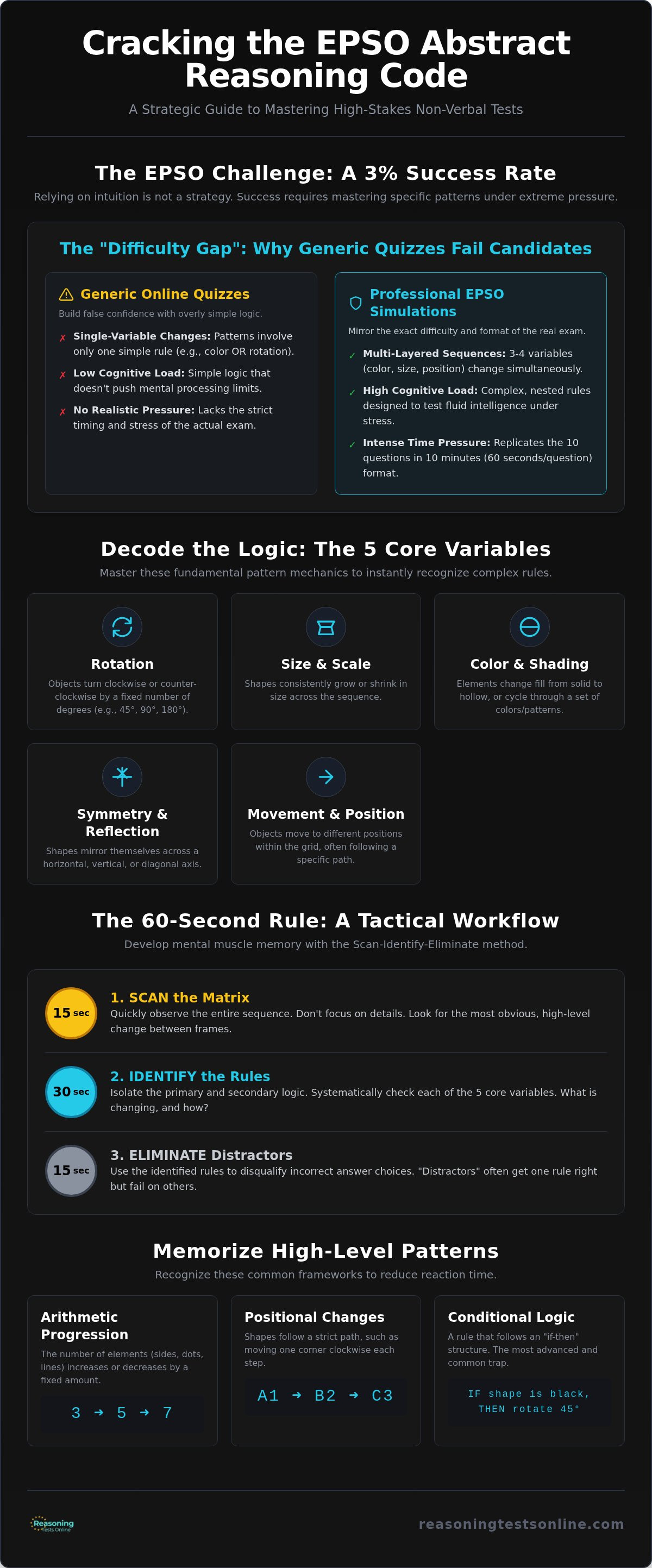
The "Difficulty Gap" is where most applications die. Free quizzes often rely on single-variable changes. You might see a shape rotate 90 degrees or change color. That's entry-level logic. Professional simulations use multi-layered sequences where color, position, size, and quantity change simultaneously. If you rely on luck or guessing, you're gambling with a career path that has an overall success rate of approximately 3%. Systematic preparation is the only way to replace hope with a strategic advantage.
The Difference Between 'IQ Quizzes' and Professional Simulations
Mental preparation requires high visual fidelity. If the interface doesn't match the proctored environment, you're training for the wrong fight. Professional tools move beyond the foundational logic of Raven's Progressive Matrices by introducing complex, nested rules. While those classic tests are useful for understanding the basics of abstract logic, they lack the multi-variable matrices found in actual EPSO tests. The psychological impact of a high-pressure timer changes how your brain processes visual data. You need to train in an environment that mirrors that stress.
Why Language-Neutral Doesn't Mean 'Easy'
It's a common myth that abstract tests require no study because they lack text. This is a dangerous assumption for any EU career seeker. EPSO uses these assessments to evaluate high-level problem-solving under extreme duress. These tests filter thousands of candidates by identifying those who can maintain logic when the pattern is obscured by "distractors"—half-right answers designed to mislead you. It's not about innate talent. It's about being trained to recognize the "why" behind pattern changes. Without a system, you'll likely fall for the cognitive traps set by examiners.
Decoding Pattern Logic: The Mechanics of Non-Verbal Mastery
Mastering a non-verbal reasoning test online requires more than a passing glance at shapes. You must learn to speak the language of abstract logic. This language is built on five core variables: rotation, size, color, symmetry, and movement. While a basic quiz might change one element, a professional EPSO simulation often manipulates three or four simultaneously. Success depends on your ability to isolate these rules without getting overwhelmed by visual noise.
Advanced questions often utilize a "Matrix" structure, typically a 3x3 grid where patterns move horizontally, vertically, or even diagonally. To solve these, you need a systematic approach to abstract reasoning pattern recognition. If you can't identify the primary rule within 15 seconds, you're likely falling behind the clock. You must treat this preparation like athletic training; you are building the mental infrastructure to process complex visual data instantly.
Common Pattern Rules You Must Memorize
You shouldn't wait for the exam to start analyzing logic. Memorize these common frameworks to build cognitive muscle memory and reduce reaction time:
- Arithmetic progression: Look for patterns in the number of sides, lines, or dots. If the first box has three dots and the second has five, the third likely has seven.
- Positional changes: Shapes rarely move randomly. They follow strict clockwise or counter-clockwise paths, often jumping a set number of degrees or positions.
- Conditional logic: This is the hallmark of high-level tests. It follows an "if-then" structure; for example, if a central shape is black, then the outer shapes must rotate 45 degrees.
The Architecture of a Non-Verbal Question
Every question consists of the "Stem"—the sequence or matrix you must solve—and several "Distractors." Distractors are cognitive traps specifically designed to mislead the unprepared candidate. They often incorporate one of the rules correctly while violating a second, more subtle rule. You might see an answer that matches the color pattern but fails the rotation logic. This is why answer B or C often feels "right" at first glance. To avoid these traps, you should practice with professional Abstract Reasoning Tests that mirror this level of complexity.
Essential Features of a High-Performance Non-Verbal Reasoning Tool
High-stakes testing is as much about psychological endurance as it is about logic. If you practice without a timer, you aren't practicing for the real exam. A professional non-verbal reasoning test online must mirror the exact 60-second-per-question constraint found in the EPSO 2026 competition. This time limit forces you to abandon slow, exhaustive analysis in favor of rapid pattern recognition. Without this pressure, your training remains theoretical and fails to prepare you for the reality of the testing center.
Knowing you missed a question is useless without understanding the underlying logic. High-performance tools provide detailed answer explanations that deconstruct every variable. If you don't see why a shape rotated or why a specific color changed, you can't build the mental frameworks needed for the next question. You should use Reasoning Tests Online EPSO packages to access these expert-level breakdowns. These explanations turn a mistake into a learning opportunity, ensuring you don't repeat the same error twice.
Difficulty scaling is another non-negotiable feature for serious candidates. The logic required for an AD5 Generalist track differs significantly from the multi-layered matrices used in AD7 Senior competitions. Your training tool should allow you to transition between these levels, ensuring your cognitive load remains high enough to foster growth without causing burnout. Mastering entry-level patterns is just the first step; you must eventually tackle the complex, nested rules that filter out the top tier of applicants.
The Importance of Realistic Interface Simulation
Exam day is not the time to learn how a digital interface works. "Interface shock" can cost you precious seconds and increase your cognitive load at the worst possible moment. By using a simulation that replicates the official layout, navigation buttons, and timing displays, you develop digital muscle memory. This familiarity allows your brain to focus entirely on solving the pattern rather than navigating the software. The closer your practice environment is to the real experience, the better your outcome will be.
Performance Analytics and Progress Tracking
You cannot improve what you do not measure. Advanced tools track your performance across different categories, identifying if you struggle specifically with 3D rotations, arithmetic progressions, or conditional logic. This data allows you to target your training sessions rather than repeating what you already know. Measuring your speed against your accuracy helps you find your "optimal performance zone." If your accuracy drops below the pass mark when you speed up, you know exactly where your logical framework needs reinforcement. Retaking these simulations isn't about memorizing specific answers; it's about cementing the systematic approach required for success.
The 60-Second Rule: Tactical Strategies for Solving Questions
Speed is a byproduct of methodology. In the 2026 EPSO competitions, you have exactly one minute per question to maintain a competitive pace. If you spend 90 seconds on a single matrix, you've already compromised your performance on the next item. Using a professional non-verbal reasoning test online allows you to practice the "Scan-Identify-Eliminate" workflow. This system replaces panic with a repeatable tactical process. You don't need to be a genius; you just need a better system than your competition.
Managing "Stall Time" is the difference between passing and failing. If you haven't identified at least one rule within the first 20 seconds, you are stalling. At this point, your cognitive load is too high to think clearly. You must learn to make an educated guess using whatever rules you've found and move on. Protecting your overall score is more important than solving a single high-difficulty puzzle. Mental training ensures you stay calm when shapes don't immediately make sense.
Step 1: Isolate One Variable at a Time
Don't look at the whole image. If you try to process everything at once, you'll see nothing but visual noise. Pick one element, such as a specific black square or a small triangle, and track that single element across the sequence. Does it move two spaces clockwise? Does it change size every other step? Once you find the rule for that element, apply it to the answer choices. Eliminate every option that violates this rule immediately. This narrows your focus and makes the remaining variables much easier to solve.
Step 2: Check for Inverse and Mirror Logic
Recognizing when a pattern reverses or reflects is essential for high-level mastery. Examiners frequently use symmetry to confuse the eye under pressure. You might see a sequence that appears to break, but it's actually reflecting across a horizontal or vertical axis. We define inverse logic as a common high-difficulty EPSO tactic where a rule is applied only when a specific condition is met, effectively flipping the expected outcome. Spotting these traps requires focused practice in a simulated environment.
Step 3: The Final Verification
Quickly check the remaining rules, like a color change or line count, against your top choice. Perform a "Sanity Check" by asking if the final pattern feels logically consistent across all steps. If it fits, lock it in and move to the next question. For those aiming for senior-level reserve lists, mastering Advanced Abstract Reasoning Tests provides the edge needed for complex AD7 logic. To start building your tactical advantage today, access our professional EPSO practice tools and begin your mental training.
Reasoning Tests Online: Your Strategic Advantage for EPSO 2026
Success in the 2026 EPSO competition cycle isn't a matter of chance. It's a matter of systematic preparation. While other candidates rely on intuition, you should rely on a proven system. We provide specialized Abstract Reasoning Tests specifically calibrated for AD5, AD7, and CAST tracks. These aren't generic IQ puzzles. They are high-fidelity simulations designed to challenge even the most experienced professionals. By training with materials that match the official difficulty, you ensure your performance is consistent and reliable.
A key advantage of our platform is the depth of our logic breakdowns. Finding a high-quality non-verbal reasoning test online is only the first step. You need to understand the 'why' behind every correct answer to replicate success under pressure. Our detailed explanations are written by logic experts who deconstruct the mechanics of every pattern, from complex arithmetic progressions to subtle mirror logic. This transparency replaces 'educated guessing' with 'systematic mastery.' When you understand the system, you eliminate the anxiety of the unknown. You stop reacting to the test and start controlling it.
Tailored for the 2026 EPSO Competition Cycle
We ensure our materials reflect the latest question styles and difficulty trends for the 2026 cycle. Our simulations mimic the current computer-based testing interface to reduce cognitive load on exam day. We focus exclusively on EU careers, providing insights that generalist platforms overlook. This specialization makes us the primary choice for serious candidates who can't afford to waste time on irrelevant materials. You'll move from practice to the official competition with the confidence that comes from having seen it all before. You aren't just taking a test; you're executing a strategy.
Investment in Your Career Success
Consider the stakes involved in this process. An EU permanent contract offers unparalleled stability, competitive benefits, and long-term career growth. Compare the modest cost of a practice package to the lifetime value of that career path. It's not just a purchase; it's a strategic move to secure your future. You can view our practice packages and pricing to choose the track that fits your specific competition. Logic is a skill, and like any other skill, it can be trained. With the right tools and a disciplined approach, you won't just pass the non-verbal reasoning test online; you'll dominate the selection process.
Secure Your EU Career with Systematic Preparation
Success in the EPSO 2026 competitions requires more than just natural intelligence. It demands a systematic approach to pattern recognition and rigorous time management. You've seen how generic tools fail to replicate the multi-variable complexity of the official exams. By isolating variables and mastering the 60-second rule, you replace guesswork with a repeatable methodology. Training with a realistic non-verbal reasoning test online is the only way to build the muscle memory needed to perform under pressure.
Our platform provides the specialized tools you need to bridge the "Difficulty Gap." With realistic EPSO simulations, detailed expert explanations, and conditions timed specifically for AD5 and AD7 tracks, you can train with precision. Don't leave your reserve list spot to chance. Get Instant Access to Professional EPSO Practice Packages and start your journey toward a permanent EU contract. Logic is a trainable skill; with the right tools, you'll enter the testing center with complete confidence.
Frequently Asked Questions
What is the difference between non-verbal and abstract reasoning?
These terms are essentially interchangeable in the context of professional cognitive assessments. Both evaluate your ability to identify rules and patterns in visual sequences without using words or numbers. Non-verbal reasoning is the broader category of visual logic; abstract reasoning is the specific term EPSO uses for these shape-based tests. Mastery requires looking past the graphics to the underlying logical mechanics that govern how shapes change.
How much time should I spend on each non-verbal question in the EPSO exam?
You have exactly 60 seconds per question for the abstract reasoning portion of the EPSO AD5 competition. This 10-question, 10-minute format is designed to test your speed and accuracy under intense pressure. If you can't solve a pattern within 45 seconds, you should use the remaining time to eliminate obvious distractors. Make an educated guess before moving to the next item to protect your overall score.
Can I really improve my non-verbal reasoning score through online practice?
Yes, you can significantly improve your score by building cognitive muscle memory. Consistent use of a professional non-verbal reasoning test online trains your brain to recognize common variables like rotation, symmetry, and arithmetic progression instantly. This systematic preparation replaces natural intuition with a repeatable methodology. It allows you to maintain accuracy even when the exam timer triggers a stress response. Success comes from disciplined training rather than luck.
Are these non-verbal reasoning tests online compatible with mobile devices?
Our simulations are optimized for desktop and laptop environments to mirror the actual EPSO testing interface. While you can review materials on mobile devices, we recommend practicing on a computer to build a realistic testing environment. Digital muscle memory is specific to the interface you'll use on exam day. Familiarizing yourself with navigation buttons and timing displays on a full screen provides a distinct strategic advantage.
Do your EPSO practice tests include detailed explanations for every answer?
Every question in our Abstract Reasoning Tests includes a comprehensive logic breakdown written by experts. We believe that knowing you are wrong is useless unless you understand the "why" behind the correct pattern. These explanations deconstruct the simultaneous rules and variables used in each matrix. This helps you identify and avoid the cognitive traps or "distractors" that EPSO examiners frequently set to mislead unprepared candidates.
How many questions are typically in a professional non-verbal reasoning simulation?
A professional simulation typically mirrors the 10-question format used in the AD5 Generalist competition. However, our practice packages offer hundreds of unique questions across multiple difficulty levels. We cover everything from entry-level CAST logic to advanced AD7 matrices. This volume of material ensures you encounter a wide variety of pattern types. It prevents you from being surprised by unfamiliar logic during the high-stakes official competition.
What is the best way to start practicing for a CAST exam?
Start by identifying your baseline performance with a timed simulation. CAST exams often feature a mix of reasoning types, so you should focus on mastering the "Scan-Identify-Eliminate" workflow for abstract sequences. Once you identify your weak patterns, such as 3D rotations or conditional logic, you can target those specific areas with our specialized practice packages. Consistent, focused training is always more effective than random exercises.
Is guessing penalized in the non-verbal reasoning section of the EPSO exam?
No, there is no negative marking for incorrect answers in EPSO reasoning tests. You should never leave a question blank on a non-verbal reasoning test online or during the official exam. If you're stuck on a complex pattern and the 60-second limit is approaching, eliminate the most unlikely choices and select the best remaining option. Our platform helps you develop the tactical skills to make these educated guesses more accurately.


