

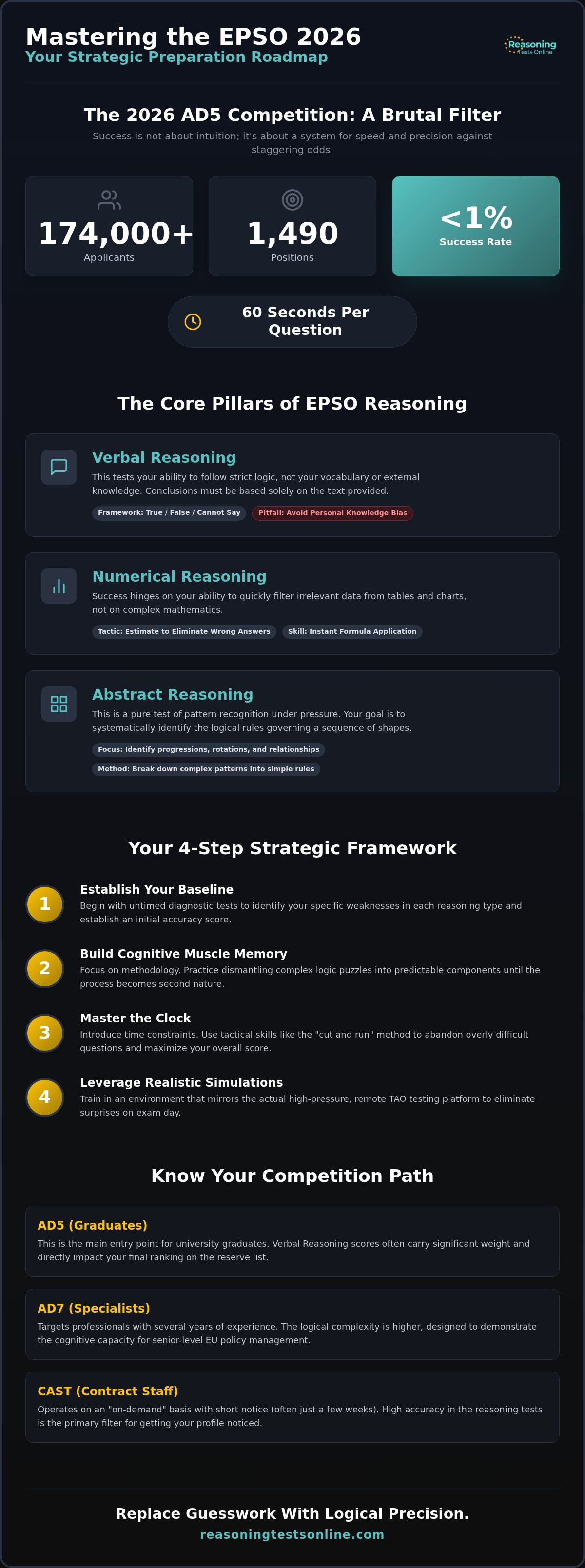
With over 174,000 applicants fighting for just 1,490 positions in the 2026 AD5 competition, your success rate sits at less than 1% if you rely on intuition alone. Effective EPSO reasoning test preparation is the only way to survive a 60-second-per-question limit that leaves no room for hesitation. You've likely stared at abstract patterns until they blurred, feeling the weight of a high-stakes career hanging on a single minute of logic. It's a brutal filter designed to reward speed and precision over general intelligence.
We're here to change your trajectory. This roadmap focuses on building systematic muscle memory rather than just memorizing answers. We'll show you how to dismantle complex logic puzzles into predictable components, allowing you to maintain accuracy under extreme time pressure. You'll gain a clear study framework that replaces confusion with a disciplined methodology. Success in these competitions isn't about luck; it's about the systems you use to process information.
We will examine the exact logic required for the 2026 pre-selection hurdles, from mastering the TAO platform interface to refining your pattern recognition. By the end of this guide, you'll have the tools to approach every question with the confidence of a seasoned strategist. Let's move beyond guesswork and start training for results.
Key Takeaways
- Navigate the 2026 selection landscape by mastering the specific logic systems required to beat the sub-1% success rate.
- Build a strategic framework for EPSO reasoning test preparation that prioritizes diagnostic baselines and untimed accuracy.
- Develop cognitive muscle memory to dismantle complex verbal, numerical, and abstract patterns in under 60 seconds.
- Learn tactical time management skills like the "cut and run" method to prevent difficult questions from stalling your progress.
- Replace guesswork with logical precision by using realistic simulations that mirror the high-pressure 2026 testing environment.
The 2026 EPSO Competition Landscape: High Stakes and Systematic Selection
The 2026 AD5 Generalist competition (EPSO/AD/427/26) attracted a record surge in candidates; some reports indicate over 174,000 applicants vied for only 1,490 positions. This creates a brutal success rate of less than 1%. Generic preparation won't bridge this gap. The European Personnel Selection Office (EPSO) has fully transitioned to a remote, computer-based testing model using the TAO platform. This shift means your technical environment and cognitive speed are now equally critical. Success requires a transition from passive reading to active, high-pressure simulation.
Your journey begins in the Single Candidate Portal (SCP), where testing windows are often restricted to short intervals of three to four weeks. In 2026, the demand for specialized reasoning has intensified. It's no longer enough to be "good" at logic. You must be faster and more precise than 99% of your peers. High-stakes selection demands a systematic approach to EPSO reasoning test preparation that mirrors the actual exam interface and time constraints.
AD5 vs. AD7: Which Preparation Path to Choose?
The AD5 competition serves as the primary entry point for university graduates. In this track, verbal reasoning scores often carry significant weight, directly impacting your final ranking and placement on the reserve list. Numerical and abstract tests are frequently pass/fail, but the "pass" threshold is effectively rising due to the extreme volume of high-performing applicants. AD7 competitions target senior administrators with several years of professional experience. The logical complexity in AD7 tests is higher. You aren't just solving puzzles; you're demonstrating the cognitive capacity for senior-level EU policy management. Identifying these weighting differences early allows you to allocate your study time where it yields the highest ROI.
The CAST Selection Procedure for 2026
The CAST selection operates on a different rhythm than permanent official competitions. Registration is always open, but testing is "on-demand." If an EU institution finds your profile relevant, they'll invite you to sit the reasoning tests. This creates a unique pressure; you might only have a few weeks' notice before your exam date. For contract staff, reasoning accuracy is the primary filter. If you don't clear the reasoning battery with high marks, your profile remains dormant in the database. Consistent, daily training is the only way to ensure you're ready when that invitation arrives in your inbox.
The Core Pillars of EPSO Reasoning: Verbal, Numerical, and Abstract Logic
Mastering the EPSO selection process requires more than high intelligence. It demands a specific cognitive agility that balances speed with surgical precision. The "60-Second Rule" dictates the rhythm of your success. If you spend 90 seconds on a single question, you've effectively stolen time from your future self. Effective EPSO reasoning test preparation transforms these tests from daunting hurdles into predictable systems.
Verbal Reasoning: Beyond Reading Comprehension
Verbal reasoning isn't a test of your vocabulary. It's a test of your ability to follow strict logic within a "True, False, Cannot Say" framework. The most common pitfall is personal knowledge bias. If a passage about EU trade policy contradicts a fact you know from your daily job, you must ignore your expertise. You only have 35 to 60 seconds to scan, analyze, and decide. Focus on identifying keywords and logical connectors like "only," "never," or "all" to avoid these traps.
Numerical Reasoning: Tactics for Non-Mathematicians
You don't need a math degree to succeed here. You need the ability to filter noise. EPSO tables are intentionally cluttered with distractor data to slow you down. Success comes from knowing which EPSO numerical reasoning formulas to apply instantly. Use the on-screen calculator for complex division, but rely on mental estimation to rule out obviously wrong answers. This balance keeps your momentum steady while ensuring accuracy. You can refine these skills by integrating realistic numerical reasoning tests into your daily routine.
Abstract Reasoning: Pattern Recognition Systems
Abstract reasoning is often the most intimidating section because it feels random. It isn't. Every matrix follows a combination of five variables: color, position, shape, size, and orientation. Don't guess the next shape in the sequence. Instead, use a systematic elimination process. Track one variable at a time across the frames to isolate the rule. For a more detailed breakdown, check out this deep dive into abstract pattern mastery. This methodical approach removes the emotional stress of "not seeing it" and replaces it with a checklist of logical possibilities as part of your comprehensive EPSO reasoning test preparation.
Building Cognitive Muscle Memory: A Strategic Preparation Framework
Success in the 2026 competition isn't a result of innate talent. It's the outcome of disciplined mental training. You must treat EPSO reasoning test preparation like an athletic endeavor. Cramming logic puzzles the night before an exam leads to cognitive burnout and poor results. Instead, you need a multi-phase framework that builds stamina and precision over time. This approach replaces the panic of the countdown with the confidence of a system.
- Phase 1: The Diagnostic. Identify your baseline logic speed. Take a full-length test to see where your accuracy plateaus and which reasoning types cause the most hesitation.
- Phase 2: Untimed Accuracy. Focus on the "why" behind the logic. Solve problems without a clock. Analyze detailed explanations to understand the underlying rules of verbal and numerical patterns.
- Phase 3: Speed Drills. Gradually reduce your time-per-question. Move from two minutes down to the critical 60-second limit. This phase builds the "muscle memory" required for instant recognition.
- Phase 4: Full Simulation. Mimic the actual exam interface. Use realistic EPSO simulations to practice managing fatigue and technical pressure in a 1:1 environment.
The 2026 Preparation Timeline
The 8 to 12 week window is the "Goldilocks Zone" for preparation. It's long enough to rewire your cognitive processes but short enough to maintain peak intensity. Daily training sessions of 30 to 45 minutes are far more effective than six-hour weekend marathons. Consistency allows your brain to consolidate logic patterns during sleep. Move from the "learning" phase to the "simulating" phase once your untimed accuracy reaches 85% or higher.
Replacing Guesswork with Systematic Elimination
Educated guessing is a high-risk strategy in a competition where the success rate is less than 1%. If you guess blindly, you have a 25% probability of being right. Systematic elimination changes the math. By identifying just two "distractor" shapes or illogical verbal statements, you jump your odds to 50%. This method requires you to look for what is wrong before searching for what is right. It turns the test into a process of deduction rather than a search for a needle in a haystack. Over time, you'll develop a reflex for common pattern repetitions, allowing you to dismiss incorrect options in seconds.
Mastering the Clock: Time Management and Accuracy Drills
Time is the ultimate filter in the 2026 competition. Your ability to solve a logic puzzle is irrelevant if you cannot do it within the strict 60-second window. The ticking clock creates a physiological pressure that often leads to "analysis paralysis." To succeed, you must find your personal break-even point: the maximum speed at which you can maintain 80% to 90% accuracy. Effective EPSO reasoning test preparation involves training your brain to recognize this rhythm until it becomes second nature.
Knowing when to "cut and run" is a strategic necessity. Candidates often fall into the trap of the sunk cost fallacy, spending two or three minutes on a single difficult abstract pattern. This mistake is fatal. If you haven't identified the logic within the first 40 seconds, you must make an educated guess and move on. Protecting your time for easier questions later in the test is more valuable than winning a single battle against a complex matrix. Realistic simulations are the only way to internalize this discipline.
The 60-Second Drill
You must train your brain to recognize a 60-second interval without looking at the timer. Break every question into a three-step tactical sequence. Spend the first 15 seconds scanning for keywords or pattern variables. Use the next 30 seconds for the actual solve. Use the final 15 seconds to verify your choice and click submit. Avoid the "one more minute" trap at all costs. This mental pacing ensures you never leave easy points on the table because you ran out of time at the end of the session.
Simulated vs. Real Test Environments
Paper-based practice is a relic of the past. It fails to prepare you for the specific stressors of the computer-based testing (CBT) interface. Digital fatigue is a silent performance killer; staring at abstract shapes on a high-brightness screen for 40 minutes drains your cognitive reserves faster than you expect. You need to practice in an environment that mimics the TAO platform's layout and functionality. To build the necessary stamina, you should use EPSO test simulations that replicate the actual exam interface. Training in a 1:1 simulation ensures that on test day, the only thing you have to focus on is the logic itself.
Leveraging Realistic EPSO Simulations for Success
The final phase of your EPSO reasoning test preparation is about testing your limits under pressure. Isolated practice sessions are useful for learning rules, but only full-scale simulations prepare you for the cognitive load of a 40-minute exam. You need to encounter questions that challenge your current baseline. If your training doesn't force you to adapt, your progress will stall. Analyzing detailed explanations for every missed question is the fastest way to bridge the gap between your current score and the reserve list requirements. You must understand the logic of the "distractor" options as clearly as the correct one.
Before you sit for the actual 2026 competition, you must reach specific performance benchmarks. These indicators prove that your logic has moved from conscious thought to an automatic reflex. Use this final checklist to measure your progress:
- Solve 10 abstract matrices in 10 minutes with 90% accuracy.
- Filter distractor data in numerical charts within 15 seconds.
- Maintain cognitive precision across three consecutive full-length simulations.
- Distinguish between "False" and "Cannot Say" in verbal passages under 45 seconds.
Why Reasoning Tests Online is Different
We avoid the fluff of monthly subscription plans that reward slow progress. Our focus is purely on results. We provide targeted simulations that expose the underlying logic of every question. Whether you are preparing as AD5, AD7, and CAST candidates, our packages mirror the specific difficulty curves of your track. We prioritize the "why" behind every response. This gives you the strategic depth to handle unexpected question variations that generic question banks often miss.
Your Next Steps: From Prep to Appointment
Build your 2026 study schedule today. Don't wait for an official testing date to refine your methodology. Use simulated exams to monitor your "Readiness Score," which is a metric that tracks your performance against the benchmarks required for the reserve list. When your score consistently places you in the top percentile, you've replaced hope with mastery. Success in EPSO isn't about innate intelligence; it's about the system you follow. Stick to the roadmap, trust the data, and earn your place in the EU civil service.
Secure Your Place on the 2026 Reserve List
Success in the EU selection process is a result of discipline, not chance. The sub-1% success rate for the 2026 competition demands more than general intelligence; it requires a specialized system. By mastering the core pillars of logic and building cognitive muscle memory, you transform the 60-second limit from a threat into a strategic advantage. Your EPSO reasoning test preparation must bridge the gap between theoretical knowledge and the high-pressure reality of the TAO platform.
Don't leave your career trajectory to guesswork. Precise training with detailed explanations for every question and timed simulations is the only way to ensure your readiness. Our specialized packages for AD5, AD7, and CAST candidates provide the exact tools needed to replicate the official testing interface. You have the roadmap; now you need the repetitions. Consistency in your methodology will always beat luck in the testing center.
Access Realistic EPSO Reasoning Test Simulations Now and start building the logic required for victory. Your future as an EU official starts with the first simulation. Execute the plan and secure your appointment.
Frequently Asked Questions
What is the most difficult part of the EPSO reasoning tests?
The 60-second-per-question limit is the most brutal aspect of the exam. Most candidates fail because they don't have a system to handle the time pressure. Abstract patterns are especially difficult because they feel random without a methodology. You must learn to dismantle these matrices into logical components quickly. Without a tactical plan, the countdown timer becomes a psychological barrier that leads to analysis paralysis and blind guessing.
How much time should I spend preparing for the EPSO competition?
You should aim for a preparation window of 8 to 12 weeks. This timeframe allows your brain to build the necessary muscle memory for pattern recognition. Daily sessions of 30 to 45 minutes are far more effective than long, infrequent study marathons. Consistent training ensures that logic becomes a reflex. Starting early is critical because the application window for competitions like the 2026 AD5 is often very short.
Can I use a calculator during the EPSO numerical reasoning test?
You are permitted to use an on-screen calculator provided within the TAO platform. You cannot use a physical device or a mobile phone during the remote exam. Success in numerical reasoning depends on your ability to use mental math for estimation first. Use the digital calculator only for final, precise computations. This prevents you from wasting time typing every number into the interface while the clock is ticking.
What is a good score on the EPSO abstract reasoning test?
A safe target is 80% to 90% accuracy in timed simulations. While the official pass mark might be lower, the 2026 AD5 competition success rate was less than 1%. This means you are competing against thousands of high-performing candidates. Aiming for near-perfect scores in your EPSO reasoning test preparation ensures that you remain competitive even if the actual exam includes unexpected difficulty spikes or more complex data sets.
Are the reasoning tests the same for AD5 and CAST exams?
The fundamental logic remains consistent, but the difficulty and application vary. AD5 and AD7 competitions are permanent official tracks with higher stakes and specific annual cycles. CAST is an "always open" registration system for contract staff where testing is on-demand. While the principles of verbal and numerical logic are identical, AD7 tests often feature more complex scenarios reflecting the seniority of the role. Tailored simulations for each track are essential.
How do I avoid guessing on abstract reasoning questions?
Stop looking for the "right" answer and start identifying what is wrong. Use a checklist of five variables: color, position, shape, size, and orientation. Track only one variable at a time across the frames. If an option violates a single rule, eliminate it immediately. This systematic deduction increases your probability of success from a 25% guess to a logical certainty, even when the pattern is complex and time is short.
Is it possible to improve my EPSO score in just two weeks?
You can achieve incremental gains in two weeks by mastering specific formulas and time-allocation strategies. However, building deep cognitive muscle memory usually takes longer. If you only have 14 days, focus your EPSO reasoning test preparation on full-length simulations. This will help you adapt to the computer-based interface and manage digital fatigue. It's a short-term fix to optimize your existing skills rather than a complete logic overhaul.
What happens if I fail the reasoning tests in a 2026 competition?
Failing the reasoning tests results in immediate elimination from that specific competition. For flagship events like the 2026 AD5 Generalist competition, you'll likely have to wait for the next cycle to reapply. Your profile won't be visible to hiring managers for that specific vacancy. For CAST, your results are valid for a specific period, but a failure means your profile remains dormant in the database until you are invited to test again.


