

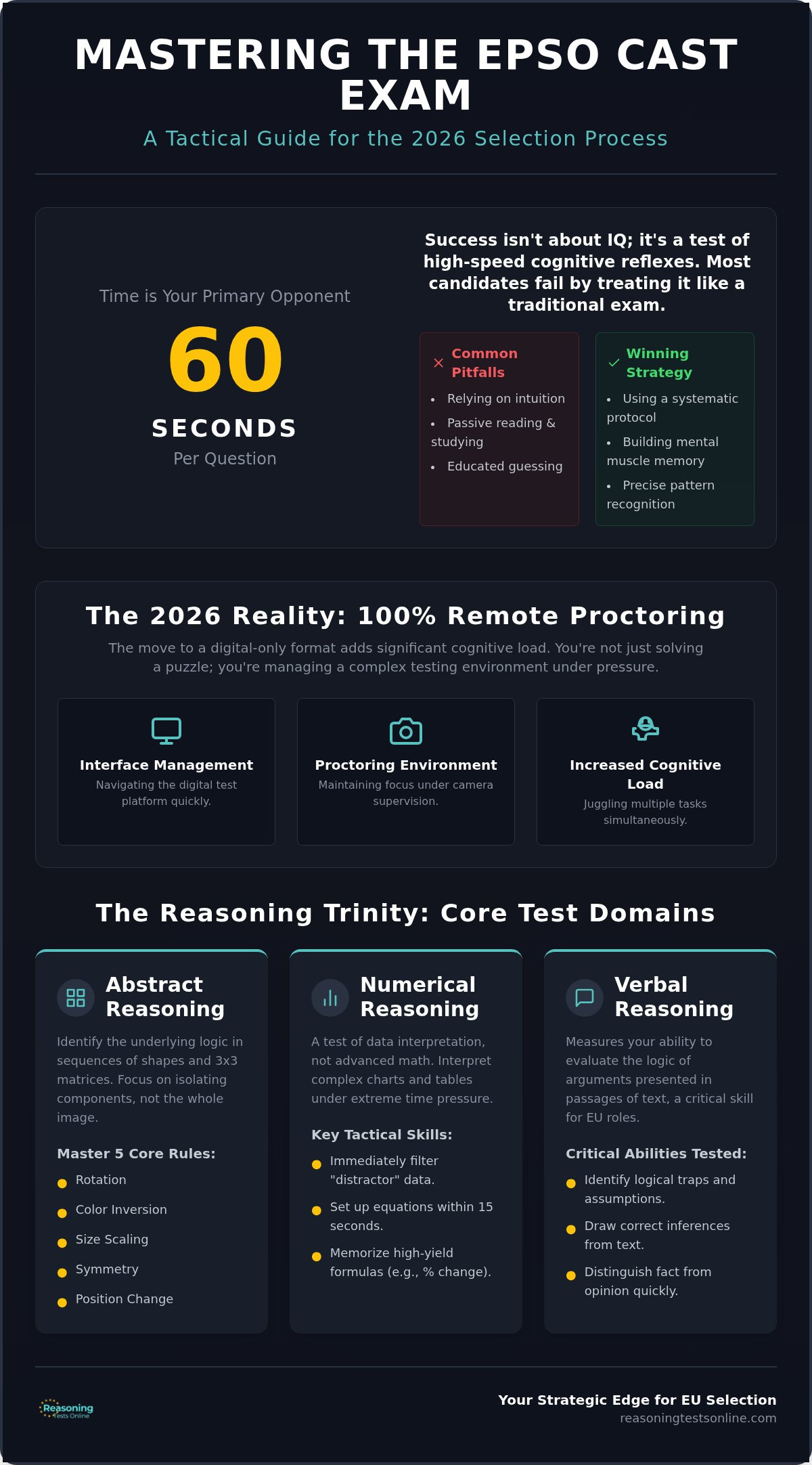
Success in the EPSO CAST isn't a measurement of your IQ; it's a test of how quickly you can decode a pattern before the 60-second clock runs out. Most candidates fail because they treat these assessments like traditional exams rather than high-speed cognitive sprints. You've likely stared at a maze of numerical data or a series of abstract shapes and felt the pressure mounting. This anxiety is the natural result of lacking a systematic approach. Professional EPSO CAST exam preparation requires you to stop relying on intuition and start using a repeatable logic protocol.
We recognize that the intense time pressure can make even simple logic feel impossible. It's time to replace that panic with a disciplined training method. This manual provides a clear system for identifying patterns and interpreting data sets with surgical precision. You'll learn to eliminate the need for guessing by mastering the underlying mechanics of the 2026 selection process. We'll preview how to build the mental muscle memory required to transform your accuracy and secure your place on the reserve list. By breaking down complex tasks into logical components, you can move through the tests with speed and total confidence.
Key Takeaways
- Identify the underlying logical patterns behind abstract and numerical data to eliminate the need for educated guessing.
- Navigate the 2026 shift to remote proctoring by understanding how the digital interface impacts your processing speed and focus.
- Implement a systematic EPSO CAST exam preparation protocol that prioritizes building mental muscle memory over passive reading.
- Master the core Reasoning Trinity of verbal, numerical, and abstract tests using a repeatable system to interpret complex data sets.
The 2026 EPSO CAST Reality: Why Standard Preparation Fails
The 2026 CAST isn't just another test. It's the strategic gatekeeper for your career in the EU institutions. If you're treating it like a standard university exam, you've already lost. Passive reading won't save you when the clock is ticking. You need to train your mental reflexes, not just "study" logic. The European Personnel Selection Office (EPSO) has moved to a 100% remote proctoring model. This digital shift significantly increases your cognitive load. You aren't just solving a puzzle; you're managing an interface, a camera, and a strict proctoring environment simultaneously. Effective EPSO CAST exam preparation must simulate this environmental friction to be successful.
The CAST Selection Procedure in 2026
The CAST Permanent procedure operates as a rolling selection process. Unlike the fixed-deadline AD5 generalist competitions that attract nearly 175,000 applicants, the CAST allows you to submit your profile at any time. However, this flexibility is a double-edged sword. You only take the reasoning tests once an EU agency selects your profile for a specific vacancy. This means your window for testing can open with very little notice. You don't have months to ramp up; you must be test-ready now. Your reasoning scores are the first filter in the recruitment pipeline. If you fail to meet the pass mark in these domains, your professional experience never reaches the recruiter's desk. The EU's competency framework begins with these cognitive baseline tests.
The Psychology of the 60-Second Rule
Time is your primary opponent. You have roughly 60 seconds per question across the verbal, numerical, and abstract reasoning domains. Under this extreme pressure, the human brain naturally defaults to "educated guessing." This is a tactical trap. Guessing destroys your consistency and lowers your final score. You need to move from hesitation toward logical certainty. Accuracy usually drops because candidates spend too much time decoding the interface rather than the problem itself. Our EPSO tests simulations focus on building the muscle memory needed to handle this time-per-question ratio. If you can't identify a pattern in the first 20 seconds, you won't have the mental space to solve it in the remaining 40. Successful EPSO CAST exam preparation involves mastering the "why" behind the logic so you can act instinctively without the panic of the countdown timer.
The Reasoning Trinity: Verbal, Numerical, and Abstract Mastery
The CAST Permanent selection process uses three core cognitive assessments to filter candidates. These aren't general knowledge tests. They measure specific mental processes: verbal, numerical, and abstract reasoning. If you want to succeed, you need to understand the mechanics of each domain. Check our comprehensive EPSO tests breakdown for a detailed look at the interface requirements. Effective EPSO CAST exam preparation requires a balanced mastery of all three, as a failure in one domain can disqualify your entire application.
Cracking the Abstract Reasoning Matrix
Abstract reasoning involves identifying the logic behind sequences of shapes. You'll encounter 3x3 matrices where variables change based on specific rules. Most candidates fail because they look at the whole image instead of isolating components. You must track five core movement rules: rotation, color inversion, size scaling, symmetry, and position. Often, a "hidden" variable exists that only appears every second frame. Mastery comes from recognizing these triggers instantly. For deeper insights, read our guide on Abstract Reasoning Tests: The Ultimate Guide to Patterns and Mastery.
Numerical Reasoning: Tactics for Data Interpretation
Numerical reasoning is a test of logic, not arithmetic. You don't need a degree in mathematics to pass. You do need to interpret complex charts and tables under pressure. The test often includes "distractor" data designed to waste your time. You must learn to filter this irrelevant information immediately. Focus on memorizing high-yield formulas like percentage change, currency conversion, and weighted averages. If you can't set up the equation in 15 seconds, you won't finish the set. Success in EPSO CAST exam preparation depends on your ability to extract the right numbers from a maze of data.
Verbal Reasoning: Identifying the Logical Trap
Verbal reasoning assesses your ability to analyze complex text and draw accurate conclusions. The most common pitfall is using external knowledge. You must base your answer strictly on the provided text. The "Cannot Say" option is a frequent trap for those who make assumptions. You'll need to distinguish between a direct statement and a logical inference. Use a scanning technique to find keywords in the passage before reading for detail. This saves critical seconds. If you're struggling with these logical nuances, our specialized reasoning packages can help you refine your approach.
Systematic Breakdown vs. Guesswork: A Tactical Framework
Guesswork is the enemy of consistency. If you're relying on "educated guesses" during your EPSO CAST exam preparation, you're playing a game of chance you can't win. The EU selection tests aren't designed to reward intuition; they're designed to penalize it. Every question contains specific logical triggers that, if missed, lead you directly to a "distractor" answer. You need a systematic breakdown to move from uncertainty to accuracy. This starts with building a "Logical Toolkit"—a repeatable step-by-step approach for every question type you encounter.
The "Elimination Method" is your most powerful tool. Instead of hunting for the correct option, focus on discarding the impossible ones. This reduces your cognitive load and increases the probability of success. In a four-choice question, eliminating two options instantly doubles your chances of being right. However, the goal isn't just to be right; it's to be certain. You must understand why the wrong answers are wrong to truly master the test engine. Relying on luck is a strategy that fails under the 60-second rule.
Deconstructing the EPSO Question Engine
EPSO questions are engineered to exploit common cognitive biases. In numerical reasoning, a distractor might be the result of a calculation that skips one essential step. In abstract reasoning, it might follow every rule except the most subtle one. One wrong answer always looks right because it's the logical conclusion of a common mistake. You must train your brain to ignore surface-level information and focus strictly on the underlying logic matrix. This shift in perspective transforms the test from a maze into a clear path. Don't let the data fool you; look for the mechanics.
The Power of Detailed Answer Explanations
Reviewing your mistakes is three times more valuable than getting a question right. Correct answers often hide flaws in your reasoning that will resurface under pressure. Detailed answer explanations reveal your specific blind spots. Are you consistently missing rotation rules in abstract matrices? Do you struggle with currency conversions in numerical tables? Our specialized reasoning packages provide the "why" behind every solution. This systematic review allows you to transition from slow, deliberate logic to fast, intuitive recognition. You don't just solve the problem; you recognize the pattern before you've even finished reading the question.
The EPSO CAST Training Protocol: Building Mental Muscle Memory
Treating your EPSO CAST exam preparation as a passive study session is a strategic error. You must approach it like an athletic endeavor. Cognitive agility isn't a fixed trait; it's a skill developed through deliberate practice. This requires a structured training protocol that builds mental muscle memory through repetitive, high-intensity drills. You're training your brain to recognize patterns the same way a sprinter trains their start. Success comes from a systematic five-step process designed to eliminate friction on exam day.
- Step 1: Baseline Assessment. Conduct a diagnostic test to identify which reasoning domain—verbal, numerical, or abstract—is your weakest.
- Step 2: Untimed Methodology. Focus exclusively on accuracy and logic. If you can't solve a matrix without a clock, you won't solve it under pressure.
- Step 3: Timed Drills. Introduce the 60-second rule in short bursts of five questions to build stamina and reduce panic.
- Step 4: Full Simulation. Perform mock exams that mirror the 2026 interface and remote proctoring environment to normalize the testing conditions.
- Step 5: Review and Refine. Analyze your errors and adjust your focus based on the difficulty level of your target profile, distinguishing between the foundational CAST requirements and the more complex AD-level challenges.
Simulation: The Key to Reducing Exam-Day Friction
Practicing in a browser-based interface is mandatory for 2026 success. The official EPSO CAST Test Format 2026: The Definitive Tactical Guide highlights how digital friction can slow down your response time. You must learn to manage your digital scratchpad and on-screen calculator effectively. In a remote proctoring setup, physical note-taking is often restricted or heavily monitored. Mastering the digital equivalent is a tactical necessity that prevents precious seconds from leaking away during the calculation phase. Don't let the interface be the reason you fail.
Scaling Difficulty: From Foundation to Mastery
Building confidence requires progressive difficulty. Starting with the most difficult questions is a recipe for discouragement. You must master the foundation before scaling to complex 3x3 matrices or dense numerical data sets. As you progress, your training should include "worst-case" scenarios to handle outliers and high-difficulty patterns. This ensures that a single difficult question doesn't derail your entire momentum or cause a mental block. You need to be prepared for the questions that are designed to be skipped. To start building your mental stamina and mastering the 2026 interface, select one of our specialized training packages today.
Reasoning Tests Online: Your Strategic Edge for EU Selection
Success in the EU recruitment pipeline requires more than just high-volume practice. It demands a deep understanding of the logical mechanics that drive every assessment. Reasoning Tests Online isn't just a database of questions; it's a strategic guide designed to demystify the hidden mechanics of selection. We focus on the "why" behind every logic matrix. By understanding the underlying system, you stop relying on luck and start relying on a repeatable protocol. This shift in mindset is what separates successful candidates from those who fail to reach the reserve list.
Our platform provides specialized packages for Abstract Reasoning Tests, Numerical Reasoning Tests, and Verbal Reasoning Tests. These aren't generic puzzles. They are realistic simulations that mirror the actual 2026 EPSO interface. Practicing in this environment reduces exam-day friction by making the digital tools feel like second nature. You can check our latest preparation package prices to find the right fit for your training needs. Each package includes detailed answer explanations that target your specific logical blind spots. Effective EPSO CAST exam preparation depends on this level of granular, results-oriented feedback.
Designed for the Modern EU Candidate
The 2026 testing landscape is highly competitive. Whether you're targeting a CAST profile or a generalist AD5 or AD7 competition, our platform adapts to your specific goals. We provide results-driven feedback that allows you to track your progress in real-time. This isn't passive learning. It's an active training routine that uses data to refine your mental reflexes. Join thousands of candidates who've successfully replaced guesswork with systematic logic. We don't just show you the right answer; we show you the logical path to find it under pressure.
Next Steps: Starting Your Training Today
Timing is a critical factor in your EPSO CAST exam preparation. Verified data indicates that candidates should practice for at least 4-6 weeks to develop the necessary cognitive stamina. Starting early allows you to move from baseline assessment to full-speed simulation without the stress of a looming deadline. Choose the package that aligns with your specific CAST profile, whether in IT, law, or administration. The sooner you begin, the more time you have to build the muscle memory required to beat the clock. Don't leave your EU career to chance. Start your first EPSO CAST simulation now and gain the tactical advantage you need.
Mastering the 2026 EU Selection Logic
The path to an EU career requires moving beyond the "educated guess" and adopting a systematic training protocol. You've learned that the 60-second rule isn't just a time limit; it's a test of your mental muscle memory and pattern recognition. Success in 2026 depends on your ability to decode abstract matrices and numerical data sets with surgical precision while navigating the remote proctoring environment.
Professional EPSO CAST exam preparation transforms these complex cognitive hurdles into manageable, repeatable steps. By utilizing specialized CAST preparation packages, you gain access to realistic timed simulations that mirror the actual exam conditions. Our detailed answer explanations ensure you understand the logic behind every solution, allowing you to refine your methodology daily. This focus on simulation and systematic breakdown serves as your primary strategic advantage.
Secure your EU career; start practicing with EPSO CAST simulations today. Your preparation is the only variable you can fully control in this high-stakes process. Take charge of your trajectory and secure your spot on the reserve list with total confidence. Success is built through discipline, not luck.
Frequently Asked Questions
What is the passing score for the EPSO CAST reasoning tests?
The passing score for the verbal reasoning test is typically 10 out of 20 questions. For numerical and abstract reasoning, you must achieve a combined score of 10 out of 20. These thresholds are the minimum requirements to remain in the selection pool. However, reaching the baseline isn't enough to guarantee an interview. Higher scores increase your visibility to recruiters during the EPSO CAST exam preparation phase.
Can I use a calculator during the EPSO numerical reasoning test?
Yes, an on-screen calculator is provided within the testing interface. You aren't permitted to use your own physical calculator due to remote proctoring regulations. Mastery of this digital tool is essential because it functions differently than standard handheld devices. You should practice using an on-screen calculator during your simulations to ensure you don't lose time during the actual assessment. Speed and accuracy depend on this familiarity.
How long should I prepare for the EPSO CAST exam?
Candidates should ideally prepare for 6 to 8 weeks to achieve optimal results. This timeframe allows you to transition from understanding basic logic to building the mental muscle memory required for the 60-second rule. Consistent daily practice is more effective than cramming in the final days. Your EPSO CAST exam preparation should focus on systematic drills that move from untimed methodology to full-speed simulations.
Is the EPSO CAST abstract reasoning test harder than AD5?
The core logic remains identical across both competitions, but AD5 questions often feature more complex variables and distractor patterns. CAST abstract reasoning typically focuses on foundational logic sequences that are slightly more direct. However, the intense time pressure remains a constant challenge for both. You should train using materials that cover multiple difficulty levels to ensure you're prepared for any outliers in the actual test.
What happens if I fail the CAST exam reasoning tests?
If you fail to reach the pass mark, you're excluded from that specific selection procedure for a period of six months. This cooling-off period applies to the specific profile you were tested for. You can still be invited for other CAST profiles if your skills match a different vacancy. This high-stakes reality highlights why a systematic approach to preparation is mandatory rather than optional for serious candidates.
Are the Reasoning Tests Online simulations updated for the 2026 format?
Yes, all Reasoning Tests Online simulations are fully updated to reflect the 2026 EPSO testing environment. This includes the shift to 100% remote proctoring and the specific interface tools used in current assessments. Our platform mimics the actual cognitive load you'll experience on exam day. We prioritize accuracy and simulation to ensure your training translates directly into higher scores when you face the real proctored interface.
How do I improve my speed in verbal reasoning without losing accuracy?
Speed improvement comes from mastering the "scan and identify" technique. Instead of reading the entire passage first, scan for keywords found in the question to locate relevant sections. You must base your conclusions strictly on the text provided and ignore all external knowledge. Training your brain to distinguish between a direct statement and a logical inference will help you eliminate distractor answers in seconds without sacrificing accuracy.
Does EPSO provide the official reasoning test questions in advance?
No, EPSO doesn't release the official database of questions in advance. They provide limited sample questions for familiarization, but these aren't comprehensive training tools. The actual test questions are randomized and change for every candidate. This is why you must master the underlying logic rather than trying to memorize specific answers. A systematic training protocol is the only reliable way to handle the unpredictable nature of the exam.


