

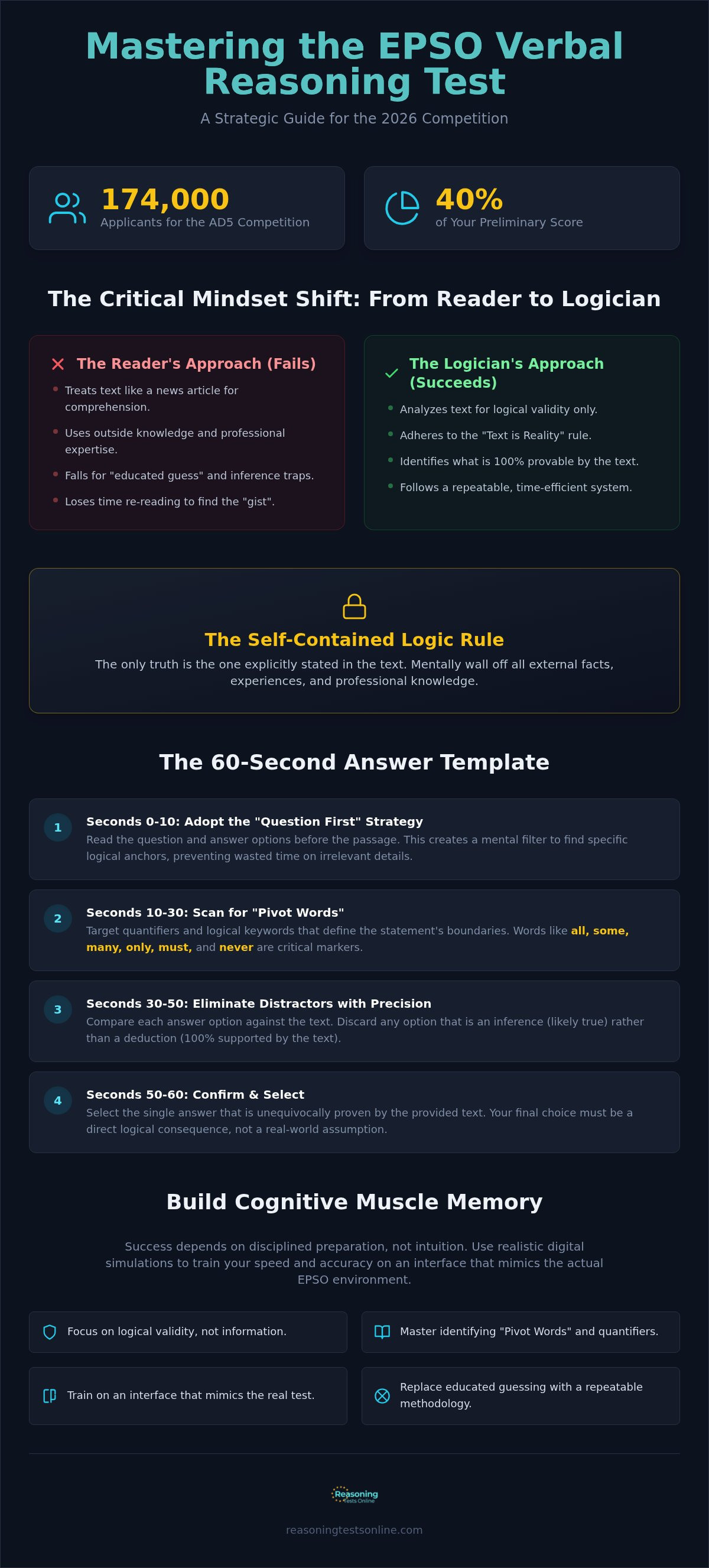
Most candidates fail the EPSO verbal reasoning test not because they lack comprehension, but because they process information like a reader instead of a logician. If you're treating these passages like a news article, you're already losing time. Mastering how to pass EPSO verbal reasoning test requires a shift from understanding content to validating logic. With approximately 174,000 applicants for the AD5 2026 competition, the margin for error is non-existent. This test carries 40% of your preliminary score, making it the single most important hurdle in the selection process.
It's exhausting to reach the final five questions only to realize you have ninety seconds left on the clock. You've likely fallen for "educated guess" traps or overanalyzed a passage using your own professional expertise. We're going to fix that. This article delivers a strategic template to deconstruct complex EU passages and select the correct answer in under 60 seconds. You'll learn a repeatable system to eliminate wrong answers and build the mental muscle memory needed to hit a top-tier score. We'll cover the specific mechanics of the 2026 format, the "outside knowledge" trap, and the exact methodology to reduce test-day anxiety through simulation.
Key Takeaways
- Shift your focus from reading for information to analyzing logical validity. This prevents the common trap of using outside knowledge to justify incorrect answers.
- Adopt a "Question First" strategy to identify specific logical requirements before scanning the text. This systematic approach is essential for mastering how to pass EPSO verbal reasoning test in under 60 seconds.
- Identify "Pivot Words" and quantifiers like all, some, and many to define the exact boundaries of a statement. These linguistic markers allow you to eliminate distractors with surgical precision.
- Build cognitive muscle memory by practicing with realistic digital simulations. Training on an interface that mimics the actual EPSO environment reduces test-day anxiety and improves timing.
- Replace educated guessing with a repeatable methodology to hit the high score thresholds required for the 2026 competitions. Success depends on disciplined preparation rather than intuition.
Why EPSO Verbal Reasoning is a Logic Test, Not a Literacy Test
The European Personnel Selection Office (EPSO) designs these assessments to measure cognitive potential, not linguistic flair. Most candidates approach the verbal reasoning section as a standard reading comprehension exercise. That's a mistake. It's a logic assessment. Success doesn't come from your ability to summarize a paragraph; it comes from your ability to validate a logical chain. If you're searching for how to pass EPSO verbal reasoning test, you must start by treating every passage as a closed system of rules. You aren't being tested on your vocabulary. You're being tested on your ability to identify valid conclusions within a strict set of parameters.
Being a "fast reader" is often a liability in this format. High-speed readers tend to skim for the general message or "gist." In the EPSO environment, the gist is irrelevant. The examiners hide traps in the tiny details, using qualifiers and specific structures to lure you into false conclusions. You aren't reading for meaning. You're scanning for structure. You need to identify the relationship between the premises and the conclusion, ignoring the actual topic of the text. If you want to master how to pass EPSO verbal reasoning test, you must prioritize logical validity over narrative flow. This requires a mental shift to the "The Text is Your Reality" mindset. For the duration of the test, the information in the box is the only truth that exists.
The Trap of Outside Knowledge
Professional experts often struggle with these tests because they know too much. If a text discusses EU environmental policy and you're a policy officer, your brain will naturally fill in blanks with facts from your daily work. This is a fatal error. EPSO tests are strictly self-contained. If a passage claims the sky is green, then for the next 60 seconds, the sky is green. You must mentally wall off any external facts, statistics, or professional experiences. The Self-Contained Logic Rule: The only truth that exists is the truth explicitly printed within the four corners of the text box.
Deduction vs. Inference in the 2026 Context
In the 2026 competition cycle, the distinction between deduction and inference is the difference between a 35/40 and a failing grade. Deduction is a conclusion that's 100% supported by the text. Inference is something that might be true or is likely true based on the context. EPSO only rewards the "definitely true." For example, if a text says "Most member states adopted the resolution," an inference trap would be "Some member states did not adopt the resolution." While this seems logical in the real world, it isn't strictly proven by the text unless the text explicitly states the total number of states. Stick to what's written. Mastering this distinction is a core part of professional EPSO preparation.
The 60-Second Template: A Step-by-Step Workflow
Speed is the primary differentiator between successful candidates and those who fail to finish the exam. While the official time limit allows for more flexibility, elite scorers target a 45-second completion rate per question. This creates a psychological buffer and banks time for the most complex passages. Understanding how to pass EPSO verbal reasoning test requires a disciplined workflow that prioritizes the question over the text. You must adopt the "Question First" strategy. Reading the passage before the question is a waste of cognitive energy; it forces you to process irrelevant information that doesn't serve the final answer.
By starting with the question, you create a mental filter. You aren't looking for the story; you're looking for specific logical anchors. This targeted approach reduces the time spent on each item and prevents the "re-reading" loop that drains your clock. Refining this speed requires realistic verbal reasoning simulations that mirror the live environment found on the Official EU Careers Portal.
Seconds 0-10: The Question Scan
Your first ten seconds are dedicated to identifying the "stem" and the logical requirement. Is the question asking which statement is definitely true, or is it asking what cannot be inferred? These are two distinct cognitive tasks. Spotting the difference immediately allows your brain to look for specific logical boundaries. You should ignore the answer options at this stage to avoid bias. Instead, focus entirely on the question stem to determine if you're searching for a direct deduction or a logical exclusion.
Seconds 10-40: The Targeted Passage Search
Once you have your question anchor, scan the passage for matching sentence structures. Ignore filler information like specific dates, names, or institutional titles unless they act as logical pivots. You can effectively ignore 70% of a passage by focusing only on the sentences that contain your keyword anchors or their synonyms. This isn't skimming; it's high-intensity scanning designed to isolate the premises that support or refute the question stem. Your goal is to find the exact line that dictates the validity of the statement.
Seconds 40-60: Final Validation
The final twenty seconds are for the elimination process. Strike out "Absolute" options that use words like "always" or "never" if the text provides a more nuanced quantifier. If you're stuck in a "Two-Option Tussle," choose the one with the most conservative logical claim. Don't change your first answer unless you find a clear, objective logical error. If the timer hits 60 seconds and you're still undecided, use the "Smart Guess" protocol. Pick the most neutral option and move on. There's no negative marking, so an empty answer is the only guaranteed mistake you can make.
Pivot Words: The Secret Language of EPSO Examiners
Understanding how to pass EPSO verbal reasoning test requires you to stop reading for content and start reading for operators. Pivot words are the linguistic markers that dictate the scope and validity of every statement. Examiners use these words to set logical boundaries that either support or invalidate a multiple-choice option. If you miss a single quantifier or a modal verb, your entire analysis collapses. You aren't looking for the general theme; you're looking for the specific constraints these words impose on the text.
Causation versus correlation markers are frequent traps. Words like "because" or "results in" indicate a direct, proven cause-effect relationship. Conversely, phrases such as "associated with" or "linked to" only suggest a relationship without proving one thing caused the other. EPSO tests often present an option that claims causation when the text only provides correlation. You must spot these shifts to avoid the "likely true" trap. If the text doesn't explicitly state a causal link, the option is logically invalid.
Modal verbs like "must," "could," and "should" determine the level of certainty in a passage. "Must" implies a mandatory condition or an absolute truth. "Could" or "might" suggests a mere possibility. Options that turn a possibility into a certainty are always incorrect. Your job is to match the level of certainty in the answer choice exactly to the level of certainty expressed in the text. This precision is what separates elite scorers from the rest of the applicant pool.
Quantifiers and Their Logical Limits
Quantifiers like "all," "most," "many," and "some" create strict logical limits. In EPSO logic, "most" means more than half, while "many" is an undefined but significant amount. They aren't interchangeable. If the text says "many people," an option stating "most people" is logically invalid because you can't prove it's over 50%. Watch for "always" and "never." These absolute traps are rarely correct because they leave no room for exceptions, which most EU passages include. Mapping these quantifiers directly to the answer options is a core skill you'll need to master how to pass EPSO verbal reasoning test.
Qualification and Concession Markers
Words like "however," "despite," and "although" signal a shift in the passage's direction. These markers often introduce the true intent or the primary constraint of a statement. If a text says a policy was successful "although" costs rose, the success is qualified. Terms like "partially" or "primarily" further limit the validity of a conclusion. You can explore our Verbal Reasoning Test Practice to see how these words function in a timed simulation. Identifying these markers allows you to eliminate distractors that ignore the passage's nuanced reality.
Building Muscle Memory Through Realistic Simulation
Knowledge of logical operators is useless if you can't apply it under extreme time pressure. If you're searching for how to pass EPSO verbal reasoning test, you must transition from passive study to active simulation. Paper practice is a relic of the past. It fails to prepare you for the digital EPSO interface, where the ticking clock and the scrolling text create a specific kind of cognitive load. You need to train your brain to manage the interface and the logic simultaneously. This isn't just about reading; it's about building the mental stamina required for high-stakes AD7 competitions where the passages are denser and the logic is more layered.
Detailed answer explanations are the most critical part of your preparation. They reveal the logical blind spots you didn't know you had. Simply seeing that you got an answer wrong doesn't help you improve. You need to see the "why" behind the "what." Our platform provides these breakdowns to ensure your brain recognizes the correct logical path every time. You can start building this muscle memory today by choosing one of our Verbal Reasoning Tests packages.
The Simulation Advantage
Simulating the stress environment is more important than memorizing vocabulary. In the real exam, the "startle response" can freeze your analytical thinking when you see a particularly complex passage. Timed drills reduce this physiological reaction. By exposing yourself to the exact interface and time constraints you'll face in the 2026 competitions, you turn a high-stress event into a routine exercise. Check our EPSO Test Prices to find a simulation package that fits your specific competition track.
Analyzing Your Error Patterns
Every practice session must serve as a diagnostic tool for your brain. You need to identify if your errors stem from speed, logic, or comprehension. Speed errors occur when you rush the question scan and miss a quantifier. Logic errors happen when you fall for an inference trap despite having enough time. Comprehension errors indicate a struggle with the technical language of the text itself. Adopt the "Review Loop" methodology. Spend twice as much time reviewing the detailed explanations as you did taking the test. This disciplined approach ensures you don't repeat the same mistakes on test day.
Ready to replace guesswork with a systematic approach? Master the logic with our realistic Verbal Reasoning Tests.
The Reasoning Tests Online System for EPSO Success
The Reasoning Tests Online platform isn't a mere collection of questions; it's a methodology designed to replace educated guessing with systematic mastery. If you're serious about learning how to pass EPSO verbal reasoning test, you must move beyond passive reading. Our system forces you to adopt the perspective of an EPSO examiner. We provide the tools to deconstruct every passage into its logical components, ensuring you select the correct answer with clinical precision. By training on an interface that mirrors the actual 2026 testing environment, you eliminate the friction of the digital interface and focus entirely on the logic.
Detailed explanations serve as the coach in the room. They don't just tell you that an answer is wrong; they explain the specific logical pivot or quantifier you missed. This level of transparency is essential for correcting the mental blind spots that prevent candidates from hitting the 35/40 threshold. Success in the 2026 cycle depends on your ability to replicate this accuracy under pressure, question after question. Preparation is the only variable you can control.
Tailored Practice for Every EU Career Path
Our platform recognizes that different competitions require different levels of logical rigor. The AD5 Generalist modules focus on the core logical operators needed for entry-level screening. In contrast, our AD7 Specialist modules feature denser texts and more complex qualification markers designed for senior-level candidates. For those pursuing contract staff roles, our CAST simulations reflect the specific reasoning patterns used in those selections. If you're targeting a senior role, you should also read our guide on EPSO Verbal Reasoning for Professionals to refine your high-level tactics.
Starting Your Training Today
We recommend a 14-Day Mastery plan to maximize your preparation. This structured approach allocates your practice time effectively, moving from untimed logical analysis to high-intensity, timed simulations. It's about building a rhythm that translates to test-day confidence. You aren't just practicing; you're conditioning your brain for the specific cognitive demands of the EU selection process.
Interestingly, your performance in other sections impacts your verbal success. Starting your training with Abstract Reasoning Tests can significantly improve your verbal logic. Both tests require you to identify patterns and rules within a closed system. Mastering the non-verbal logic of patterns makes it easier to spot the linguistic logic of verbal passages. This cross-training approach builds a more robust analytical mindset. Don't leave your EU career to chance. Get access to the full simulation suite now.
Secure Your EU Career with Strategic Logic
Success in the 2026 EPSO competitions requires a shift from passive reading to active logical validation. You've learned that the test is a closed system where outside knowledge is a liability. By using the 60-second template and identifying pivot words, you can navigate complex passages with surgical accuracy. Mastering how to pass EPSO verbal reasoning test isn't about reading faster; it's about training your brain to recognize logical boundaries instantly.
Preparation must be as realistic as possible to be effective. Our platform offers timed simulations that mimic the 2026 interface, providing the mental conditioning needed to handle the pressure of test day. With difficulty levels tailored for AD5, AD7, and CAST competitions, you'll receive detailed logical explanations for every question to eliminate your blind spots. Don't leave your results to chance when a systematic approach is within reach.
Master the EPSO Verbal Reasoning Test with our realistic simulations and turn your ambition into a professional reality. Your future in the EU institutions starts with disciplined preparation. You have the tools; now it's time to build the mastery.
Frequently Asked Questions
Is the EPSO verbal reasoning test a language test?
No, it's a logic test taken in your Language 1. While it uses text, the goal is to assess your ability to draw valid conclusions from premises. Your vocabulary and grammar aren't being tested. Instead, the focus remains on your capacity to identify logical relationships and avoid inference traps within the provided text block. You must treat the language as a vehicle for logical operators.
How many questions are in the EPSO verbal reasoning test?
For the AD5 generalist competition (EPSO/AD/427/26), the test consists of 20 questions. You have exactly 35 minutes to complete this section. This timing requires a pace of 105 seconds per question, though elite candidates target 60 seconds to ensure a buffer for the most complex passages. Mastery of how to pass EPSO verbal reasoning test depends on maintaining this rigorous tempo throughout the session.
Can I use a calculator or dictionary during the test?
No outside aids are permitted. Since these tests are remotely proctored, you cannot use dictionaries, calculators, or reference materials. You must rely entirely on your mental logic and the information explicitly provided in the passage. This constraint reinforces the "Text is Your Reality" rule, as you're prohibited from verifying facts or looking up terminology during the live assessment environment. Preparation must focus on internalizing logical rules.
What is a good score for EPSO verbal reasoning in 2026?
While the minimum pass mark is 10 out of 20, a good score for the AD5 2026 competition is significantly higher. Given that approximately 174,000 people applied, you should aim for a score of 18/20 or higher to remain competitive. The verbal reasoning test carries 40% of the preliminary combined score, so every point above the pass mark directly improves your ranking for Part 2 of the selection process.
How can I improve my reading speed for the EPSO exam?
Focus on scanning for structure rather than reading for meaning. You don't need to read faster; you need to read less. Use the "Question First" strategy to identify logical anchors before looking at the text. This allows you to skip irrelevant filler and focus only on the premises that dictate the answer. Practicing with realistic digital simulations builds the muscle memory needed to process these anchors under pressure.
What happens if I run out of time on the verbal reasoning test?
There's no negative marking for incorrect answers in the EPSO reasoning tests. If you see the timer running low, you must provide an answer for every remaining question. An educated guess is always better than leaving a blank space. Use the final ten seconds to select a neutral option for any unanswered items to ensure you don't miss out on potential points. Never leave a question unanswered.
Are the verbal reasoning questions the same for AD5 and CAST exams?
The underlying logic remains consistent, but the difficulty and complexity vary between competition tracks. AD5 generalist tests often focus on broader policy themes, while AD7 and specialist exams feature more technical passages with denser logical constraints. CAST exams use a similar database but are calibrated for different contract staff profiles. Training with simulations specific to your track is the most effective way to understand how to pass EPSO verbal reasoning test.
How often does EPSO update the verbal reasoning question database?
EPSO frequently refreshes its item bank to maintain the integrity of the selection process. While core logical principles don't change, the specific passages and question stems are updated for new competition cycles like the AD5 2026 generalist competition. This is why practicing with current, realistic simulations is more effective than using outdated materials. You need to train on the specific logical patterns used in the current year's assessment environment.


